

Pralsetinib (Blu667) |
رقم الكتالوجGC31780
 One-Click Copy Product Info
|

Pralsetinib (Blu667) (BLU-667) هو مثبط انتقائي قوي للغاية لـ RET. يمنع Pralsetinib (Blu667) (BLU-667) اندماج WT RET و RET mutants V804L و V804M و M918T و CCDC6-RET مع IC50s من 0.4 و 0.3 و 0.4 و 0.4 و 0.4 نانومتر ، على التوالي.
Products are for research use only. Not for human use. We do not sell to patients.
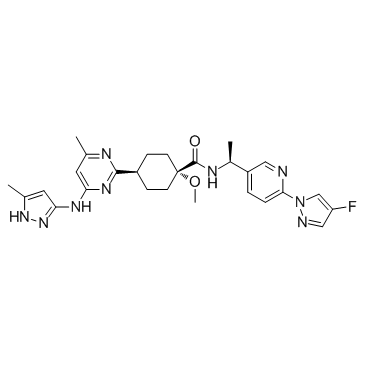
Cas No.: 2097132-94-8
Sample solution is provided at 25 µL, 10mM.
_1-3.$$$39978408@51.jpg');)
_1-9.$$$38538795@65.jpg');)
_1-9.$$$39112701@51.jpg');)
_1-7.$$$37316672@70.jpg');)
_366-372.$$$36198801@70.jpg');)
.$$$38565142@65.jpg');)
_1867-1883.$$$33248023@67.jpg');)
_eads6055.$$$39977546@45.jpg');)
_eadm9805.$$$40080571@45.jpg');)
_eadj3020.$$$39666821@45.jpg');)
_1-20.$$$39757301@28.jpg');)
_1-24.$$$38898113@28.jpg');)
_273-287.$$$36806353@46.jpg');)
_1-16.$$$37156877@44.jpg');)
_1-19.$$$37460805@44.jpg');)
_1291-1307.$$$34518654@46.jpg');)
Pralsetinib (Blu667) is a selective inhibitor of the rearranged during transfection (RET) kinase, indicated for the treatment of certain RET-altered positive tumors[1-2]. By selectively inhibiting RET fusions and mutations, Pralsetinib blocks downstream signaling pathways such as MAPK and PI3K-AKT, thereby suppressing tumor cell proliferation and inducing apoptosis[3-4].
In vitro, treatment of RET-altered thyroid cancer and non-small cell lung cancer cells (TPC1, LC-2/ad, TT, and MZCRC1) with Pralsetinib (2-5µM) significantly inhibited cell proliferation and induced cell death[5]. In T47D and MCF7 breast cancer cells expressing transcriptionally active ESR1 fusion proteins or ERα ligand-binding domain point mutations (Y537S, D538G), Pralsetinib (100-500nM) markedly suppressed cell growth[6].
In vivo, daily oral administration of Pralsetinib (10-30mg/kg) in female athymic nude mice intracranially inoculated with MDA-MB-231-BrM triple-negative breast cancer cells. Pralsetinib significantly inhibited intracranial tumor growth[7]. In a C57BL/6 mouse model bearing orthotopic lung adenocarcinoma tumors derived from Trim24-Ret cell lines, daily oral treatment with Pralsetinib (20mg/kg) for 8 weeks induced significant tumor shrinkage, although acquired resistance emerged after 3 weeks of treatment[8].
References:
[1] Markham A. Pralsetinib: First Approval. Drugs. 2020 Nov;80(17):1865-1870.
[2] Nguyen L, Monestime S. Pralsetinib: Treatment of metastatic RET fusion-positive non-small cell lung cancer. Am J Health Syst Pharm. 2022 Mar 21;79(7):527-533
[3] Syed YY. Pralsetinib: A Review in Advanced RET Fusion-Positive NSCLC. Drugs. 2022 May;82(7):811-816.
[4] Griesinger F, Curigliano G, Thomas M, et al. Safety and efficacy of pralsetinib in RET fusion-positive non-small-cell lung cancer including as first-line therapy: update from the ARROW trial. Ann Oncol. 2022 Nov;33(11):1168-1178.
[5] Hu X, Liu X, Khatri U, et al. The heterogeneous transition state of resistance to RET kinase inhibitors converges on ERK1/2-driven Aurora A/B kinases. Drug Resist Updat. 2023 May;68:100958.
[6] Gou X, Kim BJ, Anurag M, et al. Kinome Reprogramming Is a Targetable Vulnerability in ESR1 Fusion-Driven Breast Cancer. Cancer Res. 2023 Oct 2;83(19):3237-3251.
[7] Regua AT, Bindal S, Najjar M, et al. RET Receptor Tyrosine Kinase Promotes Breast Cancer Metastasis to the Brain and RET Inhibitors Pralsetinib and Selpercatinib Suppress Breast Cancer Brain Metastases. bioRxiv [Preprint]. 2025 Oct 8:2025.10.07.680986.
[8] Hinz TK, Le AT, Doan T, et al. Modeling acquired TKI resistance and effective combination therapeutic strategies in murine RET+ lung adenocarcinoma. bioRxiv [Preprint]. 2025 Jun 7:2025.06.04.657911.
| Cell experiment [1]: | |
Cell lines | T47D and MCF7 ERα+ breast cancer cells (human breast cancer cell lines) |
Preparation Method | T47D and MCF7 cells stably expressing ESR1 fusion proteins or ESR1 LBD point mutants (Y537S, D538G) were maintained in hormone-deprived CSS media. Cells were treated with Pralsetinib at clinically relevant concentrations (100-500nM) for 48 hours to 2 weeks. |
Reaction Conditions | 100-500nM; 48h to 2 weeks. |
Applications | Pralsetinib significantly inhibited cell growth of ESR1 fusion-driven breast cancer cells, with IC50 values of ~100-120nM. Pralsetinib treatment potently inhibited RET phosphorylation (p-RET Y905) and downstream signaling pathways including ERK (p-ERK T202/Y204) and STAT3 (p-STAT3 Y705). Pralsetinib also induced apoptosis. |
| Animal experiment [2]: | |
Animal models | Female athymic nude mice (nu/nu) |
Preparation Method | Mice were intracardially or intracranially inoculated with luciferase-expressing MDA-MB-231-BrM breast cancer cells. Mice received daily oral administration of Pralsetinib (10-30mg/kg; for 2 weeks) starting one day after tumor cell inoculation. For the treatment model, Pralsetinib administration began 10-14 days post-inoculation after brain metastases were established. Mice were monitored by bioluminescent imaging twice weekly. |
Dosage form | 10-30mg/kg; oral gavage; daily for 2 weeks. |
Applications | Pralsetinib treatment significantly reduced brain metastasis burden by 67% in the preventative model when administered early (30mg/kg). In the intracranial model, Pralsetinib (10mg/kg) significantly suppressed established brain tumor growth and enhanced tumor cell apoptosis. |
References: | |
| Cas No. | 2097132-94-8 | SDF | |
| Canonical SMILES | O=C([C@@]1(OC)CC[C@@H](C2=NC(NC3=NNC(C)=C3)=CC(C)=N2)CC1)N[C@H](C4=CC=C(N5N=CC(F)=C5)N=C4)C | ||
| Formula | C27H32FN9O2 | M.Wt | 533.6 |
| الذوبان | DMSO : ≥ 100 mg/mL (187.41 mM);Water : < 0.1 mg/mL (insoluble) | Storage | Store at 4°C |
| General tips | Please select the appropriate solvent to prepare the stock solution according to the
solubility of the product in different solvents; once the solution is prepared, please store it in
separate packages to avoid product failure caused by repeated freezing and thawing.Storage method
and period of the stock solution: When stored at -80°C, please use it within 6 months; when stored
at -20°C, please use it within 1 month. To increase solubility, heat the tube to 37°C and then oscillate in an ultrasonic bath for some time. |
||
| Shipping Condition | Evaluation sample solution: shipped with blue ice. All other sizes available: with RT, or with Blue Ice upon request. | ||
| Prepare stock solution | |||

|
1 mg | 5 mg | 10 mg |
| 1 mM | 1.8741 mL | 9.3703 mL | 18.7406 mL |
| 5 mM | 374.8 μL | 1.8741 mL | 3.7481 mL |
| 10 mM | 187.4 μL | 937 μL | 1.8741 mL |
Step 1: Enter information below (Recommended: An additional animal making an allowance for loss during the experiment)
 g
μL
g
μL
Step 2: Enter the in vivo formulation (This is only the calculator, not formulation. Please contact us first if there is no in vivo formulation at the solubility Section.)
Calculation results:
Working concentration: mg/ml;
Method for preparing DMSO master liquid: mg drug pre-dissolved in μL DMSO ( Master liquid concentration mg/mL, Please contact us first if the concentration exceeds the DMSO solubility of the batch of drug. )
Method for preparing in vivo formulation: Take μL DMSO master liquid, next addμL PEG300, mix and clarify, next addμL Tween 80, mix and clarify, next add μL saline, mix and clarify.
Method for preparing in vivo formulation: Take μL DMSO master liquid, next add μL Corn oil, mix and clarify.
Note: 1. Please make sure the liquid is clear before adding the next solvent.
2. Be sure to add the solvent(s) in order. You must ensure that the solution obtained, in the previous addition, is a clear solution before proceeding to add the next solvent. Physical methods such as vortex, ultrasound or hot water bath can be used to aid dissolving.
3. All of the above co-solvents are available for purchase on the GlpBio website.
Quality Control & SDS
- View current batch:
Average Rating: 5 (Based on Reviews and 11 reference(s) in Google Scholar.)