

Pralsetinib (Blu667) |
カタログ番号GC31780
 One-Click Copy Product Info
|

Pralsetinib (Blu667)はトランスフェクション中に再編成される(RET、rearranged during transfection)キナーゼの選択的な阻害剤であり、特定のRET遺伝子変異陽性腫瘍の治療に使われる。
Products are for research use only. Not for human use. We do not sell to patients.
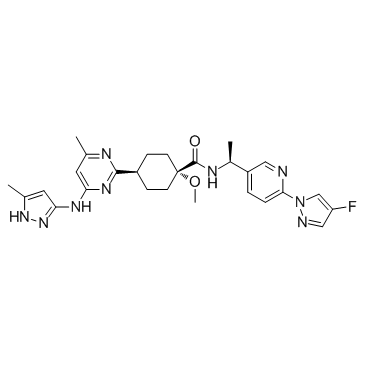
Cas No.: 2097132-94-8
Sample solution is provided at 25 µL, 10mM.
_1-3.$$$39978408@51.jpg');)
_1-9.$$$38538795@65.jpg');)
_1-9.$$$39112701@51.jpg');)
_1-7.$$$37316672@70.jpg');)
_366-372.$$$36198801@70.jpg');)
.$$$38565142@65.jpg');)
_1867-1883.$$$33248023@67.jpg');)
_eads6055.$$$39977546@45.jpg');)
_eadm9805.$$$40080571@45.jpg');)
_eadj3020.$$$39666821@45.jpg');)
_1-20.$$$39757301@28.jpg');)
_1-24.$$$38898113@28.jpg');)
_273-287.$$$36806353@46.jpg');)
_1-16.$$$37156877@44.jpg');)
_1-19.$$$37460805@44.jpg');)
_1291-1307.$$$34518654@46.jpg');)
Pralsetinib (Blu667)はトランスフェクション中に再編成される(RET、rearranged during transfection)キナーゼの選択的な阻害剤であり、特定のRET遺伝子変異陽性腫瘍の治療に使われる[1-2]。RET融合と変異を選択的に阻害することで、Pralsetinibは、MAPKやPI3K-AKTなどの下流シグナル伝達経路を遮断し、よって腫瘍細胞の増殖を抑制し、アポトーシスを誘発する[3-4]。
体外で、Pralsetinib(2-5µM)でRET遺伝子変異甲状腺癌と非小細胞肺癌細胞(TPC1、LC-2/ad、TTとMZCRC1)を処理した結果、細胞の増殖を著しく阻害し、細胞死を誘発した[5]。転写的に活性なESR1融合タンパク質またはERαリガンド結合ドメインポイント変異(Y537S、D538G)を発見するT47DとMCF7乳癌細胞で、Pralsetinib(100-500nM)は細胞の成長を著しく抑制した[6]。
体内で、MDA-MB-231-BrMトリプルネガティブ乳癌細胞を頭蓋内接種した雌無胸腺ヌードマウスにPralsetinib(10-30mg/kg)を毎日経口投与した。Pralsetinibは、頭蓋内腫瘍の成長を著しく阻害した[7]。Trim24-Ret細胞株由来の同所性肺腺癌腫瘍を持つC57BL/6マウスモデルで、Pralsetinib(20mg/kg)を8週間毎日経口投与した結果、著しい腫瘍の縮小を誘発したものの、3週間の処理後に、獲得性抵抗力が現れた[8]。
References:
[1] Markham A. Pralsetinib: First Approval. Drugs. 2020 Nov;80(17):1865-1870.
[2] Nguyen L, Monestime S. Pralsetinib: Treatment of metastatic RET fusion-positive non-small cell lung cancer. Am J Health Syst Pharm. 2022 Mar 21;79(7):527-533
[3] Syed YY. Pralsetinib: A Review in Advanced RET Fusion-Positive NSCLC. Drugs. 2022 May;82(7):811-816.
[4] Griesinger F, Curigliano G, Thomas M, et al. Safety and efficacy of pralsetinib in RET fusion-positive non-small-cell lung cancer including as first-line therapy: update from the ARROW trial. Ann Oncol. 2022 Nov;33(11):1168-1178.
[5] Hu X, Liu X, Khatri U, et al. The heterogeneous transition state of resistance to RET kinase inhibitors converges on ERK1/2-driven Aurora A/B kinases. Drug Resist Updat. 2023 May;68:100958.
[6] Gou X, Kim BJ, Anurag M, et al. Kinome Reprogramming Is a Targetable Vulnerability in ESR1 Fusion-Driven Breast Cancer. Cancer Res. 2023 Oct 2;83(19):3237-3251.
[7] Regua AT, Bindal S, Najjar M, et al. RET Receptor Tyrosine Kinase Promotes Breast Cancer Metastasis to the Brain and RET Inhibitors Pralsetinib and Selpercatinib Suppress Breast Cancer Brain Metastases. bioRxiv [Preprint]. 2025 Oct 8:2025.10.07.680986.
[8] Hinz TK, Le AT, Doan T, et al. Modeling acquired TKI resistance and effective combination therapeutic strategies in murine RET+ lung adenocarcinoma. bioRxiv [Preprint]. 2025 Jun 7:2025.06.04.657911.
| 細胞実験[1]: | |
細胞株 | T47DとMCF7 ERα+乳癌細胞(ヒト乳癌細胞株) |
準備方法 | ESR1融合タンパク質またはESR1 LBDポイント変異(Y537S、D538G)を安定的に発見するT47DとMCF7細胞をホルモン剥奪のCSS培地で培養した。臨床的に関連する濃度(100-500nM)のPralsetinibで細胞を48時間から2週間処理した。 |
反応条件 | 100-500nM;48時間から2週間 |
アプリケーション | Pralsetinibは、ESR1融合遺伝子の乳癌細胞の成長を著しく阻害し、IC50値は~100-120nMであった。Pralsetinibの処理は、RETリン酸化(p-RET Y905)と下流シグナル伝達経路(ERK (p-ERK T202/Y204)やSTAT3 (p-STAT3 Y705)など)を有力に阻害した。Pralsetinibはアポトーシスをも誘発した。 |
| 動物実験 [2]: | |
動物モデル | 雌の無胸腺ヌードマウス(nu/nu) |
準備方法 | luciferaseを発見するMDA-MB-231-BrM乳癌細胞をマウスに心臓内または頭蓋内接種した。腫瘍細胞接種の1日後から、マウスにPralsetinib(10-30mg/kg;2週間)を毎日経口投与した。処理モデルについて、脳転移を作成した後、接種の10-14日後に、Pralsetinib処理を始めた。マウスには、週に二回、生物発光イメージングでモニタリングした。 |
投与形態 | 10-30mg/kg;経口投与;2週間、毎日 |
アプリケーション | 早期に投与(30mg/kg)した場合、Pralsetinibは予防モデルで脳転移量を67%著しく減らした。頭蓋内モデルで、Pralsetinib(10mg/kg)は作成された脳腫瘍の成長を著しく抑制し、腫瘍細胞のアポトーシスを増強した。 |
References: | |
| Cas No. | 2097132-94-8 | SDF | |
| Canonical SMILES | O=C([C@@]1(OC)CC[C@@H](C2=NC(NC3=NNC(C)=C3)=CC(C)=N2)CC1)N[C@H](C4=CC=C(N5N=CC(F)=C5)N=C4)C | ||
| Formula | C27H32FN9O2 | M.Wt | 533.6 |
| 溶解度 | DMSO : ≥ 100 mg/mL (187.41 mM);Water : < 0.1 mg/mL (insoluble) | Storage | Store at 4°C |
| General tips | Please select the appropriate solvent to prepare the stock solution according to the
solubility of the product in different solvents; once the solution is prepared, please store it in
separate packages to avoid product failure caused by repeated freezing and thawing.Storage method
and period of the stock solution: When stored at -80°C, please use it within 6 months; when stored
at -20°C, please use it within 1 month. To increase solubility, heat the tube to 37°C and then oscillate in an ultrasonic bath for some time. |
||
| Shipping Condition | Evaluation sample solution: shipped with blue ice. All other sizes available: with RT, or with Blue Ice upon request. | ||
| Prepare stock solution | |||

|
1 mg | 5 mg | 10 mg |
| 1 mM | 1.8741 mL | 9.3703 mL | 18.7406 mL |
| 5 mM | 374.8 μL | 1.8741 mL | 3.7481 mL |
| 10 mM | 187.4 μL | 937 μL | 1.8741 mL |
Step 1: Enter information below (Recommended: An additional animal making an allowance for loss during the experiment)
 g
μL
g
μL
Step 2: Enter the in vivo formulation (This is only the calculator, not formulation. Please contact us first if there is no in vivo formulation at the solubility Section.)
Calculation results:
Working concentration: mg/ml;
Method for preparing DMSO master liquid: mg drug pre-dissolved in μL DMSO ( Master liquid concentration mg/mL, Please contact us first if the concentration exceeds the DMSO solubility of the batch of drug. )
Method for preparing in vivo formulation: Take μL DMSO master liquid, next addμL PEG300, mix and clarify, next addμL Tween 80, mix and clarify, next add μL saline, mix and clarify.
Method for preparing in vivo formulation: Take μL DMSO master liquid, next add μL Corn oil, mix and clarify.
Note: 1. Please make sure the liquid is clear before adding the next solvent.
2. Be sure to add the solvent(s) in order. You must ensure that the solution obtained, in the previous addition, is a clear solution before proceeding to add the next solvent. Physical methods such as vortex, ultrasound or hot water bath can be used to aid dissolving.
3. All of the above co-solvents are available for purchase on the GlpBio website.
Quality Control & SDS
- View current batch:
Average Rating: 5 (Based on Reviews and 11 reference(s) in Google Scholar.)