

Caffeine (Synonyms: Methyltheobromine, NSC 5036) |
Catalog No.GN10350
 One-Click Copy Product Info
|

Un alcaloïde méthylxanthine
Products are for research use only. Not for human use. We do not sell to patients.
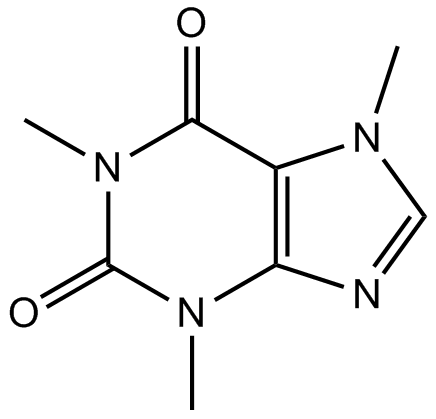
Cas No.: 58-08-2
Sample solution is provided at 25 µL, 10mM.
Caffeine is a methylxanthine alkaloid naturally found in various plant parts that acts as an antagonist at central adenosine receptors at relevant physiological concentrations (IC50 = ~30 μM).[1],2 It alters fatigue, mood, alertness, motor reaction time, vascular hemodynamics, and pain sensation.[2],[3],[4] Caffeine has also been implicated in carcinogenesis, although the concentrations used to affect cell cycling and apoptosis in the laboratory may not be commonly achieved in vivo.[5]
Reference:
[1]. Snyder, S.H., Katims, J.J., Annau, Z., et al. Adenosine receptors and behavioral actions of methylxanthines. Proc. Natl. Acad. Sci. USA 78(5), 3260-3264 (1981).
[2]. Fredholm, B.B., Bättig, K., Holmén, J., et al. Actions of caffeine in the brain with special reference to factors that contribute to its widespread use. Pharmacological Reviews 51(1), 83-133 (1999).
[3]. Carrillo, J.A., and Benitez, J. Clinically significant pharmacokinetic interactions between dietary caffeine and medications. Clinical Pharmacokinetics 39(2), 127-153 (2000).
[4]. Pelligrino, D.A., Xu, H.L., and Vetri, F. Caffeine and the control of cerebral hemodynamics. J.Alzheimers Dis. 20, S51-S62 (2010).
[5]. Bode, A.M., and Dong, Z. The enigmatic effects of caffeine in cell cycle and cancer. Cancer Letters 247(1), 26-39 (2007).
| Cas No. | 58-08-2 | SDF | |
| Synonymes | Methyltheobromine, NSC 5036 | ||
| Chemical Name | 1,3,7-trimethylpurine-2,6-dione | ||
| Canonical SMILES | CN1C=NC2=C1C(=O)N(C(=O)N2C)C | ||
| Formula | C8H10N4O2 | M.Wt | 194.19 |
| Solubility | 0.2mg/mL in ethanol, 3mg/mL in DMSO, 10mg/mL in DMF; 33.3mg/ml in Water(Need ultrasonic) | Storage | Store at -20°C |
| General tips | Please select the appropriate solvent to prepare the stock solution according to the
solubility of the product in different solvents; once the solution is prepared, please store it in
separate packages to avoid product failure caused by repeated freezing and thawing.Storage method
and period of the stock solution: When stored at -80°C, please use it within 6 months; when stored
at -20°C, please use it within 1 month. To increase solubility, heat the tube to 37°C and then oscillate in an ultrasonic bath for some time. |
||
| Shipping Condition | Evaluation sample solution: shipped with blue ice. All other sizes available: with RT, or with Blue Ice upon request. | ||
| Prepare stock solution | |||

|
1 mg | 5 mg | 10 mg |
| 1 mM | 5.1496 mL | 25.748 mL | 51.496 mL |
| 5 mM | 1.0299 mL | 5.1496 mL | 10.2992 mL |
| 10 mM | 515 μL | 2.5748 mL | 5.1496 mL |
Step 1: Enter information below (Recommended: An additional animal making an allowance for loss during the experiment)
 g
μL
g
μL
Step 2: Enter the in vivo formulation (This is only the calculator, not formulation. Please contact us first if there is no in vivo formulation at the solubility Section.)
Calculation results:
Working concentration: mg/ml;
Method for preparing DMSO master liquid: mg drug pre-dissolved in μL DMSO ( Master liquid concentration mg/mL, Please contact us first if the concentration exceeds the DMSO solubility of the batch of drug. )
Method for preparing in vivo formulation: Take μL DMSO master liquid, next addμL PEG300, mix and clarify, next addμL Tween 80, mix and clarify, next add μL saline, mix and clarify.
Method for preparing in vivo formulation: Take μL DMSO master liquid, next add μL Corn oil, mix and clarify.
Note: 1. Please make sure the liquid is clear before adding the next solvent.
2. Be sure to add the solvent(s) in order. You must ensure that the solution obtained, in the previous addition, is a clear solution before proceeding to add the next solvent. Physical methods such as vortex, ultrasound or hot water bath can be used to aid dissolving.
3. All of the above co-solvents are available for purchase on the GlpBio website.
Quality Control & SDS
- View current batch:
- Purity: >98.00% Appearance: A solid
- COA (Certificate of Analysis)
- SDS (Safety Data Sheet)
- Datasheet
Average Rating: 5 (Based on Reviews and 30 reference(s) in Google Scholar.)