

Chelerythrine Chloride (Synonyms: Broussonpapyrine chloride, NSC 646662) |
Catalog No.GC13065
 One-Click Copy Product Info
|

Chelerythrine Chloride est un inhibiteur puissant et perméable aux cellules de la protéine kinase C (PKC), avec une valeur d' IC50 de 660nM.
Products are for research use only. Not for human use. We do not sell to patients.
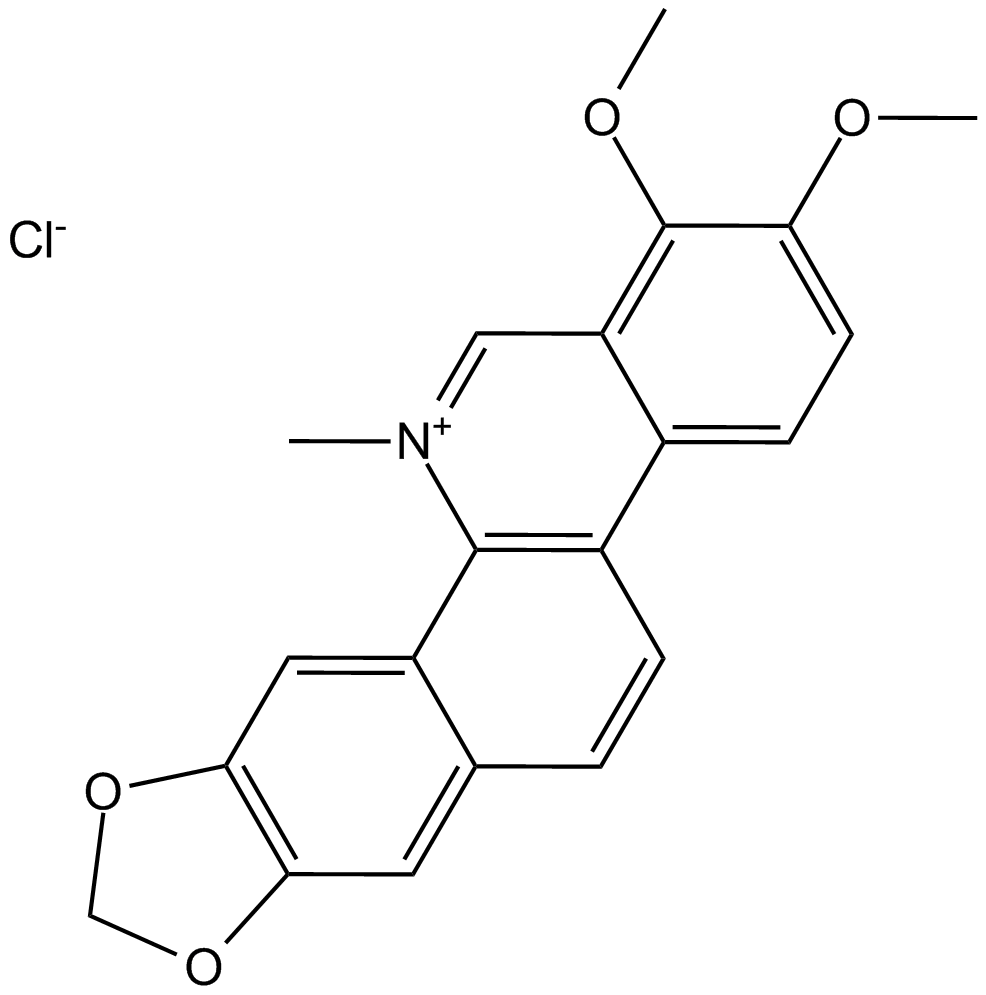
Cas No.: 3895-92-9
Sample solution is provided at 25 µL, 10mM.
_1-3.$$$39978408@51.jpg');)
_1-9.$$$38538795@65.jpg');)
_1-9.$$$39112701@51.jpg');)
_1-7.$$$37316672@70.jpg');)
_366-372.$$$36198801@70.jpg');)
.$$$38565142@65.jpg');)
_1867-1883.$$$33248023@67.jpg');)
_eads6055.$$$39977546@45.jpg');)
_eadm9805.$$$40080571@45.jpg');)
_eadj3020.$$$39666821@45.jpg');)
_1-20.$$$39757301@28.jpg');)
_1-24.$$$38898113@28.jpg');)
_273-287.$$$36806353@46.jpg');)
_1-16.$$$37156877@44.jpg');)
_1-19.$$$37460805@44.jpg');)
_1291-1307.$$$34518654@46.jpg');)
Chelerythrine Chloride est un inhibiteur puissant et perméable aux cellules de la protéine kinase C (PKC), avec une valeur d' IC50 de 660nM[1]. Il s'agit en se liant sélectivement au domaine catalytique de PKC, inhibant son activité par compétition avec le phosphoaccepteur du substrat plutôt qu'avec ATP[2]. Chelerythrine Chloride est couramment utilisé dans des études portant sur les effets anti-inflammatoires, les mécanismes de l'apoptose, la biologie tumorale et l'immunorégulation[3,4].
In vitro, le traitement de cellules NCI-H1703 avec Chelerythrine Chloride (3μg/mL) pendant 24h induit significativement l'activité des caspases-3 et -7, favorisant l'apoptose. Lorsque des cellules ont été traitées avec Chelerythrine Chloride (1.5, 3, 6μg/mL) pendant 3 semaines, une inhibition dose-dépendante de la formation de colonies en gélose molle a été observée[5]. Le traitement de neutrophiles humaine (PMN) avec Chelerythrine Chloride (10μM) pendant 4 h a induit l'apoptose dans 93% des cellules, un taux significativement plus élevé que dans le groupe exposé aux UV (70%)[6].
In vivo, l'administration de Chelerythrine Chloride (2.5mg/kg; i.p.)à des souris nude porteuses de cellules tumorales SQ-20B aux jours 8, 10 et 12 après l'implantation de la tumeur a significativement retardé la croissance tumorale[7]. Un traitement quotidien à Chelerythrine Chloride (10mg/kg/jour; i.p.) pendant 4 semaines chez des souris porteuses de xénogreffes tumorales ELT3-Luciférase déficientes en TSC2 a significativement inhibé la croissance du volume tumorale (de 57%) sans provoquer de perte de poids ni de toxicité apparente[8].
References:
[1] HERBERT J M, AUGEREAU J M, GLEYE J, et al. Chelerythrine is a potent and specific inhibitor of protein kinase C[J]. Biochemical and biophysical research communications, 1990, 172(3): 993-999.
[2] SIOMMOING X, GRESSIER B, DINE T, et al. Investigation of the inhibitory effects of chelerythrine chloride on the translocation of the protein kinase c βi, βii, ζ in human neutrophils[J]. Il Farmaco, 2001, 56(11): 859-865.
[3] ZHANG Z, GUO Y, ZHANG J, et al. Induction of apoptosis by chelerythrine chloride through mitochondrial pathway and Bcl-2 family proteins in human hepatoma SMMC-7721 cell[J]. Archives of pharmacal research, 2011, 34(5): 791-800.
[4] NIU X F, ZHOU P, LI W F, et al. Effects of chelerythrine, a specific inhibitor of cyclooxygenase-2, on acute inflammation in mice[J]. Fitoterapia, 2011, 82(4): 620-625.
[5] HENG W S, CHEAH S C. Chelerythrine chloride downregulates β-catenin and inhibits stem cell properties of non-small cell lung carcinoma[J]. Molecules, 2020, 25(1): 224.
[6] SWEENEY J F, NGUYEN P K, ATKINS K B, et al. Chelerythrine chloride induces rapid polymorphonuclear leukocyte apoptosis through activation of caspase-3[J]. Shock, 2000, 13(6): 464-471.
[7] CHMURA S J, DOLAN M E, CHA A, et al. In vitro and in vivo activity of protein kinase C inhibitor chelerythrine chloride induces tumor cell toxicity and growth delay in vivo[J]. Clinical Cancer Research, 2000, 6(2): 737-742.
[8] MEDVETZ D, SUN Y, LI C, et al. High-throughput drug screen identifies chelerythrine as a selective inducer of death in a TSC2-null setting[J]. Molecular Cancer Research, 2015, 13(1): 50-62.
| Expériences cellulaires [1]: | |
Lignées cellulaires | Cellules NCI-H1703 |
Méthode de préparation | Les cellules NCI-H1703 ont été ensemencées pendant une nuit dans des microp plaques à parois opaques et blanches à une densité de 1 × 10⁴ cellules/puits, avant l'administration de 3μg/mL de Chelerythrine Chloride. Après un traitement de 24h , la viabilité et la cytotoxicité cellulaires ont été évaluées en mesurant la fulorescence à 400Ex/505Em et 485Ex/520Em, respectivement. La Luminescence pour la mesure de l'activité des caspases-3/7 a ensuite été mesurée après ajout du réactif approprié. |
Conditions de réaction | 3μg/mL; 24h |
Domaines d'application | Le traitement à Chelerythrine Chloride a induit de manière significative l'activité des caspases-3/7 et favorisé l'apoptose. |
| Expériences animales [2]: | |
Modèles animaux | Souris porteuses de xénogreffes tumroles ELT3-luciférase déficientes en TSC2 |
Méthode de préparation | 2 × 10⁶ cellules ont été inoculées de manière bilat érale dans le flanc postérieur de souris nues (Charles River). Six semaines après l'injection des cellules, les souris porteuses de tumeurs sous-cutanées ont été traitées avec Chelerythrine Chloride (10mg/kg/jour; 4 semaines; i.p.). La surface tumroale a été mesurée chaque semaine à l'aide d'un pied à coulisse numérique. |
Forme de dosage | 10mg/kg/jour; 4 semaines; i.p. |
Domaines d'application | Le traitement à Chelerythrine Chloride a significativement inhibé la croissance tumroale (la réduisant de 57%), sans provoquer de perte de poids ni de toxicité significative. |
References: | |
| Cas No. | 3895-92-9 | SDF | |
| Synonymes | Broussonpapyrine chloride, NSC 646662 | ||
| Chemical Name | 1,2-dimethoxy-12-methyl-[1,3]benzodioxolo[5,6-c]phenanthridin-12-ium | ||
| Canonical SMILES | C[N+]1=C2C(=C3C=CC(=C(C3=C1)OC)OC)C=CC4=CC5=C(C=C42)OCO5.[Cl-] | ||
| Formula | C21H18ClNO4 | M.Wt | 383.83 |
| Solubility | ≥ 19.2 mg/mL in DMSO, ≥ 9.45 mg/mL in EtOH with ultrasonic and warming | Storage | Store at -20°C,protect from light |
| General tips | Please select the appropriate solvent to prepare the stock solution according to the
solubility of the product in different solvents; once the solution is prepared, please store it in
separate packages to avoid product failure caused by repeated freezing and thawing.Storage method
and period of the stock solution: When stored at -80°C, please use it within 6 months; when stored
at -20°C, please use it within 1 month. To increase solubility, heat the tube to 37°C and then oscillate in an ultrasonic bath for some time. |
||
| Shipping Condition | Evaluation sample solution: shipped with blue ice. All other sizes available: with RT, or with Blue Ice upon request. | ||
| Prepare stock solution | |||

|
1 mg | 5 mg | 10 mg |
| 1 mM | 2.6053 mL | 13.0266 mL | 26.0532 mL |
| 5 mM | 521.1 μL | 2.6053 mL | 5.2106 mL |
| 10 mM | 260.5 μL | 1.3027 mL | 2.6053 mL |
Step 1: Enter information below (Recommended: An additional animal making an allowance for loss during the experiment)
 g
μL
g
μL
Step 2: Enter the in vivo formulation (This is only the calculator, not formulation. Please contact us first if there is no in vivo formulation at the solubility Section.)
Calculation results:
Working concentration: mg/ml;
Method for preparing DMSO master liquid: mg drug pre-dissolved in μL DMSO ( Master liquid concentration mg/mL, Please contact us first if the concentration exceeds the DMSO solubility of the batch of drug. )
Method for preparing in vivo formulation: Take μL DMSO master liquid, next addμL PEG300, mix and clarify, next addμL Tween 80, mix and clarify, next add μL saline, mix and clarify.
Method for preparing in vivo formulation: Take μL DMSO master liquid, next add μL Corn oil, mix and clarify.
Note: 1. Please make sure the liquid is clear before adding the next solvent.
2. Be sure to add the solvent(s) in order. You must ensure that the solution obtained, in the previous addition, is a clear solution before proceeding to add the next solvent. Physical methods such as vortex, ultrasound or hot water bath can be used to aid dissolving.
3. All of the above co-solvents are available for purchase on the GlpBio website.
Quality Control & SDS
- View current batch:
- Purity: >98.00% Appearance: A solid
- COA (Certificate of Analysis)
- SDS (Safety Data Sheet)
- Datasheet
Average Rating: 5 (Based on Reviews and 30 reference(s) in Google Scholar.)