


Flecainide acetate |
| Catalog No.GC15823 |
An inhibitor of cardiac late sodium current
Products are for research use only. Not for human use. We do not sell to patients.
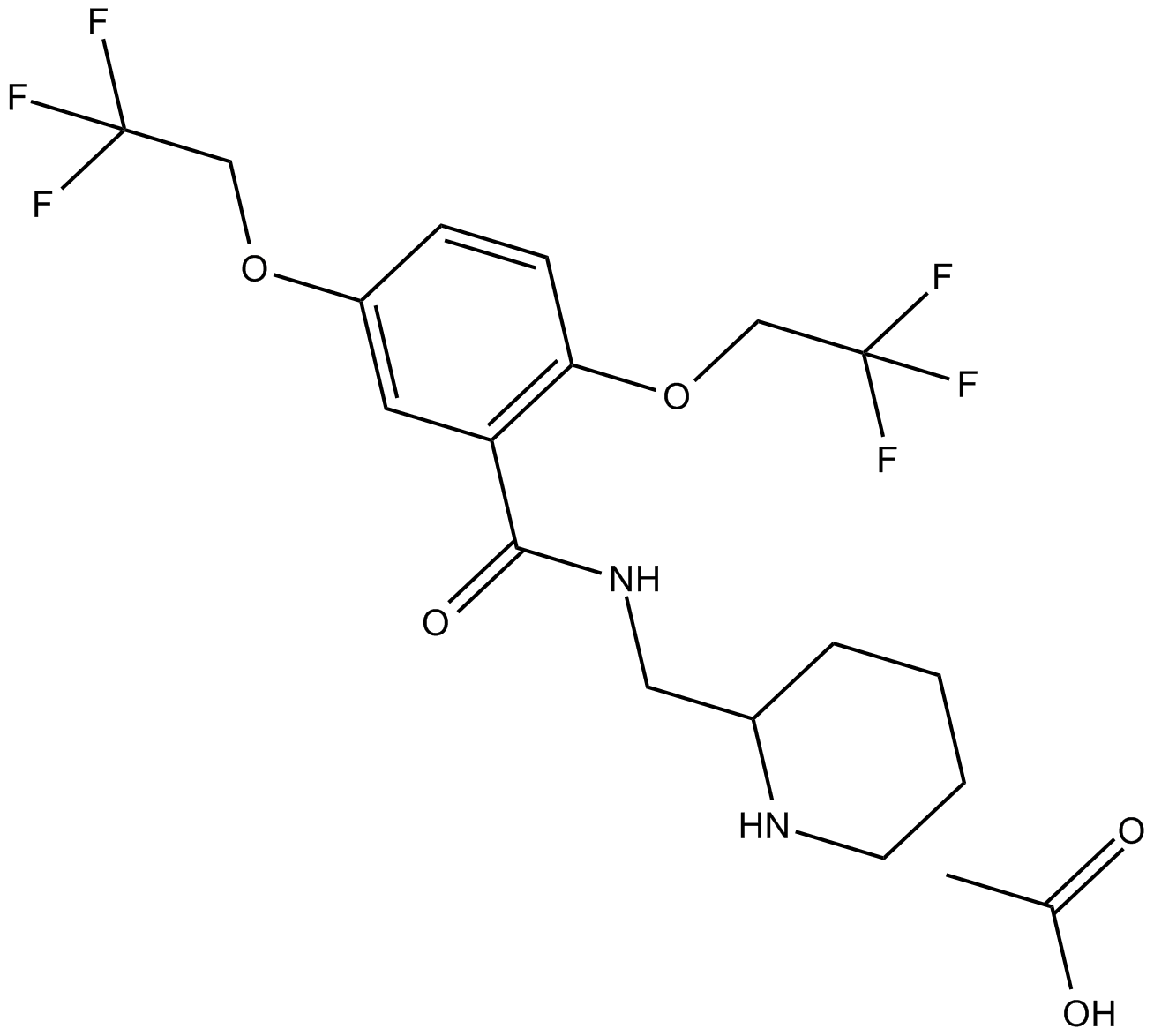
Cas No.: 54143-56-5
Sample solution is provided at 25 µL, 10mM.
;)
,-1-7$$$37316672.jpg');)
;)
;)
$$$36806353.jpg');)
;33(7)%EF%BC%9A546-561$$$37156877.jpg');)
;)
;)
;)
%201124-1138.$$$35908550.jpg');)
%20766-780.$$$37100057.jpg');)
%20418-432.$$$36893736.jpg');)
%EF%BC%9A-240-255.$$$35108512.jpg');)
533-545$$$36543525.jpg');)
%201-13.$$$36600053.jpg');)
;)
Flecainide, a nonselective Na (+) channel blocker, is a class 1C antiarrhythmic drug, especially used for the management of supraventricular arrhythmia. Flecainide has been used extensively in the effect on providing long-term sinus rhythm (SR) restoration as well as decreasing AF symptoms.
Flecainide revealed to suppress the Nav1.5 sodium channel in the heart, leading to prolongation of the cardiac action potential. Flecainide showed to reduce Ca+ spark, wave frequency and Ca+ wave velocity in the intact rat cardiomyocyte. Besides, flecainide has shown to reduce Ca(2+) wave when I(Na) is active. It has been demonstrated that flecainide could remarkably increase the Na(+)/Ca(2+)-exchanger (NCX)-mediated Ca(2+) efflux [1].
Flecainide has been reported to prolong ventricular repolarization, with the stronger effect at the left ventricular epicardium related to the right ventricular epicardium. Flecainide was found to produce a greater effective refractory period (ERP) lengthening at endocardium than epicardium, leading to a significant increase of ERP dispersion across the ventricular wall [2].
Flecainide has shown to dose-dependently reduce systemic pressures (32% at 0.8 μg/mL) and peripheral vascular resistance (15% at 0.8 μg/mL). In addition, at therapeutic plasma concentrations, flecainide at 0.8 μg/mL remarkably reduced the heart rate (55 beats/min) and increased QRS intervals (9.9 msec) in a rat hindlimb perfusion model [3].
References:
1.Sikkel MB1, Collins TP, Rowlands C, Shah M, O'Gara P, Williams AJ, Harding SE, Lyon AR, MacLeod KT. Flecainide reduces Ca(2+) spark and wave frequency via inhibition of the sarcolemmal sodium current. Cardiovasc Res. 2013 May 1;98(2):286-96. doi: 10.1093/cvr/cvt012. Epub 2013 Jan 19.
2.Osadchii OE.Flecainide-induced proarrhythmia is attributed to abnormal changes in repolarization and refractoriness in perfused guinea-pig heart. J Cardiovasc Pharmacol. 2012 Nov;60(5):456-66. doi: 10.1097/FJC.0b013e31826b86cf.
3.Allison B1, Yang Y, Pourrier M, Gibson JK. Comparison of the in vivo hemodynamic effects of the antiarrhythmic agents vernakalant and flecainide in a rat hindlimb perfusion model. J Cardiovasc Pharmacol. 2011 Apr;57(4):463-8. doi: 10.1097/FJC.0b013e318210276b.


Average Rating: 5 (Based on Reviews and 30 reference(s) in Google Scholar.)
GLPBIO products are for RESEARCH USE ONLY. Please make sure your review or question is research based.
Required fields are marked with *