

ML 218 hydrochloride |
Catalog No.GC15386
 One-Click Copy Product Info
|

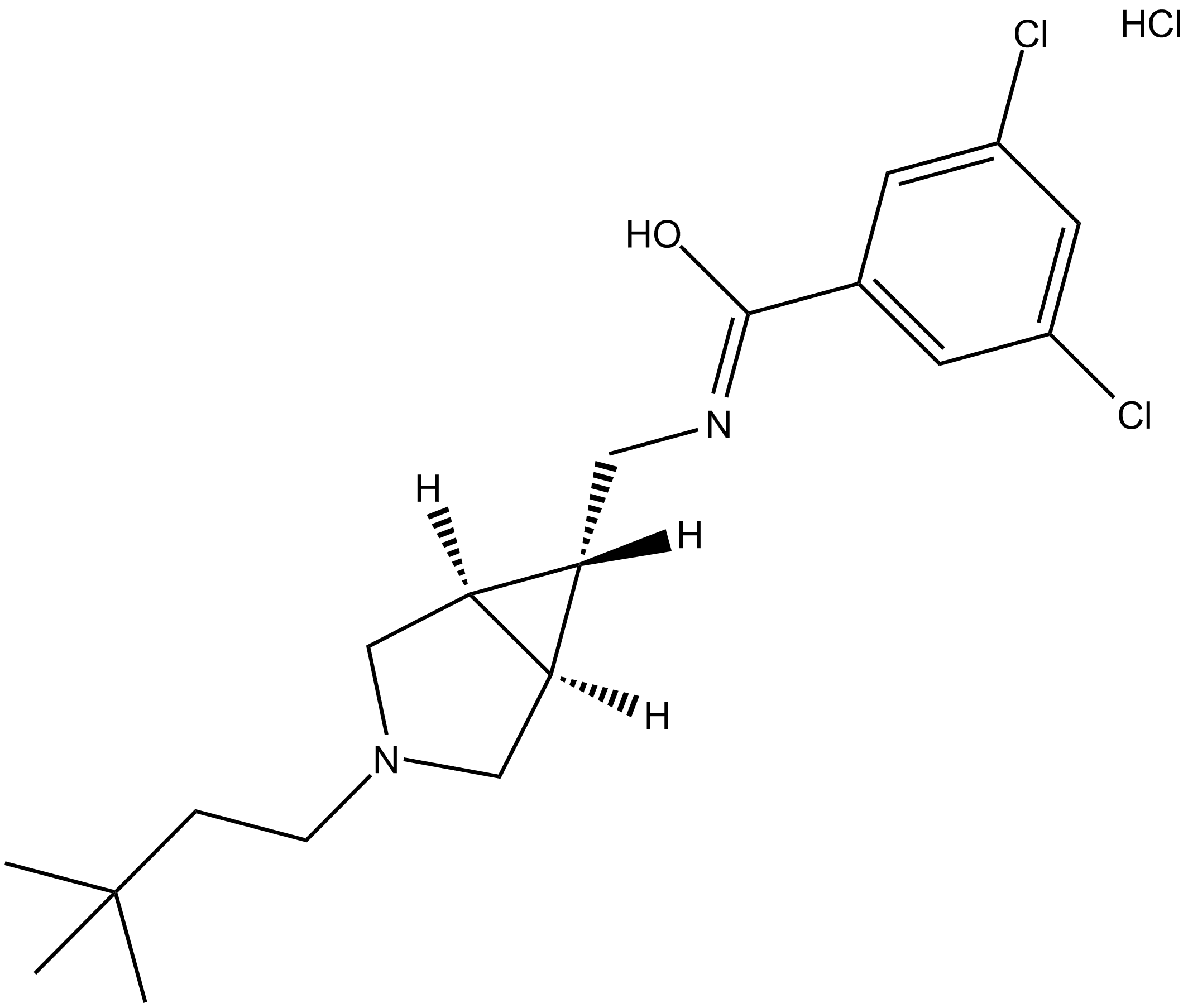
Le chlorhydrate de ML 218 est un inhibiteur puissant, sélectif et oralement actif des canaux Ca2+ de type T (Cav3.1, Cav3.2, Cav3.3) avec des CI50 de 310 nM et 270 nM pour Cav3.2 et Cav3.3, respectivement.
Products are for research use only. Not for human use. We do not sell to patients.
Cas No.: 1346233-68-8
Sample solution is provided at 25 µL, 10mM.
_1-3.$$$39978408@51.jpg');)
_1-9.$$$38538795@65.jpg');)
_1-9.$$$39112701@51.jpg');)
_1-7.$$$37316672@70.jpg');)
_366-372.$$$36198801@70.jpg');)
.$$$38565142@65.jpg');)
_1867-1883.$$$33248023@67.jpg');)
_eads6055.$$$39977546@45.jpg');)
_eadm9805.$$$40080571@45.jpg');)
_eadj3020.$$$39666821@45.jpg');)
_1-20.$$$39757301@28.jpg');)
_1-24.$$$38898113@28.jpg');)
_273-287.$$$36806353@46.jpg');)
_1-16.$$$37156877@44.jpg');)
_1-19.$$$37460805@44.jpg');)
_1291-1307.$$$34518654@46.jpg');)
ML218 is a selective T-type calcium channel inhibitor with IC50s of 270 and 310 nM for Cav3.3 and Cav3.2 in electrophysiology assay, respectively.
ML218 (CID 45115620) inhibits Cav3.1, Cav3.2, Cav3.3[1].
Electrophysiology studies in STN neurons demonstrate robust effects of ML218 on the inhibition of T-type calcium current, inhibition of low threshold spike, and rebound burst activity. ML218 was found to be orally efficacious in a dose-dependent manner in a preclinical Parkinson’s disease model, haloperidol-induced catalepsy, and comparable to clinically validated A2A antagonism[1]. ML218 reaches a peak cerebrospinal fluid concentration 1-2 hrs after s.c. administration. No effects of ML218 on cardiac rhythmicity is found in electrocardiographic studies. ML218 does not have antiparkinsonian effects in MPTP-treated parkinsonian monkeys, due at least in part, to the agent’s sedative effects[2].
References:
[1]. Xiang Z, et al. The Discovery and Characterization of ML218: A Novel, Centrally Active T-Type Calcium Channel Inhibitor with Robust Effects in STN Neurons and in a Rodent Model of Parkinson's Disease. ACS Chem Neurosci. 2011 Dec 21;2(12):730-742.
[2]. https://www.ncbi.nlm.nih.gov/pubmed/22368764
Animal experiment: | Rats: ML218 is administered intravenously (IV) to rats via the jugular vein catheter in 20% DMSO/80% saline at a dose of 1 mg/kg and a dose volume of 1 mL/kg. Blood collections via the carotid artery are performed at predose, and at 2 min, 7 min, 15 min, 30 min, and 1 h, 2 h, 4 h, 7 h, and 24 h post dose. Samples are collected into chilled, EDTA-fortified tubes, and centrifuged for 10 min at 3000 rpm (4°C), and resulting plasma is aliquoted into 96-well plates for LC/MS/MS analysis. For oral exposure studies, measuring both systemic plasma and CNS tissue exposure, ML218 is administered (oral gavage) to fasted rats as suspensions in 10% Tween 80/0.5% methylcellulose at a dose of 10 mg/kg and in a dosing volume of 10 mL/kg; blood and whole brain samples are collected at 1.5 h post dose. Blood is collected into chilled, EDTA-fortified tubes, centrifuged for 10 min at 3000 rpm (4°C), and stored at −80 °C until LC/MS/MS analysis[1]. |
References: [1]. Xiang Z, et al. The Discovery and Characterization of ML218: A Novel, Centrally Active T-Type Calcium Channel Inhibitor with Robust Effects in STN Neurons and in a Rodent Model of Parkinson's Disease. ACS Chem Neurosci. 2011 Dec 21;2(12):730-742. | |
| Cas No. | 1346233-68-8 | SDF | |
| Chemical Name | (Z)-3,5-dichloro-N-(((1R,5S,6s)-3-(3,3-dimethylbutyl)-3-azabicyclo[3.1.0]hexan-6-yl)methyl)benzimidic acid hydrochloride | ||
| Canonical SMILES | CC(C)(CCN(C[C@]12[H])C[C@@]2([H])[C@]1([H])C/N=C(O)/C3=CC(Cl)=CC(Cl)=C3)C.Cl | ||
| Formula | C19H26Cl2N2O.HCl | M.Wt | 405.79 |
| Solubility | DMSO : 125 mg/mL (338.45 mM; Need ultrasonic) | Storage | Store at -20°C |
| General tips | Please select the appropriate solvent to prepare the stock solution according to the
solubility of the product in different solvents; once the solution is prepared, please store it in
separate packages to avoid product failure caused by repeated freezing and thawing.Storage method
and period of the stock solution: When stored at -80°C, please use it within 6 months; when stored
at -20°C, please use it within 1 month. To increase solubility, heat the tube to 37°C and then oscillate in an ultrasonic bath for some time. |
||
| Shipping Condition | Evaluation sample solution: shipped with blue ice. All other sizes available: with RT, or with Blue Ice upon request. | ||
| Prepare stock solution | |||

|
1 mg | 5 mg | 10 mg |
| 1 mM | 2.4643 mL | 12.3216 mL | 24.6433 mL |
| 5 mM | 492.9 μL | 2.4643 mL | 4.9287 mL |
| 10 mM | 246.4 μL | 1.2322 mL | 2.4643 mL |
Step 1: Enter information below (Recommended: An additional animal making an allowance for loss during the experiment)
 g
μL
g
μL
Step 2: Enter the in vivo formulation (This is only the calculator, not formulation. Please contact us first if there is no in vivo formulation at the solubility Section.)
Calculation results:
Working concentration: mg/ml;
Method for preparing DMSO master liquid: mg drug pre-dissolved in μL DMSO ( Master liquid concentration mg/mL, Please contact us first if the concentration exceeds the DMSO solubility of the batch of drug. )
Method for preparing in vivo formulation: Take μL DMSO master liquid, next addμL PEG300, mix and clarify, next addμL Tween 80, mix and clarify, next add μL saline, mix and clarify.
Method for preparing in vivo formulation: Take μL DMSO master liquid, next add μL Corn oil, mix and clarify.
Note: 1. Please make sure the liquid is clear before adding the next solvent.
2. Be sure to add the solvent(s) in order. You must ensure that the solution obtained, in the previous addition, is a clear solution before proceeding to add the next solvent. Physical methods such as vortex, ultrasound or hot water bath can be used to aid dissolving.
3. All of the above co-solvents are available for purchase on the GlpBio website.
Quality Control & SDS
- View current batch:
- Purity: >99.00% Appearance: A solid
- COA (Certificate of Analysis)
- SDS (Safety Data Sheet)
- Datasheet
Average Rating: 5 (Based on Reviews and 34 reference(s) in Google Scholar.)