

ML 9 hydrochloride |
Catalog No.GC11404
 One-Click Copy Product Info
|

ML 9 hydrochloride est un inhibiteur sélectif de protéines kinases. ML 9 hydrochloride inhibe l'activité de la kinase Akt, de la kinase de la chaîne légère de myosine (MLCK) et de la molécule d'interaction stromale 1 (STIM1), et induit l'autophagie en stimulant la formation d'autophagosomes.
Products are for research use only. Not for human use. We do not sell to patients.
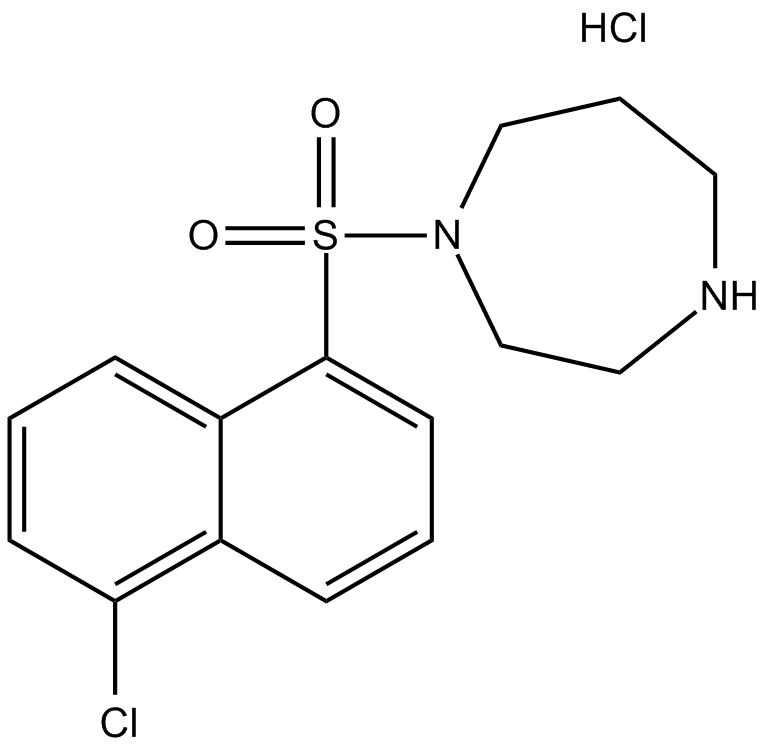
Cas No.: 105637-50-1
Sample solution is provided at 25 µL, 10mM.
_1-3.$$$39978408@51.jpg');)
_1-9.$$$38538795@65.jpg');)
_1-9.$$$39112701@51.jpg');)
_1-7.$$$37316672@70.jpg');)
_366-372.$$$36198801@70.jpg');)
.$$$38565142@65.jpg');)
_1867-1883.$$$33248023@67.jpg');)
_eads6055.$$$39977546@45.jpg');)
_eadm9805.$$$40080571@45.jpg');)
_eadj3020.$$$39666821@45.jpg');)
_1-20.$$$39757301@28.jpg');)
_1-24.$$$38898113@28.jpg');)
_273-287.$$$36806353@46.jpg');)
_1-16.$$$37156877@44.jpg');)
_1-19.$$$37460805@44.jpg');)
_1291-1307.$$$34518654@46.jpg');)
ML 9 hydrochloride est un inhibiteur sélectif de protéines kinases. ML 9 hydrochloride inhibe l'activité de la kinase Akt, de la kinase de la chaîne légère de myosine (MLCK) et de la molécule d'interaction stromale 1 (STIM1), et induit l'autophagie en stimulant la formation d'autophagosomes[1-2]. ML 9 hydrochloride peut être utilisé pour des recherches liées au cancer, à la transduction du signal et aux mécanisme de l'autophagie[3-4].
In vitro, des adipocytes 3T3-L1 ont été prétraités avec ML 9 hydrochloride (100µM) pendant 20 minutes, puis stimulés par l'insuline (33nM) pendant 14 minutes. ML 9 hydrochloride a significativement inhibé l'activité de transport du 2-déoxyglucose induite par l'insuline et a inhibé la translocation des transporteurs de glucose (GLUT4 et GLUT1) de l'espace intracellulaire vers la membrane plasmique[5]. Des cellules HEK293 ont été traitées avec ML 9 hydrochloride (1–100µM) pendant 24 heures. ML 9 hydrochloride a inhibé de manière dose-dépendante les courants induits par le canal TRPC6[6].
In vivo, un modèle de souris BALB/c avec brûlure a reçu une injection intrapéritonéale de ML 9 hydrochloride (2mg/kg; injection unique ). ML 9 hydrochloride a significativement atténué l'augmentation de la perméabilité intestinale, les dommages tissulaires de la muqueuse intestinale et la distribution anormale des protéines de jonction serré (ZO-1, occludine, claudine-1) induit par la brûlure, et a réduit le niveau de phosphorylation de la chaîne légère de myosine (MLC) dans la muquese iléale[7]. Une injection de ML 9 hydrochloride (10µM; 25µL) a été réalisée dans la région cervico-vaginale de souris BALB/c AnNCr, suivie d'une inoculation intravaginale de pseudovirus HPV16 (10⁶RLU/µL; 25µL). ML 9 hydrochloride a significativement inhibé l'infection par HPV16 chez ces souris[8].
References:
[1] Ito S, Kume H, Honjo H, et al. ML-9, a myosin light chain kinase inhibitor, reduces intracellular Ca2+ concentration in guinea pig trachealis. Eur J Pharmacol. 2004 Feb 23;486(3):325-33.
[2] Shaikh S, Troncoso R, Mondaca-Ruff D, et al. The STIM1 inhibitor ML9 disrupts basal autophagy in cardiomyocytes by decreasing lysosome content. Toxicol In Vitro. 2018 Apr;48:121-127.
[3] Kondratskyi A, Yassine M, Slomianny C, et al. Identification of ML-9 as a lysosomotropic agent targeting autophagy and cell death. Cell Death Dis. 2014 Apr 24;5(4):e1193.
[4] Ribeiro D, Freitas M, Rocha S, et al. Calcium Pathways in Human Neutrophils-The Extended Effects of Thapsigargin and ML-9. Cells. 2018 Nov 9;7(11):204.
[5] Inoue G, Kuzuya H, Hayashi T, et al. Effects of ML-9 on insulin stimulation of glucose transport in 3T3-L1 adipocytes. J Biol Chem. 1993 Mar 5;268(7):5272-8.
[6] Shi J, Takahashi S, Jin XH, et al. Myosin light chain kinase-independent inhibition by ML-9 of murine TRPC6 channels expressed in HEK293 cells. Br J Pharmacol. 2007 Sep;152(1):122-31.
[7] Chen C, Wang P, Su Q, et al. Myosin Light Chain Kinase Mediates Intestinal Barrier Disruption following Burn Injury. PLoS One. 2012;7(4):e34946.
[8] Zhang Y, Liu W, He F, et al. Myosin 9 and N-glycans jointly regulate human papillomavirus entry. J Biol Chem. 2024 Feb;300(2):105660.
| Expériences cellulaires [1]: | |
Lignées cellulaires | Adipocytes 3T3-L1 (lignée cellulaire adipocytaire dérivée de fibroblastes de souris ) |
Méthode de préparation | Les adipocytes 3T3-L1 différenciés ont été maitenus en culture et utilisés 8 à 12 jours après l'initiation de la différenciation. Les cellules ont été pré-incubées dans un tampon Krebs-Ringer phosphate tamponné à HEPES avec ML 9 hydrochloride (0-100µM) pendant 20 minutes à 37°C. |
Conditions de réaction | 0-100µM; 20 minutes. |
Domaines d'application | ML 9 hydrochloride a inhibé l'activité de transport du 2-déoxyglucose stimulée par l'insuline sans affecter le transport basal. ML 9 hydrochloride a inhibé de manière dose-dépendante la translocation induite par l'insuline des transporteurs de glucose GLUT4 et GLUT1 du compartiment intracellulaire vers la membrane plasmique. |
| Expériences animales [2]: | |
Modèles animaux | Souris Balb/c |
Méthode de préparation | Des souris ont été soumises à une brûlure thermique au troisième degré couvrant 30% de la surface corporelle totale (SCT). Immédiatement après la brûlure, les souris ont reçu une injection intrapéritonéale de ML 9 hydrochloride (2mg/kg) dissous dans une solution saline. Les souris ont été euthanasiées 6 heures après la brûlure pour analyse. |
Forme de dosage | 2mg/kg; i.p.; injection unique immédiatement après la brûlure |
Domaines d'application | ML 9 hydrochloride a significativement atténué l'augmentation de la perméabilité intestinale induite par la brûlure (mesurée par la concentration plasmatique de FITC-dextran), réduit les dommages histologiques de la muquese iléale et amélioré la redisribution des protéines de jonction serrée(ZO-1, occludine, claudine-1). ML 9 hydrochloride a également aboli l'augmentation induite par la brûlure de al chaîne légère de myosine phosphorylée (p-MLC) dans muqueuse iléale, sans affecter significativement l'augmentation de l'expression protéique de MLCK. |
References: | |
| Cas No. | 105637-50-1 | SDF | |
| Chemical Name | 1-((5-chloronaphthalen-1-yl)sulfonyl)-1,4-diazepane hydrochloride | ||
| Canonical SMILES | ClC1=C2C(C(S(=O)(N3CCCNCC3)=O)=CC=C2)=CC=C1.Cl | ||
| Formula | C15H17ClN2O2S.HCl | M.Wt | 361.29 |
| Solubility | ≥ 9.55mg/mL in DMSO | Storage | Desiccate at RT |
| General tips | Please select the appropriate solvent to prepare the stock solution according to the
solubility of the product in different solvents; once the solution is prepared, please store it in
separate packages to avoid product failure caused by repeated freezing and thawing.Storage method
and period of the stock solution: When stored at -80°C, please use it within 6 months; when stored
at -20°C, please use it within 1 month. To increase solubility, heat the tube to 37°C and then oscillate in an ultrasonic bath for some time. |
||
| Shipping Condition | Evaluation sample solution: shipped with blue ice. All other sizes available: with RT, or with Blue Ice upon request. | ||
| Prepare stock solution | |||

|
1 mg | 5 mg | 10 mg |
| 1 mM | 2.7679 mL | 13.8393 mL | 27.6786 mL |
| 5 mM | 553.6 μL | 2.7679 mL | 5.5357 mL |
| 10 mM | 276.8 μL | 1.3839 mL | 2.7679 mL |
Step 1: Enter information below (Recommended: An additional animal making an allowance for loss during the experiment)
 g
μL
g
μL
Step 2: Enter the in vivo formulation (This is only the calculator, not formulation. Please contact us first if there is no in vivo formulation at the solubility Section.)
Calculation results:
Working concentration: mg/ml;
Method for preparing DMSO master liquid: mg drug pre-dissolved in μL DMSO ( Master liquid concentration mg/mL, Please contact us first if the concentration exceeds the DMSO solubility of the batch of drug. )
Method for preparing in vivo formulation: Take μL DMSO master liquid, next addμL PEG300, mix and clarify, next addμL Tween 80, mix and clarify, next add μL saline, mix and clarify.
Method for preparing in vivo formulation: Take μL DMSO master liquid, next add μL Corn oil, mix and clarify.
Note: 1. Please make sure the liquid is clear before adding the next solvent.
2. Be sure to add the solvent(s) in order. You must ensure that the solution obtained, in the previous addition, is a clear solution before proceeding to add the next solvent. Physical methods such as vortex, ultrasound or hot water bath can be used to aid dissolving.
3. All of the above co-solvents are available for purchase on the GlpBio website.
Quality Control & SDS
- View current batch:
- Purity: >99.50% Appearance: A solid
- COA (Certificate of Analysis)
- SDS (Safety Data Sheet)
- Datasheet
Average Rating: 5 (Based on Reviews and 18 reference(s) in Google Scholar.)