

NVP-HDM201 (Synonyms: NVP-HDM201; HDM201) |
Catalog No.GC19268
 One-Click Copy Product Info
|

NVP-HDM201 (NVP-HDM201) est un puissant inhibiteur de l'interaction p53-MDM2 biodisponible par voie orale et hautement spécifique.
Products are for research use only. Not for human use. We do not sell to patients.
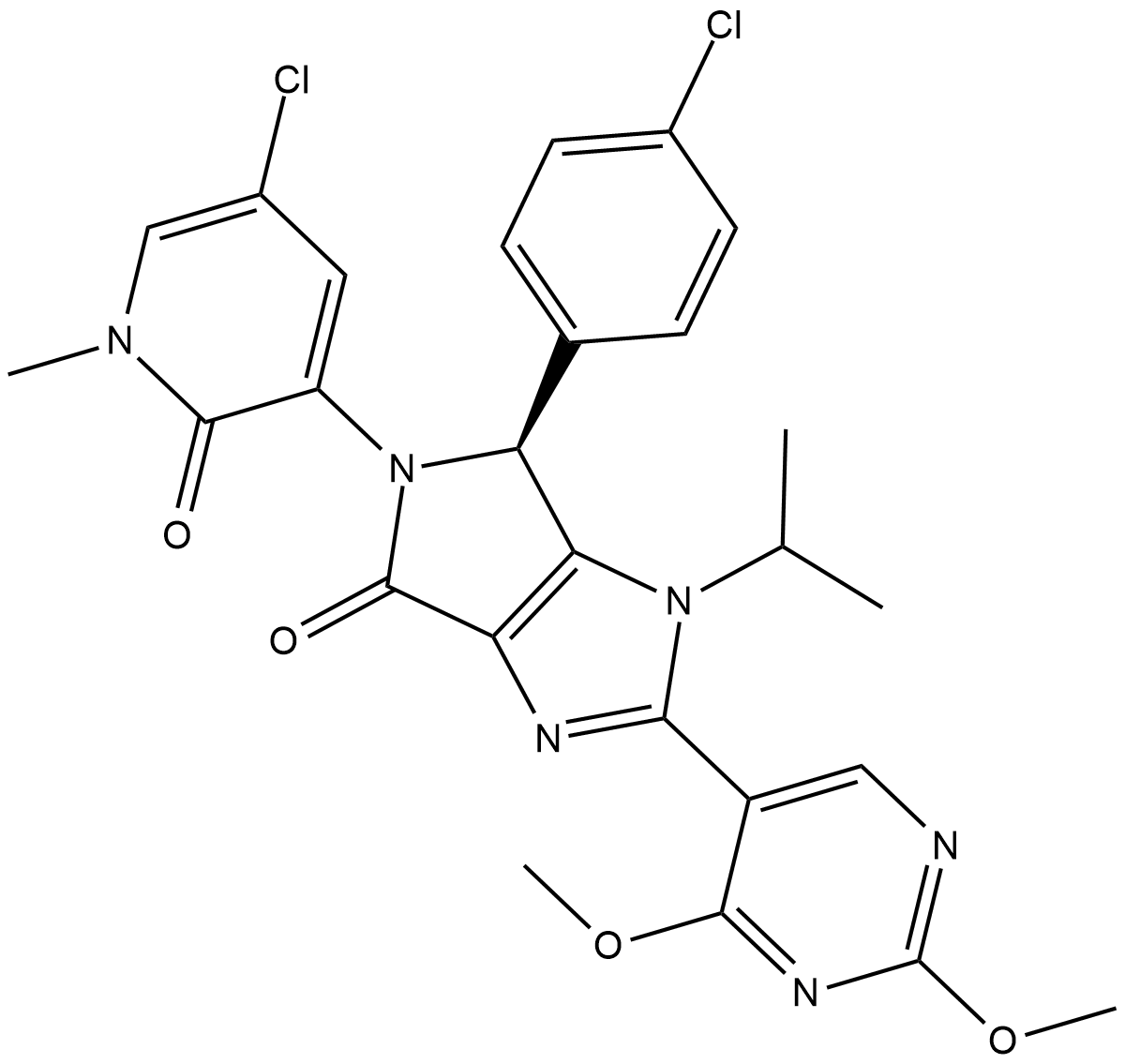
Cas No.: 1448867-41-1
Sample solution is provided at 25 µL, 10mM.
_1-3.$$$39978408@51.jpg');)
_1-9.$$$38538795@65.jpg');)
_1-9.$$$39112701@51.jpg');)
_1-7.$$$37316672@70.jpg');)
_366-372.$$$36198801@70.jpg');)
.$$$38565142@65.jpg');)
_1867-1883.$$$33248023@67.jpg');)
_eads6055.$$$39977546@45.jpg');)
_eadm9805.$$$40080571@45.jpg');)
_eadj3020.$$$39666821@45.jpg');)
_1-20.$$$39757301@28.jpg');)
_1-24.$$$38898113@28.jpg');)
_273-287.$$$36806353@46.jpg');)
_1-16.$$$37156877@44.jpg');)
_1-19.$$$37460805@44.jpg');)
_1291-1307.$$$34518654@46.jpg');)
NVP-HDM201 (HDM201) is a potent and highly specific MDM-2/p53 inhibitor currently under phase I clinical trial.
NVP-HDM201 disrupts both human and murine TP53- MDM2 interactions, with nanomolar cellular IC50 values, blocking TP53 degradation[1].
NVP-HDM201 is an imidazolopyrrolidinone analogue, showing a very advantageous in vivo profile. NVP-HDM201 has recently entered Phase 1 clinical trials in cancer patients[2]. Constitutive PB mutagenesis in Arf-/- mice provides a collection of spontaneous tumors with characterized insertional genetic landscapes. Tumors are allografted in large cohorts of mice to assess the pharmacologic effects of NVP-HDM201. Sixteen out of 21 allograft models are sensitive to NVP-HDM201 but ultimately relapse under treatment. A comparison of tumors with acquired resistance to NVP-HDM201 and untreated tumors identified 87 genes that are differentially and significantly targeted by the PB transposon[1]. NVP-HDM201 administered either daily at a low dose or once at a high dose revealed a differentiated engagement of the p53 molecular response. In contrast to the daily low dose treatment regimen, the single high dose NVP-HDM201 regimen results in a rapid and dramatic induction of p53-dependent PUMA expression and apoptosis. This is consistent with the finding that a single high dose NVP-HDM201 treatment, administered orally or intravenously, results in a robust and sustained tumor regression. Overall, both daily and once every 3 weeks dosing regimen shows comparable long term efficacy in preclinical studies. The ongoing clinical trial is currently designed to compare both dosing regimens with regard to efficacy and tolerability[3].
References:
[1]. Chapeau EA, et al. Resistance mechanisms to TP53-MDM2 inhibition identified by in vivo piggyBac transposon mutagenesis screen in an Arf-/- mouse model. Proc Natl Acad Sci U S A. 2017 Mar 21;114(12):3151-3156.
[2]. Furet P, et al. Discovery of a novel class of highly potent inhibitors of the p53-MDM2 interaction by structure-based design starting from a conformational argument. Bioorg Med Chem Lett. 2016 Oct 1;26(19):4837-41.
[3]. Stéphane F, et al. Abstract 1224: Insights into the mechanism of action of NVP-HDM201, a differentiated and versatile Next-Generation small-molecule inhibitor of Mdm2, under evaluation in phase I clinical trials. Insights into the mechanism of action of NVP-HDM201, a differentiated and versatile Next-Generation small-molecule inhibitor of Mdm2, under evaluation in phase I clinical trials. [abstract]. In: Proceedings of the 107th Annual Meeting of the American Association for Cancer Research; 2016 Apr 16-20; New Orleans, LA. Philadelphia (PA): AACR; Cancer Res 2016;76(14 Suppl):Abstract nr 1224.
| Cas No. | 1448867-41-1 | SDF | |
| Synonymes | NVP-HDM201; HDM201 | ||
| Canonical SMILES | O=C1N(C2=CC(Cl)=CN(C)C2=O)[C@@H](C3=CC=C(Cl)C=C3)C4=C1N=C(C5=CN=C(OC)N=C5OC)N4C(C)C | ||
| Formula | C26H24Cl2N6O4 | M.Wt | 555.41 |
| Solubility | DMSO : ≥ 56.75 mg/mL (102.18 mM) | Storage | Store at -20°C |
| General tips | Please select the appropriate solvent to prepare the stock solution according to the
solubility of the product in different solvents; once the solution is prepared, please store it in
separate packages to avoid product failure caused by repeated freezing and thawing.Storage method
and period of the stock solution: When stored at -80°C, please use it within 6 months; when stored
at -20°C, please use it within 1 month. To increase solubility, heat the tube to 37°C and then oscillate in an ultrasonic bath for some time. |
||
| Shipping Condition | Evaluation sample solution: shipped with blue ice. All other sizes available: with RT, or with Blue Ice upon request. | ||
| Prepare stock solution | |||

|
1 mg | 5 mg | 10 mg |
| 1 mM | 1.8005 mL | 9.0024 mL | 18.0047 mL |
| 5 mM | 360.1 μL | 1.8005 mL | 3.6009 mL |
| 10 mM | 180 μL | 900.2 μL | 1.8005 mL |
Step 1: Enter information below (Recommended: An additional animal making an allowance for loss during the experiment)
 g
μL
g
μL
Step 2: Enter the in vivo formulation (This is only the calculator, not formulation. Please contact us first if there is no in vivo formulation at the solubility Section.)
Calculation results:
Working concentration: mg/ml;
Method for preparing DMSO master liquid: mg drug pre-dissolved in μL DMSO ( Master liquid concentration mg/mL, Please contact us first if the concentration exceeds the DMSO solubility of the batch of drug. )
Method for preparing in vivo formulation: Take μL DMSO master liquid, next addμL PEG300, mix and clarify, next addμL Tween 80, mix and clarify, next add μL saline, mix and clarify.
Method for preparing in vivo formulation: Take μL DMSO master liquid, next add μL Corn oil, mix and clarify.
Note: 1. Please make sure the liquid is clear before adding the next solvent.
2. Be sure to add the solvent(s) in order. You must ensure that the solution obtained, in the previous addition, is a clear solution before proceeding to add the next solvent. Physical methods such as vortex, ultrasound or hot water bath can be used to aid dissolving.
3. All of the above co-solvents are available for purchase on the GlpBio website.
Quality Control & SDS
- View current batch:
- Purity: >98.00% Appearance: A solid
- COA (Certificate of Analysis)
- SDS (Safety Data Sheet)
- Datasheet
Average Rating: 5 (Based on Reviews and 9 reference(s) in Google Scholar.)