

Solifenacin hydrochloride |
Catalog No.GC10508
 One-Click Copy Product Info
|

Le chlorhydrate de solifénacine (chlorhydrate de YM905) est un antagoniste des récepteurs muscariniques, avec des pKis de 7,6, 6,9 et 8,0 pour les récepteurs M1, M2 et M3, respectivement.
Products are for research use only. Not for human use. We do not sell to patients.
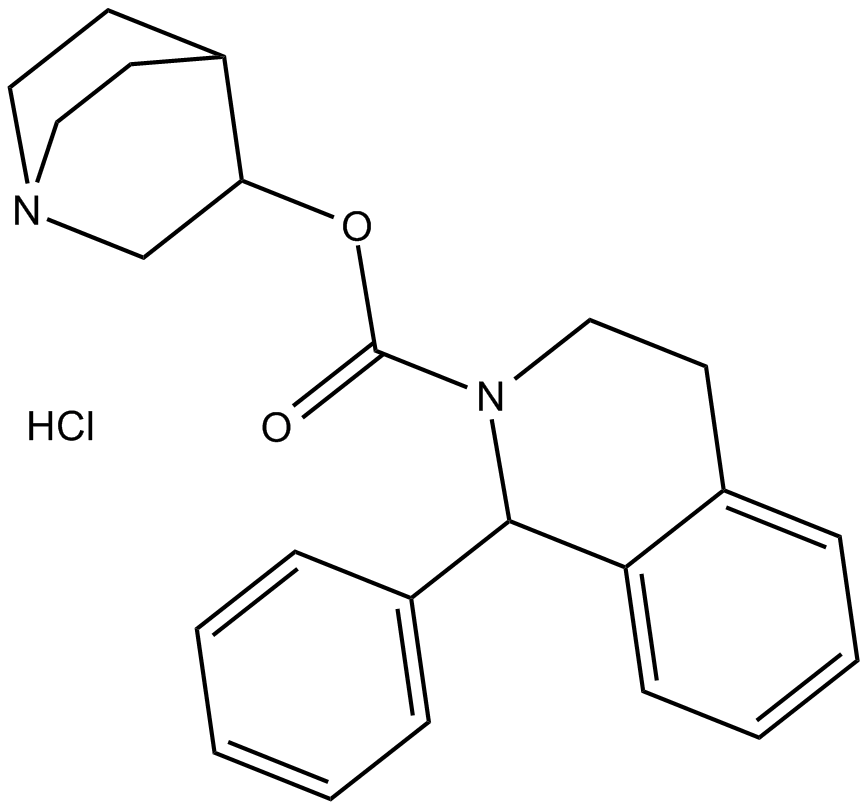
Cas No.: 180468-39-7
Sample solution is provided at 25 µL, 10mM.
_1-3.$$$39978408@51.jpg');)
_1-9.$$$38538795@65.jpg');)
_1-9.$$$39112701@51.jpg');)
_1-7.$$$37316672@70.jpg');)
_366-372.$$$36198801@70.jpg');)
.$$$38565142@65.jpg');)
_1867-1883.$$$33248023@67.jpg');)
_eads6055.$$$39977546@45.jpg');)
_eadm9805.$$$40080571@45.jpg');)
_eadj3020.$$$39666821@45.jpg');)
_1-20.$$$39757301@28.jpg');)
_1-24.$$$38898113@28.jpg');)
_273-287.$$$36806353@46.jpg');)
_1-16.$$$37156877@44.jpg');)
_1-19.$$$37460805@44.jpg');)
_1291-1307.$$$34518654@46.jpg');)
Solifenacin hydrochloride (YM905 hydrochloride) is a muscarinic receptor antagonist, with pKis of 7.6, 6.9 and 8.0 for M1, M2 and M3 receptors, respectively.
Solifenacin hydrochloride (YM905 hydrochloride) is a novel muscarinic receptor antagonist with pKis of 7.6±0.056, 6.9±0.034 and 8.0±0.021 for M1, M2 and M3 receptors, respectively. In murine submandibular gland cells, the antagonistic effects of 100 nM Solifenacin hydrochloride and oxybutynin on Ca2+ mobilization evoked by varying doses of carbachol (CCh) are examined. Solifenacin hydrochloride does not shift the CCh dose-activation curve in a parallel manner whereas oxybutynin shows insurmountable antagonism. The pKb values are obtained as 7.4±0.17 for Solifenacin hydrochloride and 8.8±0.21 for oxybutynin[1].
Solifenacin hydrochloride (YM905 hydrochloride) reduces bladder responses by 40% at a dose of 210 nmol/kg (0.1 mg/kg) and abolishes them at 2100 nmol/kg (1 mg/kg). In contrast, its inhibitory effects on salivary and cardiac responses are only slight at 630 nmol/kg (0.3 mg/kg), and reach 66% and 49%, respectively, at 2100 nmol/kg (1 mg/kg). At doses of 63 and 210 nmol/kg (0.03 and 0.1 mg/kg), Solifenacin hydrochloride slightly increases saliva secretion[1]. Solifenacin hydrochloride (0.01 to 0.3 mg/kg i.v.) dose-dependently increases bladder capacity and voided volume at doses of 0.03 mg/kg i.v. or more, but does not affect residual volume or micturition pressure at any dose tested[2].
References:
[1]. Ronald A. Smulders et al. Pharmacokinetics and Safety of Solifenacin Succinate in Healthy Young Men. J Clin Pharmacol September 2004 vol. 44 no. 9 1023-1033
[2]. Krishna SR, Rao BM, Rao NS.A validated rapid stability-indicating method for the determination of related substances in solifenacin succinate by ultra-fast liquid chromatography.J Chromatogr Sci. 2010 Nov;48(10):807-10.
[3]. Ohtake A, Sato S, Sasamata M, Miyata K.The forefront for novel therapeutic agents based on the pathophysiology of lower urinary tract dysfunction: ameliorative effect of solifenacin succinate (Vesicare), a bladder-selective antimuscarinic agent, on overactive bladder symptoms, especially urgency episodes.J Pharmacol Sci. 2010;112(2):135-41. Epub 2010 Feb 4.
[4]. Hoffstetter S, Leong FC.Solifenacin succinate for the treatment of overactive bladder.Expert Opin Drug Metab Toxicol. 2009 Mar;5(3):345-50.
[5]. Choo MS, Lee JZ, Lee JB, Kim YH, Jung HC, Lee KS, Kim JC, Seo JT, Paick JS, Kim HJ, Na YG, Lee JG.Efficacy and safety of solifenacin succinate in Korean patients with overactive bladder: a randomised, prospective, double-blind, multicentre study.Int J Clin Pract. 2008 Nov;62(11):1675-83.
| Cas No. | 180468-39-7 | SDF | |
| Chemical Name | [(3R)-1-azabicyclo[2.2.2]octan-3-yl] (1S)-1-phenyl-3,4-dihydro-1H-isoquinoline-2-carboxylate;hydrochloride | ||
| Canonical SMILES | C1CN2CCC1C(C2)OC(=O)N3CCC4=CC=CC=C4C3C5=CC=CC=C5.Cl | ||
| Formula | C23H27ClN2O2 | M.Wt | 398.93 |
| Solubility | DMSO : 50 mg/mL (125.34 mM; Need ultrasonic); H2O : 50 mg/mL (125.34 mM; Need ultrasonic) | Storage | Store at -20°C |
| General tips | Please select the appropriate solvent to prepare the stock solution according to the
solubility of the product in different solvents; once the solution is prepared, please store it in
separate packages to avoid product failure caused by repeated freezing and thawing.Storage method
and period of the stock solution: When stored at -80°C, please use it within 6 months; when stored
at -20°C, please use it within 1 month. To increase solubility, heat the tube to 37°C and then oscillate in an ultrasonic bath for some time. |
||
| Shipping Condition | Evaluation sample solution: shipped with blue ice. All other sizes available: with RT, or with Blue Ice upon request. | ||
| Prepare stock solution | |||

|
1 mg | 5 mg | 10 mg |
| 1 mM | 2.5067 mL | 12.5335 mL | 25.0671 mL |
| 5 mM | 501.3 μL | 2.5067 mL | 5.0134 mL |
| 10 mM | 250.7 μL | 1.2534 mL | 2.5067 mL |
Step 1: Enter information below (Recommended: An additional animal making an allowance for loss during the experiment)
 g
μL
g
μL
Step 2: Enter the in vivo formulation (This is only the calculator, not formulation. Please contact us first if there is no in vivo formulation at the solubility Section.)
Calculation results:
Working concentration: mg/ml;
Method for preparing DMSO master liquid: mg drug pre-dissolved in μL DMSO ( Master liquid concentration mg/mL, Please contact us first if the concentration exceeds the DMSO solubility of the batch of drug. )
Method for preparing in vivo formulation: Take μL DMSO master liquid, next addμL PEG300, mix and clarify, next addμL Tween 80, mix and clarify, next add μL saline, mix and clarify.
Method for preparing in vivo formulation: Take μL DMSO master liquid, next add μL Corn oil, mix and clarify.
Note: 1. Please make sure the liquid is clear before adding the next solvent.
2. Be sure to add the solvent(s) in order. You must ensure that the solution obtained, in the previous addition, is a clear solution before proceeding to add the next solvent. Physical methods such as vortex, ultrasound or hot water bath can be used to aid dissolving.
3. All of the above co-solvents are available for purchase on the GlpBio website.
Quality Control & SDS
- View current batch:
- Purity: >99.00% Appearance: A solid
- COA (Certificate of Analysis)
- SDS (Safety Data Sheet)
- Datasheet
Average Rating: 5 (Based on Reviews and 37 reference(s) in Google Scholar.)