

Solifenacin succinate (Synonyms: YM-67905) |
Catalog No.GC17182
 One-Click Copy Product Info
|

Le succinate de solifénacine (YM905) est un nouvel antagoniste des récepteurs muscariniques avec un pKis de 7,6, 6,9 et 8,0 pour les récepteurs M1, M2 et M3, respectivement.
Products are for research use only. Not for human use. We do not sell to patients.
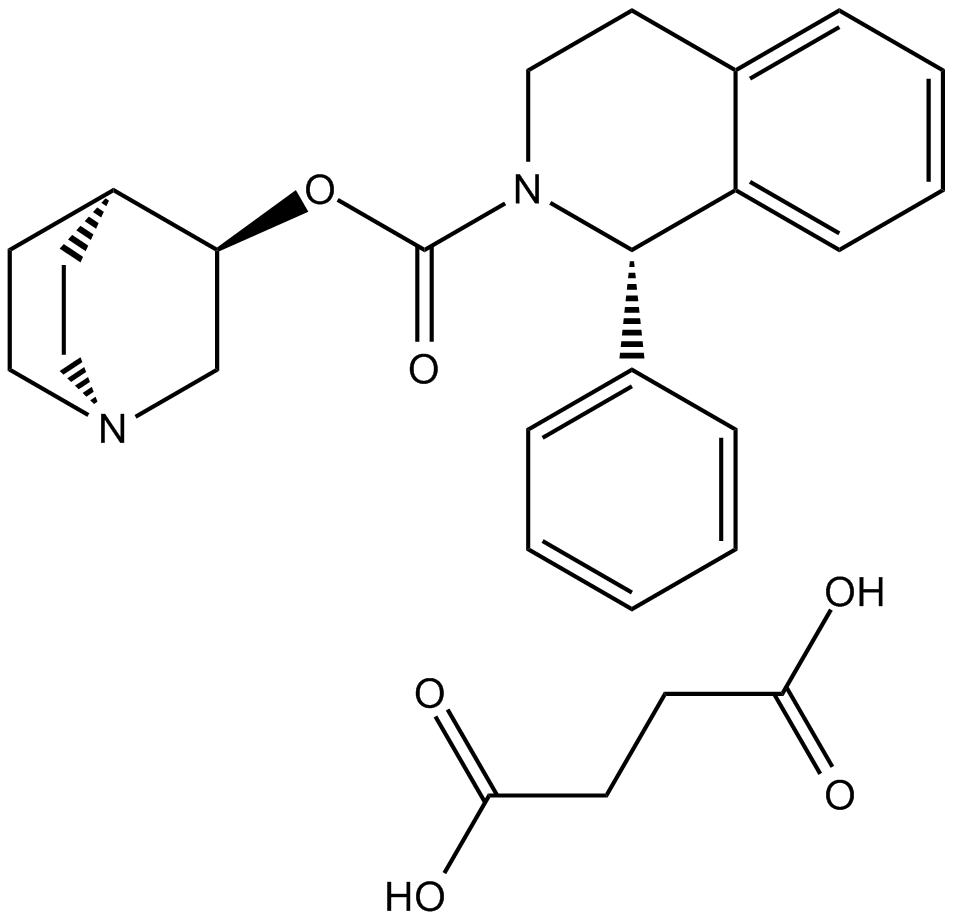
Cas No.: 242478-38-2
Sample solution is provided at 25 µL, 10mM.
_1-3.$$$39978408@51.jpg');)
_1-9.$$$38538795@65.jpg');)
_1-9.$$$39112701@51.jpg');)
_1-7.$$$37316672@70.jpg');)
_366-372.$$$36198801@70.jpg');)
.$$$38565142@65.jpg');)
_1867-1883.$$$33248023@67.jpg');)
_eads6055.$$$39977546@45.jpg');)
_eadm9805.$$$40080571@45.jpg');)
_eadj3020.$$$39666821@45.jpg');)
_1-20.$$$39757301@28.jpg');)
_1-24.$$$38898113@28.jpg');)
_273-287.$$$36806353@46.jpg');)
_1-16.$$$37156877@44.jpg');)
_1-19.$$$37460805@44.jpg');)
_1291-1307.$$$34518654@46.jpg');)
Solifenacin succinate is a quinuclidine and tetrahydroisoquinoline derivative and selective M3 muscarinic antagonist. It is used as a urological agent in the treatment of overactive bladder[1].
M3 muscarinic receptor is a muscarinic acetylcholine receptor encoded by the human gene CHRM3. Muscarinic M3 receptors are involved in various cellular responses, including breakdown of phosphoinositides, inhibition of adenylate cyclase and modulation of potassium channels through the action of G proteins[2].
In vitro: In radioligand receptor binding assay, the Kivalues of solifenacin for human muscarinic M1, M2, M3, M4and M5receptors were 26, 170, 12, 110 and 31 nM, respectively. In isolated rat urinary bladder, solifenacin competitively antagonized carbachol-induced contractions, with a pA2value of 7.44±0.09[3].In bladder smooth muscle cells and salivary gland cells isolated from rats, solifenacin and the other antimuscarinic drugs inhibited carbachol-induced increases in intracellular Ca2+levels in a concentration-dependent manner. ThepKi was 8.12for bladder smooth muscle cells, 3.6-fold more potent than that for salivary gland cells (pKi=7.57) [1].
In vivo: In anesthetized rats, solifenacin dose-dependently inhibited carbachol-induced intravesical pressure elevation and salivary secretion, and exhibited selectivity (3.7- to 6.5-fold) for urinary bladder over salivary gland [1]. In anesthetized rats, solifenacin and oxybutynin increased the maximum bladder capacity in a dose-dependent manner and also decreased the maximum intravesical pressure [3].In healthy young men, multidose study evaluated doses. In the single-dose of solifenacin succinate (5-, 10-, 20-, and 30-mg), mean time to maximal concentration and elimination half-life ranged from 3.3 to 4.8 and from 40.2 to 57.6 hours, respectively.In the multidose study, the ranges were 2.9 to 5.8 and 45.0 to 64.8, respectively. The single-dose administration was well tolerated. The common adverse events were dry mouth, blurred vision, and headache [4].
Clinical trials: In this phase 3 trial in patients with symptoms related to overactive bladder, treatment with solifenacin (5 mg or 10 mg, once daily) significantly improved all the major symptoms of overactive bladder including urgency, frequency and incontinence. Solifenacin (10 mg) decreased the frequency of nocturia. Solifenacin therapy has been associated with a favorable tolerability profile and low incidence of dry mouth, especially at the 5 mg starting dose [5].
References:
[1]. Ohtake A, Ukai M, Hatanaka T, et al. In vitro and in vivo tissue selectivity profile of solifenacin succinate (YM905) for urinary bladder over salivary gland in rats[J]. European journal of pharmacology, 2004, 492(2): 243-250.
[2]. Yang J, Williams J A, Yule D I, et al. Mutation of carboxyl-terminal threonine residues in human m3 muscarinic acetylcholine receptor modulates the extent of sequestration and desensitization[J]. Molecular pharmacology, 1995, 48(3): 477-485.
[3]. Ohtake A, Saitoh C, Yuyama H, et al. Pharmacological characterization of a new antimuscarinic agent, solifenacin succinate, in comparison with other antimuscarinic agents[J]. Biological and Pharmaceutical Bulletin, 2007, 30(1): 54-58.
[4]. Smulders R A, Krauwinkel W J, Swart P J, et al. Pharmacokinetics and safety of solifenacin succinate in healthy young men[J]. The Journal of Clinical Pharmacology, 2004, 44(9): 1023-1033.
[5]. Cardozo L, Lisec M, Millard R, et al. Randomized, double-blind placebo controlled trial of the once daily antimuscarinic agent solifenacin succinate in patients with overactive bladder[J]. The Journal of urology, 2004, 172(5): 1919-1924.
| Cell experiment [1,2]: | |
|
Cell lines |
Bladder smooth muscle cells, CEM human leukemic T cells |
|
Preparation method |
The solubility of this compound in DMSO is >24.1mg/mL. General tips for obtaining a higher concentration: Please warm the tube at 37 ℃ for 10 minutes and/or shake it in the ultrasonic bath for a while. Stock solution can be stored below -20℃ for several months. |
|
Reacting condition |
0.1 nM-1 μM |
|
Applications |
In bladder smooth muscle cells, solifenacin inhibited Ca2+ mobilization induced by 10 μM carbachol in a concentration-dependent manner. In CEM human leukemic T cells, YM905 (10 nM to 10 μM) significantly reduced the number of cells responding to 10 μM Oxo-M. YM905 attenuated the upregulation of c-fos mRNA expression induced by 10 μM Oxo-M, though it had no effect on basal expression of c-fos mRNA at 1 or 10 μM. |
| Animal experiment [1,3]: | |
|
Animal models |
Female Wistar rats, Mice |
|
Dosage form |
Intravenous injection, 0.03-1 mg/kg |
|
Application |
YM905 (0.03-1 mg/kg, i.v.) dose-dependently and significantly suppressed increases in intravesical pressure. YM905 (0.1 mg/kg, i.v.) had no effect on salivary secretion. YM905 (i.v.) showed more than about 50% inhibition at 0.3 mg/kg. YM905 showed significantly more potent inhibition of bladder responses over salivary responses, with ID30 and ID50 values indicating 6.5- and 3.7-fold greater selectivity for urinary bladder, respectively. YM905 potently inhibited restraint stress-induced fecal pellet output in fed rats (ED50: 4.0 mg/kg) and diarrhea in fasted rats (ED50: 1.7 mg/kg). YM905 inhibited 5-hydroxytryptamine (5-HT)-, prostaglandin E2- and castor oil-induced secretory diarrhea in mice (ED50: 5.5, 14 and 6.3 mg/kg, respectively), but showed no significant effect on cholera toxin-induced intestinal secretion in mice. YM905 (3, 10 mg/kg) reversed morphine-decreased postprandial defecation in ferrets, a model of spastic constipation. |
|
Other notes |
Please test the solubility of all compounds indoor, and the actual solubility may slightly differ with the theoretical value. This is caused by an experimental system error and it is normal. |
|
References: [1]. Ohtake, A., Ukai, M., Hatanaka, T., Kobayashi, S., Ikeda, K., et, al (2004). In vitro and in vivo tissue selectivity profile of solifenacin succinate (YM905) for urinary bladder over salivary gland in rats. European journal of pharmacology, 492(2), 243-250. [2]. Fujii, T., & Kawashima, K. (2000). YM905, a novel M 3 antagonist, inhibits Ca 2+ signaling and c-fos gene expression mediated via muscarinic receptors in human T cells. General Pharmacology: The Vascular System, 35(2), 71-75. [3]. Kobayashi, S., Ikeda, K., Suzuki, M., Yamada, T., & Miyata, K. (2001). Effects of YM905, a novel muscarinic M3-receptor antagonist, on experimental models of bowel dysfunction in vivo. The Japanese journal of pharmacology, 86(3), 281-288. |
|
| Cas No. | 242478-38-2 | SDF | |
| Synonymes | YM-67905 | ||
| Chemical Name | [(3R)-1-azabicyclo[2.2.2]octan-3-yl] (1S)-1-phenyl-3,4-dihydro-1H-isoquinoline-2-carboxylate;butanedioic acid | ||
| Canonical SMILES | C1CN2CCC1C(C2)OC(=O)N3CCC4=CC=CC=C4C3C5=CC=CC=C5.C(CC(=O)O)C(=O)O | ||
| Formula | C27H32N2O6 | M.Wt | 480.55 |
| Solubility | ≥ 24.05mg/mL in DMSO | Storage | Store at -20°C |
| General tips | Please select the appropriate solvent to prepare the stock solution according to the
solubility of the product in different solvents; once the solution is prepared, please store it in
separate packages to avoid product failure caused by repeated freezing and thawing.Storage method
and period of the stock solution: When stored at -80°C, please use it within 6 months; when stored
at -20°C, please use it within 1 month. To increase solubility, heat the tube to 37°C and then oscillate in an ultrasonic bath for some time. |
||
| Shipping Condition | Evaluation sample solution: shipped with blue ice. All other sizes available: with RT, or with Blue Ice upon request. | ||
| Prepare stock solution | |||

|
1 mg | 5 mg | 10 mg |
| 1 mM | 2.0809 mL | 10.4047 mL | 20.8095 mL |
| 5 mM | 416.2 μL | 2.0809 mL | 4.1619 mL |
| 10 mM | 208.1 μL | 1.0405 mL | 2.0809 mL |
Step 1: Enter information below (Recommended: An additional animal making an allowance for loss during the experiment)
 g
μL
g
μL
Step 2: Enter the in vivo formulation (This is only the calculator, not formulation. Please contact us first if there is no in vivo formulation at the solubility Section.)
Calculation results:
Working concentration: mg/ml;
Method for preparing DMSO master liquid: mg drug pre-dissolved in μL DMSO ( Master liquid concentration mg/mL, Please contact us first if the concentration exceeds the DMSO solubility of the batch of drug. )
Method for preparing in vivo formulation: Take μL DMSO master liquid, next addμL PEG300, mix and clarify, next addμL Tween 80, mix and clarify, next add μL saline, mix and clarify.
Method for preparing in vivo formulation: Take μL DMSO master liquid, next add μL Corn oil, mix and clarify.
Note: 1. Please make sure the liquid is clear before adding the next solvent.
2. Be sure to add the solvent(s) in order. You must ensure that the solution obtained, in the previous addition, is a clear solution before proceeding to add the next solvent. Physical methods such as vortex, ultrasound or hot water bath can be used to aid dissolving.
3. All of the above co-solvents are available for purchase on the GlpBio website.
Quality Control & SDS
- View current batch:
- Purity: >99.00% Appearance: A solid
- COA (Certificate of Analysis)
- SDS (Safety Data Sheet)
- Datasheet
Average Rating: 5 (Based on Reviews and 17 reference(s) in Google Scholar.)