

TAPI-1 (Synonyms: TAPI) |
Catalog No.GC12344
 One-Click Copy Product Info
|

TAPI-1 est un inhibiteur de TACE (enzyme convertissant le facteur de nécrose tumorale-α) qui bloque la sécrétion du domaine extracellulaire des protéines membranaires cellulaires (l'amphiréguline, AREG) médiée par TACE en inhibant son activité protéolytique. TAPI-1 est également un inhibiteur de la métalloprotéinase de matrice (MMP).
Products are for research use only. Not for human use. We do not sell to patients.
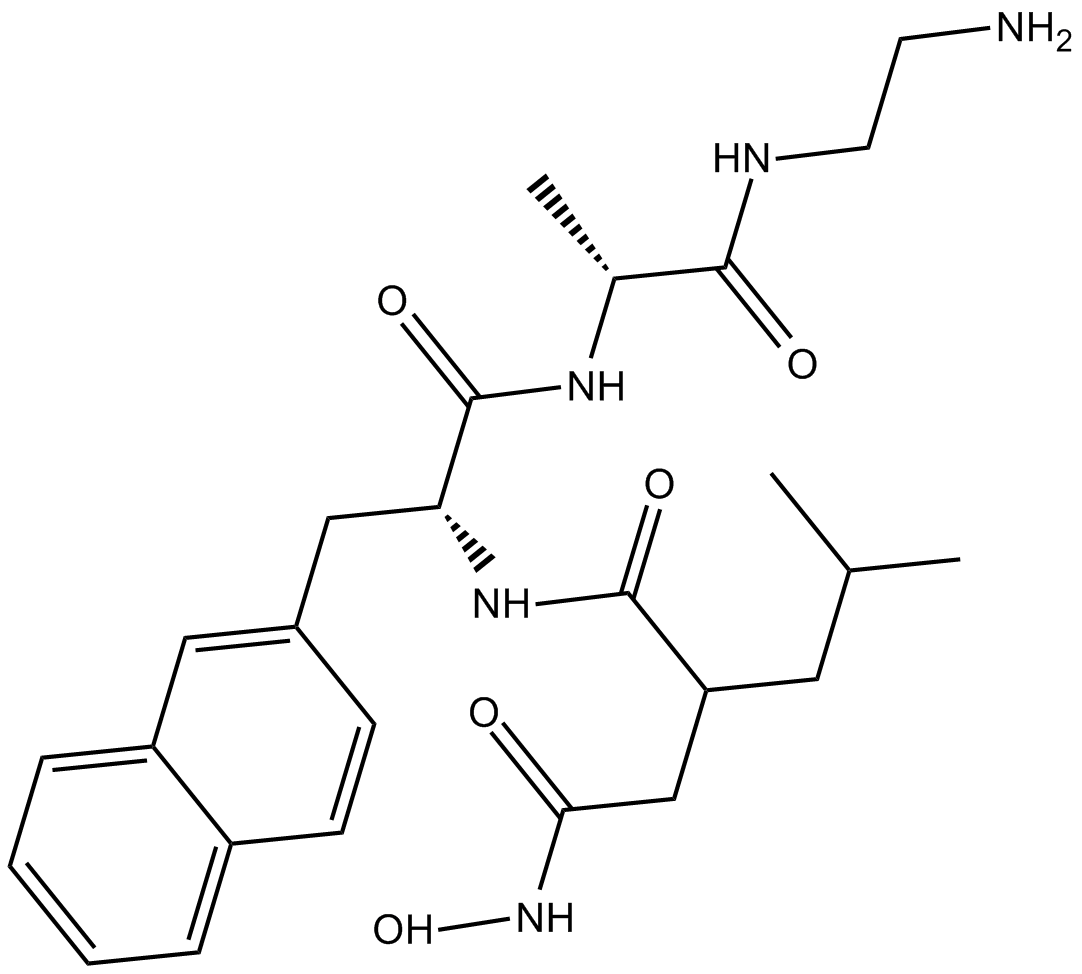
Cas No.: 163847-77-6
Sample solution is provided at 25 µL, 10mM.
TAPI-1 est un inhibiteur de TACE (enzyme convertissant le facteur de nécrose tumorale-α) qui bloque la sécrétion du domaine extracellulaire des protéines membranaires cellulaires (l'amphiréguline, AREG) médiée par TACE en inhibant son activité protéolytique[1, 2]. TAPI-1 est également un inhibiteur de la métalloprotéinase de matrice (MMP)[3]. TAPI-1 peut réduire le stress oxydatif et la production de facteurs inflammatoires[4].
Le traitement in vitro avec TAPI-1 (0-20µM) aux cellules TE-1 et Eca109 pendant 24h a inhibé la viabilité cellulaire, la migration et l'invasion cellulaires de manière dose-dépendante, et a favorisé l'apoptose induite par le cisplatine[5]. Le traitement avec TAPI-1 (20µM) aux cellules A549 pendant 24h a réduit la prolifération cellulaire et inhibé l'expression de mRNAs de EGFR et de Notch1[6]. Le traitement avec TAPI-1 (5, 10µM) aux cellules NCI-H292 pendant 6 et 24h a bloqué la sécrétion d'amphiréguline (AREG) par les cellules stimulées par le diacétyle[7].
In vivo, TAPI-1 (10mg/kg) administré par injection intra-péritonéale aux rats atteints d'arthrite induite par Staphylococcus aureus a réduit significativement l'enflure de la patte et diminué les concentrations de superoxyde, d'oxyde nitrique et de peroxyde d'hydrogène dans les tissus articulaires[8].
References:
[1] Slack B E, Ma L K, Seah C C. Constitutive shedding of the amyloid precursor protein ectodomain is up-regulated by tumour necrosis factor-α converting enzyme[J]. Biochemical Journal, 2001, 357(3): 787-794.
[2] Liu C, Xu P, Lamouille S, et al. TACE-mediated ectodomain shedding of the type I TGF-β receptor downregulates TGF-β signaling[J]. Molecular cell, 2009, 35(1): 26-36.
[3] Koon H W, Zhao D, Na X, et al. Metalloproteinases and transforming growth factor-α mediate substance P-induced mitogen-activated protein kinase activation and proliferation in human colonocytes[J]. Journal of Biological Chemistry, 2004, 279(44): 45519-45527.
[4] Bae E H, Kim I J, Choi H S, et al. Tumor necrosis factor α-converting enzyme inhibitor attenuates lipopolysaccharide-induced reactive oxygen species and mitogen-activated protein kinase expression in human renal proximal tubule epithelial cells[J]. The Korean Journal of Physiology & Pharmacology, 2018, 22(2): 135-143.
[5] Gao L, Li L, Zhang D, et al. TAPI-1 exhibits Anti-tumor efficacy in human esophageal squamous cell carcinoma cells via suppression of NF-κB signaling pathway[J]. Digestive Diseases and Sciences, 2024, 69(1): 81-94.
[6] Pancewicz J, Golec P. The effect of TAPI-1 treatment in non-small cell lung cancer cells[J].
[7] Kelly F L, Sun J, Fischer B M, et al. Diacetyl induces amphiregulin shedding in pulmonary epithelial cells and in experimental bronchiolitis obliterans[J]. American journal of respiratory cell and molecular biology, 2014, 51(4): 568-574.
[8] Sultana S, Bishayi B. Potential anti-arthritic and anti-inflammatory effects of TNF-α processing inhibitor-1 (TAPI-1): A new approach to the treatment of S. aureus arthritis[J]. Immunobiology, 2020, 225(2): 151887.
| Expériences cellulaires [1]: | |
Lignées cellulaires | Cellules TE-1 et Eca109 |
Méthode de préparation | Les cellules TE-1 et Eca109 ont été exposées à des doses variables de TAPI-1 (0, 1.25, 2.5, 5, 10, et 20μM) pendant 24 heures, après quoi la viabilité cellulaire a été déterminée par le test CCK-8. |
Conditions de réaction | 0, 1.25, 2.5, 5, 10, 20μM; 24h |
Domaines d'application | Après exposition à TAPI-1, la viabilité des cellules TE-1 et Eca109 a été inhibée de manière dose-dépendante. |
| Expériences animales [2]: | |
Modèles animaux | Rats mâles adultes de souche Swiss albino |
Méthode de préparation | TAPI-1 a été dilué dans une solution saline stérile contenant 5% de DMSO. La concentration finale utilisée était 10mg/kg de poids corporel. La première dose de TAPI-1 a été administrée par voie intra-péritonéale à chaque rat 24 heures après l'infection par S.aureus, et des administrations répétées ont été effectuées aux jours 4,7, 10 et 13 post-infection. Les rats témoins ont reçu une unique dose de TAPI-1 deux jours avant l'euthanasie. |
Forme de dosage | 10mg/kg; i.p. |
Domaines d'application | L'administration de TAPI-1 a significativement réduit l'enflure de la patte chez les rats atteints d'arthrite induite par Staphylococcus aureus. Après le traitement avec TAPI-1, les concentrations de superoxyde d'hydrogène ont toutes été réduites dans les articulations arthritiques. |
References: | |
| Cas No. | 163847-77-6 | SDF | |
| Synonymes | TAPI | ||
| Chemical Name | N1-((R)-1-(((R)-1-((2-aminoethyl)amino)-1-oxopropan-2-yl)amino)-3-(naphthalen-2-yl)-1-oxopropan-2-yl)-N4-hydroxy-2-isobutylsuccinamide | ||
| Canonical SMILES | NCCNC([C@@H](C)NC([C@H](NC(C(CC(C)C)CC(NO)=O)=O)CC1=CC2=CC=CC=C2C=C1)=O)=O | ||
| Formula | C26H37N5O5 | M.Wt | 499.6 |
| Solubility | ≥ 24.98mg/mL in DMSO | Storage | Store at -20°C |
| General tips | Please select the appropriate solvent to prepare the stock solution according to the
solubility of the product in different solvents; once the solution is prepared, please store it in
separate packages to avoid product failure caused by repeated freezing and thawing.Storage method
and period of the stock solution: When stored at -80°C, please use it within 6 months; when stored
at -20°C, please use it within 1 month. To increase solubility, heat the tube to 37°C and then oscillate in an ultrasonic bath for some time. |
||
| Shipping Condition | Evaluation sample solution: shipped with blue ice. All other sizes available: with RT, or with Blue Ice upon request. | ||
| Prepare stock solution | |||

|
1 mg | 5 mg | 10 mg |
| 1 mM | 2.0016 mL | 10.008 mL | 20.016 mL |
| 5 mM | 400.3 μL | 2.0016 mL | 4.0032 mL |
| 10 mM | 200.2 μL | 1.0008 mL | 2.0016 mL |
Step 1: Enter information below (Recommended: An additional animal making an allowance for loss during the experiment)
 g
μL
g
μL
Step 2: Enter the in vivo formulation (This is only the calculator, not formulation. Please contact us first if there is no in vivo formulation at the solubility Section.)
Calculation results:
Working concentration: mg/ml;
Method for preparing DMSO master liquid: mg drug pre-dissolved in μL DMSO ( Master liquid concentration mg/mL, Please contact us first if the concentration exceeds the DMSO solubility of the batch of drug. )
Method for preparing in vivo formulation: Take μL DMSO master liquid, next addμL PEG300, mix and clarify, next addμL Tween 80, mix and clarify, next add μL saline, mix and clarify.
Method for preparing in vivo formulation: Take μL DMSO master liquid, next add μL Corn oil, mix and clarify.
Note: 1. Please make sure the liquid is clear before adding the next solvent.
2. Be sure to add the solvent(s) in order. You must ensure that the solution obtained, in the previous addition, is a clear solution before proceeding to add the next solvent. Physical methods such as vortex, ultrasound or hot water bath can be used to aid dissolving.
3. All of the above co-solvents are available for purchase on the GlpBio website.
Quality Control & SDS
- View current batch:
- Purity: >98.00% Appearance: A solid
- COA (Certificate of Analysis)
- SDS (Safety Data Sheet)
- Datasheet
Average Rating: 5 (Based on Reviews and 39 reference(s) in Google Scholar.)