

UNC1999 |
Catalog No.GC11375
 One-Click Copy Product Info
|

UNC1999 est un inhibiteur active par voie orale d'EZH2 (IC50=2nM) et d'EZH1 (IC50=45nM).
Products are for research use only. Not for human use. We do not sell to patients.
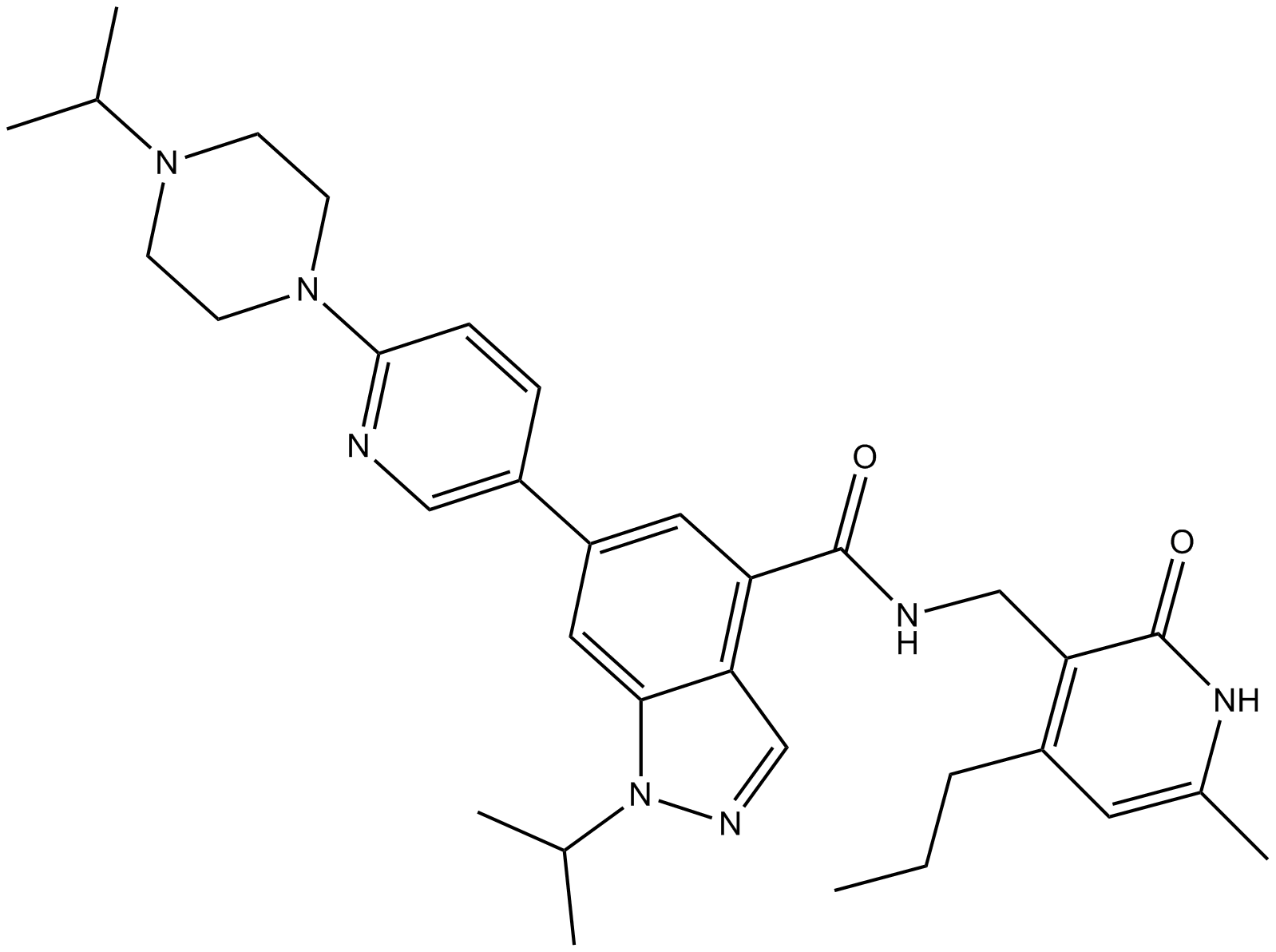
Cas No.: 1431612-23-5
Sample solution is provided at 25 µL, 10mM.
_1-3.$$$39978408@51.jpg');)
_1-9.$$$38538795@65.jpg');)
_1-9.$$$39112701@51.jpg');)
_1-7.$$$37316672@70.jpg');)
_366-372.$$$36198801@70.jpg');)
.$$$38565142@65.jpg');)
_1867-1883.$$$33248023@67.jpg');)
_eads6055.$$$39977546@45.jpg');)
_eadm9805.$$$40080571@45.jpg');)
_eadj3020.$$$39666821@45.jpg');)
_1-20.$$$39757301@28.jpg');)
_1-24.$$$38898113@28.jpg');)
_273-287.$$$36806353@46.jpg');)
_1-16.$$$37156877@44.jpg');)
_1-19.$$$37460805@44.jpg');)
_1291-1307.$$$34518654@46.jpg');)
UNC1999 est un inhibiteur active par voie orale d'EZH2 (IC50=2nM) et d'EZH1 (IC50=45nM)[1-2]. UNC1999 peut être utilisé pour étudier les mécanismes d'action de EZH2 et de EZH1 dans la régulation de l'expression génique, le développement du cancer et le maintien des cellules souches[3-4].
Le traitement in vitro avec UNC1999 (2.5–5μM) aux cellules de cancer colorectal humain (HCT116, LoVo, HCT-15, DLD-1) pendant 24 à 72 heures induit l'autophagie en augmentant la régulation de l'expression du gène LC3B au niveau transcriptionnel, active le stress du réticulum endoplasmique (RE) et la voie PERK/eIF2α de la réponse aux protéines non-repliées (UPR), favorisant finalement la mort des cellules tumorales[5]. Le traitement avec UNC1999 (0.1–100μM) aux lignées cellulaires de cancer de la vessie humaine E-J et 5637 pendant 24 à 120 heures a significativement inhibé la prolifération et la migration cellulaires, tout en induisant l'apoptose en supprimant l'activité de EZH2 et en bloquant la voie de signalisation JAK2/STAT3[6].
In vivo, l'injection intra-péritonéale de UNC1999 (15–25mg/kg) deux fois par semaine pendant 3 semaines chez les rats NOG porteurs de xénogreffes de myélome multiple humain MM.1S inhibe considérablement la croissance tumorale et prolonge la survie[7]. L'injection intra-péritonéale de UNC1999 (25mg/kg) deux fois par semaine pendant 4 semaines chez les rats nus BALB/c inoculés avec des cellules de rétinoblastome humain Y79 supprime significativement la croissance des tumeurs xénogreffées sous-cutanées[8].
References:
[1] Zhou C, He A, Kang Q, et al. Development of a UPLC-MS/MS method for determination of a dual EZH1/2 inhibitor UNC1999 in rat plasma. Bioanalysis. 2022 Jan;14(2):67-74.
[2] Xu B, On DM, Ma A, et al. Selective inhibition of EZH2 and EZH1 enzymatic activity by a small molecule suppresses MLL-rearranged leukemia. Blood. 2015 Jan 8;125(2):346-57.
[3] Shinno Y, Takenobu H, Sugino RP, et al. Polycomb EZH1 regulates cell cycle/5-fluorouracil sensitivity of neuroblastoma cells in concert with MYCN. Cancer Sci. 2022 Dec;113(12):4193-4206.
[4] Zhang Q, Deng X, Tang X, et al. MicroRNA-20a Suppresses Tumor Proliferation and Metastasis in Hepatocellular Carcinoma by Directly Targeting EZH1. Front Oncol. 2021 Dec 16;11:737986.
[5] Hsieh YY, Lo HL, Yang PM. EZH2 inhibitors transcriptionally upregulate cytotoxic autophagy and cytoprotective unfolded protein response in human colorectal cancer cells. Am J Cancer Res. 2016 Aug 1;6(8):1661-80.
[6] Chen Z, Du Y, Liu X, et al. EZH2 inhibition suppresses bladder cancer cell growth and metastasis via the JAK2/STAT3 signaling pathway. Oncol Lett. 2019 Jul;18(1):907-915.
[7] Rizq O, Mimura N, Oshima M, et al. Dual Inhibition of EZH2 and EZH1 Sensitizes PRC2-Dependent Tumors to Proteasome Inhibition. Clin Cancer Res. 2017 Aug 15;23(16):4817-4830. doi: 10.1158/1078-0432.CCR-16-2735.
[8] Zhao Y, Cheng Y, Qu Y. The role of EZH2 as a potential therapeutic target in retinoblastoma. Exp Eye Res. 2023 Feb;227:109389.
| Expériences cellulaires [1]: | |
Lignées cellulaires | Cellules E-J et 5637 (lignées cellulaires de cancer de la vessie humain) |
Méthode de préparation | Les cellules E-J et 5637 ont été maintenues dans un milieu RPMI 1640 supplémenté avec 10% de sérum bovin foetal (FBS) à 37°C et 5% CO₂. Les cellules ont été traitées avec l'inhibiteur EZH2 UNC1999 à des concentrations de 0.1, 1, 10, et 100µM pendant 24, 72, et 120 heures. |
Conditions de réaction | 0.1-100µM; 24-120h |
Domaines d'application | UNC1999 a inhibé significativement la prolifération des cellules de cancer de la vessie de manière dépendante de la dose et du temps. UNC1999 a entraîné une apoptose significative et supprimé la migration et l'invasion cellulaires. Sur le plan mécanistique, UNC1999 a réduit le niveau de phosphorylation de JAK2 et STAT3, indiquant l'inhibition de la voie de signalisation JAK2/STAT3. |
| Expériences animales [2]: | |
Modèles animaux | Rats nus BALB/c |
Méthode de préparation | Les cellules de rétinoblastome Y79 ont été injectées par voie sous-cutanée dans le flanc postérieur de rats féminins nus BALB/c. Après une semaine de croissance tumorale, les rats ont été aléatoirement divisés en deux groupes. Un groupe a été traité avec UNC1999 (25mg/kg, i.p.) deux fois par semaine pendant 3 semaines. Le groupe témoin a reçu des injections intra-péritonéales de véhicule (5% DMSO dans de l'huile de maïs). Le volume tumoral a été mesuré trois fois par semaine. Les rats ont été mesurés trois fois par semaine. Les rats ont été sacrifiés après 4 semaines, et les tumeurs ont été collectées pour des analyses complémentaires. |
Forme de dosage | 25mg/kg; i.p.; deux fois par semaine pendant 3 semaines |
Domaines d'application | L'administration de UNC1999 a inhibé significativement la croissance des tumeurs xénogreffées de rétinoblastome in vivo par rapport au groupe témoin de véhicule. Le traitement avec UNC1999 a réduit le niveau protéique de EZH2 et de STAT3 phosphorylé (pY-STAT3), tout en augmentant l'expression de FoxO1 dans les tumeurs excisées. |
References: | |
| Cas No. | 1431612-23-5 | SDF | |
| Chemical Name | N-[(6-methyl-2-oxo-4-propyl-1H-pyridin-3-yl)methyl]-1-propan-2-yl-6-[6-(4-propan-2-ylpiperazin-1-yl)pyridin-3-yl]indazole-4-carboxamide | ||
| Canonical SMILES | CCCC1=C(C(=O)NC(=C1)C)CNC(=O)C2=C3C=NN(C3=CC(=C2)C4=CN=C(C=C4)N5CCN(CC5)C(C)C)C(C)C | ||
| Formula | C33H43N7O2 | M.Wt | 569.74 |
| Solubility | ≥ 28.5mg/mL in DMSO | Storage | Store at -20° C |
| General tips | Please select the appropriate solvent to prepare the stock solution according to the
solubility of the product in different solvents; once the solution is prepared, please store it in
separate packages to avoid product failure caused by repeated freezing and thawing.Storage method
and period of the stock solution: When stored at -80°C, please use it within 6 months; when stored
at -20°C, please use it within 1 month. To increase solubility, heat the tube to 37°C and then oscillate in an ultrasonic bath for some time. |
||
| Shipping Condition | Evaluation sample solution: shipped with blue ice. All other sizes available: with RT, or with Blue Ice upon request. | ||
| Prepare stock solution | |||

|
1 mg | 5 mg | 10 mg |
| 1 mM | 1.7552 mL | 8.7759 mL | 17.5519 mL |
| 5 mM | 351 μL | 1.7552 mL | 3.5104 mL |
| 10 mM | 175.5 μL | 877.6 μL | 1.7552 mL |
Step 1: Enter information below (Recommended: An additional animal making an allowance for loss during the experiment)
 g
μL
g
μL
Step 2: Enter the in vivo formulation (This is only the calculator, not formulation. Please contact us first if there is no in vivo formulation at the solubility Section.)
Calculation results:
Working concentration: mg/ml;
Method for preparing DMSO master liquid: mg drug pre-dissolved in μL DMSO ( Master liquid concentration mg/mL, Please contact us first if the concentration exceeds the DMSO solubility of the batch of drug. )
Method for preparing in vivo formulation: Take μL DMSO master liquid, next addμL PEG300, mix and clarify, next addμL Tween 80, mix and clarify, next add μL saline, mix and clarify.
Method for preparing in vivo formulation: Take μL DMSO master liquid, next add μL Corn oil, mix and clarify.
Note: 1. Please make sure the liquid is clear before adding the next solvent.
2. Be sure to add the solvent(s) in order. You must ensure that the solution obtained, in the previous addition, is a clear solution before proceeding to add the next solvent. Physical methods such as vortex, ultrasound or hot water bath can be used to aid dissolving.
3. All of the above co-solvents are available for purchase on the GlpBio website.
Quality Control & SDS
- View current batch:
- Purity: >99.50% Appearance: A solid
- COA (Certificate of Analysis)
- SDS (Safety Data Sheet)
- Datasheet
Average Rating: 5 (Based on Reviews and 33 reference(s) in Google Scholar.)