

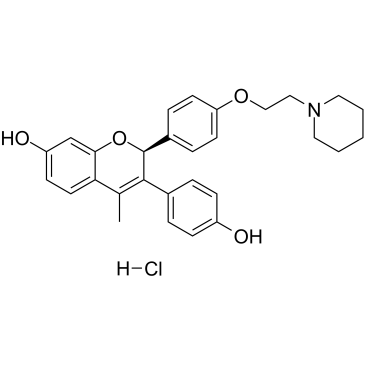
Acolbifene hydrochloride (Synonyms: EM-652 hydrochloride; SCH 57068 hydrochloride) |
カタログ番号GC61514
 One-Click Copy Product Info
|

EM800 の活性代謝物であるアコルビフェン (EM-652) 塩酸塩は、経口で活性な、がんを予防する選択的エストロゲン受容体モジュレーター (SERM) です。アコルビフェン (EM-652) 塩酸塩は、エストラジオール (E2) によって誘導される ERα (IC50=2 nM) および ERβ (IC50=0.4 nM) の転写活性を阻害します。アコルビフェン (EM-652) 塩酸塩は、乳腺と子宮で強力かつ純粋な抗エストロゲン作用を発揮します。抗発がん特性。
Products are for research use only. Not for human use. We do not sell to patients.
Cas No.: 252555-01-4
Sample solution is provided at 25 µL, 10mM.
_1-3.$$$39978408@51.jpg');)
_1-9.$$$38538795@65.jpg');)
_1-9.$$$39112701@51.jpg');)
_1-7.$$$37316672@70.jpg');)
_366-372.$$$36198801@70.jpg');)
.$$$38565142@65.jpg');)
_1867-1883.$$$33248023@67.jpg');)
_eads6055.$$$39977546@45.jpg');)
_eadm9805.$$$40080571@45.jpg');)
_eadj3020.$$$39666821@45.jpg');)
_1-20.$$$39757301@28.jpg');)
_1-24.$$$38898113@28.jpg');)
_273-287.$$$36806353@46.jpg');)
_1-16.$$$37156877@44.jpg');)
_1-19.$$$37460805@44.jpg');)
_1291-1307.$$$34518654@46.jpg');)
Acolbifene (EM-652) hydrochloride, the active metabolite of EM800, is an orally active pure antiestrogen and selective estrogen receptor antagonist with an IC50 of of 0.110 nM in T-47D cells. Acolbifene (EM-652) hydrochloride possesses potent and pure anticarcinogenic properties[1][2].
Acolbifene (ACOL) does not affect pathways of cholesterol synthesis, supporting the involvement of the clearance-related receptors in its hypocholesterolemic action[2].Acolbifene (EM-652) shows no agonistic activity on ERα and ERβ transcriptional function and blocks the estradiol (E2)-mediated activation of both ERα and ERβ[3].Acolbifene (EM-652) shows the most potent inhibition of estradiol-stimulated cell proliferation in human breast cancer cells (ZR-75-1, MCF-7, T-47D) and is devoid of any intrinsic estrogenic activity[4].
Acolbifene (ACOL) reduces food intake and strongly decreases cholesterolemia in rats fed a cholesterol-free diet[2].Acolbifene (ACOL) reduces food intake (16%) and weight gain (45%, mainly fat) similarly in both dietary cohorts[2]. Animal Model: Female Sprague-Dawley rats (n = 42) initially weighing 175-200 g[2].
[1]. Wang T, et al. Recent advances in selective estrogen receptor modulators for breast cancer. Mini Rev Med Chem. 2009 Sep;9(10):1191-201. [2]. Christian Lemieux, et al. The selective estrogen receptor modulator acolbifene reduces cholesterolemia independently of its anorectic action in control and cholesterol-fed rats. J Nutr. 2005 Sep;135(9):2225-9. [3]. A Tremblay, et al. EM-800, a novel antiestrogen, acts as a pure antagonist of the transcriptional functions of estrogen receptors alpha and beta. Endocrinology. 1998 Jan;139(1):111-8. [4]. Sylvain Gauthier, et al. Synthesis and structure-activity relationships of analogs of EM-652 (acolbifene), a pure selective estrogen receptor modulator. Study of nitrogen substitution. J Enzyme Inhib Med Chem. 2005 Apr;20(2):165-77.
| Cas No. | 252555-01-4 | SDF | |
| 同義語 | EM-652 hydrochloride; SCH 57068 hydrochloride | ||
| Canonical SMILES | OC1=CC=C2C(C)=C(C3=CC=C(O)C=C3)[C@H](C4=CC=C(OCCN5CCCCC5)C=C4)OC2=C1.[H]Cl | ||
| Formula | C29H32ClNO4 | M.Wt | 494.02 |
| 溶解度 | DMSO: 180 mg/mL (364.36 mM) | Storage | Store at -20°C |
| General tips | Please select the appropriate solvent to prepare the stock solution according to the
solubility of the product in different solvents; once the solution is prepared, please store it in
separate packages to avoid product failure caused by repeated freezing and thawing.Storage method
and period of the stock solution: When stored at -80°C, please use it within 6 months; when stored
at -20°C, please use it within 1 month. To increase solubility, heat the tube to 37°C and then oscillate in an ultrasonic bath for some time. |
||
| Shipping Condition | Evaluation sample solution: shipped with blue ice. All other sizes available: with RT, or with Blue Ice upon request. | ||
| Prepare stock solution | |||

|
1 mg | 5 mg | 10 mg |
| 1 mM | 2.0242 mL | 10.121 mL | 20.2421 mL |
| 5 mM | 404.8 μL | 2.0242 mL | 4.0484 mL |
| 10 mM | 202.4 μL | 1.0121 mL | 2.0242 mL |
Step 1: Enter information below (Recommended: An additional animal making an allowance for loss during the experiment)
 g
μL
g
μL
Step 2: Enter the in vivo formulation (This is only the calculator, not formulation. Please contact us first if there is no in vivo formulation at the solubility Section.)
Calculation results:
Working concentration: mg/ml;
Method for preparing DMSO master liquid: mg drug pre-dissolved in μL DMSO ( Master liquid concentration mg/mL, Please contact us first if the concentration exceeds the DMSO solubility of the batch of drug. )
Method for preparing in vivo formulation: Take μL DMSO master liquid, next addμL PEG300, mix and clarify, next addμL Tween 80, mix and clarify, next add μL saline, mix and clarify.
Method for preparing in vivo formulation: Take μL DMSO master liquid, next add μL Corn oil, mix and clarify.
Note: 1. Please make sure the liquid is clear before adding the next solvent.
2. Be sure to add the solvent(s) in order. You must ensure that the solution obtained, in the previous addition, is a clear solution before proceeding to add the next solvent. Physical methods such as vortex, ultrasound or hot water bath can be used to aid dissolving.
3. All of the above co-solvents are available for purchase on the GlpBio website.
Quality Control & SDS
- View current batch:
- Purity: >98.00% Appearance: A solid
- COA (Certificate of Analysis)
- SDS (Safety Data Sheet)
- Datasheet
Average Rating: 5 (Based on Reviews and 2 reference(s) in Google Scholar.)