

Cefdinir (Synonyms: BMY 28488, CI-983, FK-482) |
カタログ番号GC16083
 One-Click Copy Product Info
|

セフジニル (FK-482) は、セファロスポリン クラスの第 3 世代の半合成広域スペクトル抗生物質であり、いくつかのグラム陰性菌およびグラム陽性菌によって引き起こされる感染症に有効であることが証明されています。
Products are for research use only. Not for human use. We do not sell to patients.
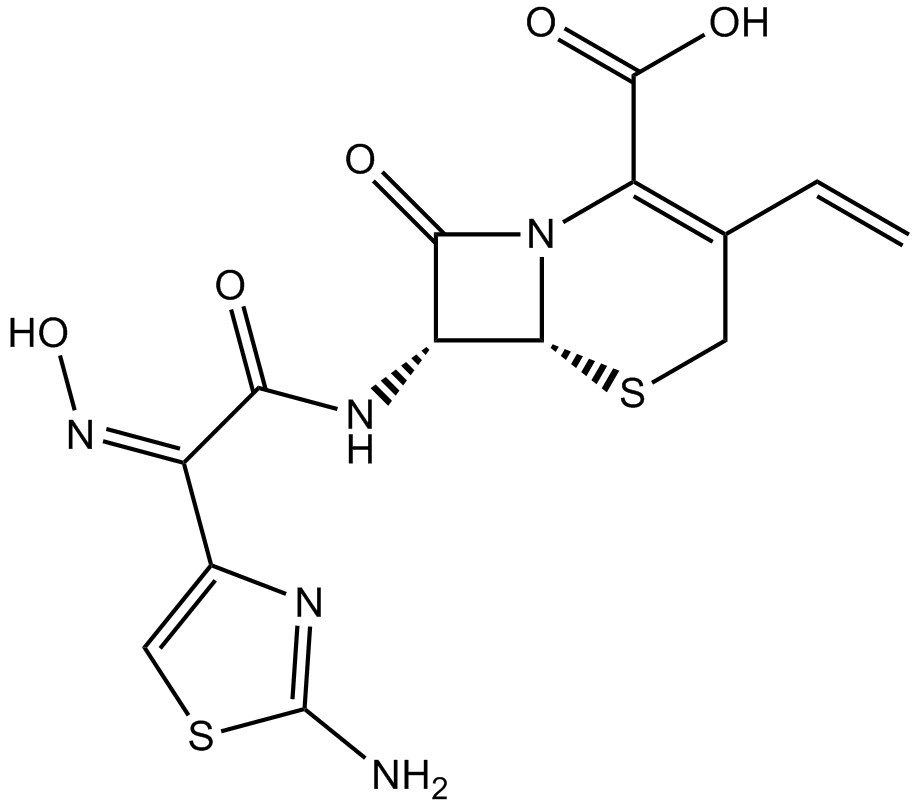
Cas No.: 91832-40-5
Sample solution is provided at 25 µL, 10mM.
_1-3.$$$39978408@51.jpg');)
_1-9.$$$38538795@65.jpg');)
_1-9.$$$39112701@51.jpg');)
_1-7.$$$37316672@70.jpg');)
_366-372.$$$36198801@70.jpg');)
.$$$38565142@65.jpg');)
_1867-1883.$$$33248023@67.jpg');)
_eads6055.$$$39977546@45.jpg');)
_eadm9805.$$$40080571@45.jpg');)
_eadj3020.$$$39666821@45.jpg');)
_1-20.$$$39757301@28.jpg');)
_1-24.$$$38898113@28.jpg');)
_273-287.$$$36806353@46.jpg');)
_1-16.$$$37156877@44.jpg');)
_1-19.$$$37460805@44.jpg');)
_1291-1307.$$$34518654@46.jpg');)
Cefdinir (FK-482) is a semi-synthetic, broad-spectrum antibiotic, which is proved to be effective for common bacterial infections of the ear, sinus, throat, and skin.
Cefdinir (FK-482) is a third generation oral cephalosporin antibiotic. Cefdinir (Omnicef) is a semi-synthetic, broad-spectrum antibiotic in the third generation of the cephalosporin class, which is proved to be effective for common bacterial infections of the ear, sinus, throat, and skin. It can be used to treat infections caused by several Gram-negative and Gram-positive bacteria. It is available in US as Omnicef by Abbott Laboratories and in India as Cednir by Abbott, Kefnir by Glenmark and Cefdiel by Ranbaxy. As of 2008, cefdinir was the highest-selling cephalosporin antibiotic in the United States, with more than US$585 million in retail sales of its generic versions alone[1]. Cefdinir (FK-482), a new oral 2-amino-5-thiazolyl cephalosporin, inhibited the luminol-amplified chemiluminescence (LACL) response of human neutrophils stimulated by PMA but not opsonized zymosan, in a concentration-dependent but not time-dependent manner. The LACL response to opsonized zymosan in cytochalasin B-treated neutrophils was, however, inhibited by cefdinir. Furthermore, cefdinir inhibited LACL generation in cell-free systems consisting of H2O2, NaI, and either horseradish peroxidase or a myeloperoxidase-containing neutrophil extract. Orthodianisidine oxidation in these two acellular systems was inhibited by cefdinir[2].
References:
[1]. Soejima R. Cefdinir. Jpn J Antibiot. 1992 Oct;45(10):1239-52.
[2]. Labro MT, et al. Cefdinir (CI-983), a new oral amino-2-thiazolyl cephalosporin, inhibits human neutrophil myeloperoxidase in the extracellular medium but not the phagolysosome. J Immunol. 1994 Mar 1;152(5):2447-55.
| Cas No. | 91832-40-5 | SDF | |
| 同義語 | BMY 28488, CI-983, FK-482 | ||
| Chemical Name | (6R,7R)-7-[[(2Z)-2-(2-amino-1,3-thiazol-4-yl)-2-hydroxyiminoacetyl]amino]-3-ethenyl-8-oxo-5-thia-1-azabicyclo[4.2.0]oct-2-ene-2-carboxylic acid | ||
| Canonical SMILES | C=CC1=C(N2C(C(C2=O)NC(=O)C(=NO)C3=CSC(=N3)N)SC1)C(=O)O | ||
| Formula | C14H13N5O5S2 | M.Wt | 395.41 |
| 溶解度 | ≥ 19.55mg/mL in DMSO | Storage | Store at -20°C |
| General tips | Please select the appropriate solvent to prepare the stock solution according to the
solubility of the product in different solvents; once the solution is prepared, please store it in
separate packages to avoid product failure caused by repeated freezing and thawing.Storage method
and period of the stock solution: When stored at -80°C, please use it within 6 months; when stored
at -20°C, please use it within 1 month. To increase solubility, heat the tube to 37°C and then oscillate in an ultrasonic bath for some time. |
||
| Shipping Condition | Evaluation sample solution: shipped with blue ice. All other sizes available: with RT, or with Blue Ice upon request. | ||
| Prepare stock solution | |||

|
1 mg | 5 mg | 10 mg |
| 1 mM | 2.529 mL | 12.6451 mL | 25.2902 mL |
| 5 mM | 505.8 μL | 2.529 mL | 5.058 mL |
| 10 mM | 252.9 μL | 1.2645 mL | 2.529 mL |
Step 1: Enter information below (Recommended: An additional animal making an allowance for loss during the experiment)
 g
μL
g
μL
Step 2: Enter the in vivo formulation (This is only the calculator, not formulation. Please contact us first if there is no in vivo formulation at the solubility Section.)
Calculation results:
Working concentration: mg/ml;
Method for preparing DMSO master liquid: mg drug pre-dissolved in μL DMSO ( Master liquid concentration mg/mL, Please contact us first if the concentration exceeds the DMSO solubility of the batch of drug. )
Method for preparing in vivo formulation: Take μL DMSO master liquid, next addμL PEG300, mix and clarify, next addμL Tween 80, mix and clarify, next add μL saline, mix and clarify.
Method for preparing in vivo formulation: Take μL DMSO master liquid, next add μL Corn oil, mix and clarify.
Note: 1. Please make sure the liquid is clear before adding the next solvent.
2. Be sure to add the solvent(s) in order. You must ensure that the solution obtained, in the previous addition, is a clear solution before proceeding to add the next solvent. Physical methods such as vortex, ultrasound or hot water bath can be used to aid dissolving.
3. All of the above co-solvents are available for purchase on the GlpBio website.
Quality Control & SDS
- View current batch:
- Purity: >99.50% Appearance: A solid
- COA (Certificate of Analysis)
- SDS (Safety Data Sheet)
- Datasheet
Average Rating: 5 (Based on Reviews and 13 reference(s) in Google Scholar.)