

Guanidinosuccinic acid (Synonyms: Guanidinosuccinic Acid, NSC 49078) |
カタログ番号GC31413
 One-Click Copy Product Info
|

グアニジノコハク酸は窒素代謝産物です。
Products are for research use only. Not for human use. We do not sell to patients.
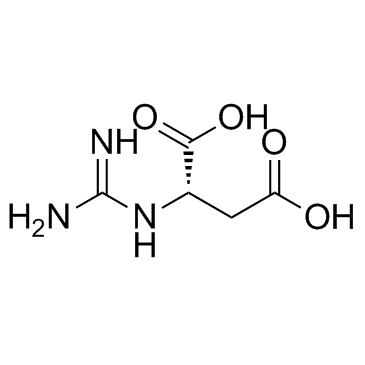
Cas No.: 6133-30-8
Sample solution is provided at 25 µL, 10mM.
_1-3.$$$39978408@51.jpg');)
_1-9.$$$38538795@65.jpg');)
_1-9.$$$39112701@51.jpg');)
_1-7.$$$37316672@70.jpg');)
_366-372.$$$36198801@70.jpg');)
.$$$38565142@65.jpg');)
_1867-1883.$$$33248023@67.jpg');)
_eads6055.$$$39977546@45.jpg');)
_eadm9805.$$$40080571@45.jpg');)
_eadj3020.$$$39666821@45.jpg');)
_1-20.$$$39757301@28.jpg');)
_1-24.$$$38898113@28.jpg');)
_273-287.$$$36806353@46.jpg');)
_1-16.$$$37156877@44.jpg');)
_1-19.$$$37460805@44.jpg');)
_1291-1307.$$$34518654@46.jpg');)
Guanidinosuccinic acid is a nitrogenous metabolite isolated in excess from serum and urine.
Guanidinosuccinic acid, a constituent of normal urine, is elevated in the urine and serum of azotemic patients[1]. Guanidinosuccinic acid (GSA), a guanidino compound found to be greatly increased in uremia, is administered by intraperitoneal (i.p.) injection to adult albino mice and to young mice 7, 14 and 21 days old. Epileptogenic and toxic properties are assessed and Guanidinosuccinic acid brain levels following i.p. injection ae determined. In adult mice, Guanidinosuccinic acid induces long-lasting generalized clonic and clonic-tonic convulsions in a dose-dependent manner with a CD50 (and 95% confidence interval) of 363 (287-458) mg/kg (n=35), and an LD50 of 579 (445-756) mg/kg. The CD50 of Guanidinosuccinic acid corresponded with a brain concentration of 56 nmol/g tissue. Electrocorticographic recording in five adult mice revealed epileptiform discharges (spikes, spike-waves, and polyspike-waves) which appeared concomitant with the convulsions, When young mice are i.p. injected with a (for adults) subconvulsive dose of Guanidinosuccinic acid (250 mg/kg), an age-dependent decrease is noted in Guanidinosuccinic acid-induced convulsions and in the resulting brain concentration[2].
[1]. Milstien S, et al. Role of intestinal microflora in the metabolism of guanidinosuccinic acid. J Bacteriol. 1973 May;114(2):641-4. [2]. D'Hooge R, et al. Behavioral toxicity of guanidinosuccinic acid in adult and young mice. Toxicol Lett. 1992 Dec;64-65 Spec No:773-7.
|
Animal experiment: |
Mice[2]Randomly bred Swiss mice (male and female, body weight 13-25 g for the first series of experiments) are housed under standard environmentally controlled conditions. For another series of experiments, young Swiss mice 7, 14 and 21 days old are used. Injections of Guanidinosuccinic acid suspensions are delivered in volumes of 0.1 mL per 10 g body weight, i.p. and in doses between 250 and 1000 mg/kg (5 mice per dose, in duplicate). After injection, the mice are put in individual cylindrical transparent cages and observed for 1 h (for 2 h in the case of the young mice). Both CD50 and LD50 are calculated by probit analysis or moving average interpolation[2]. |
|
References: [1]. Milstien S, et al. Role of intestinal microflora in the metabolism of guanidinosuccinic acid. J Bacteriol. 1973 May;114(2):641-4. |
|
| Cas No. | 6133-30-8 | SDF | |
| 同義語 | Guanidinosuccinic Acid, NSC 49078 | ||
| Canonical SMILES | O=C(O)C[C@@H](C(O)=O)NC(N)=N | ||
| Formula | C5H9N3O4 | M.Wt | 175.14 |
| 溶解度 | DMSO : 75 mg/mL (428.23 mM);Water : 6 mg/mL (34.26 mM) | Storage | Store at -20°C |
| General tips | Please select the appropriate solvent to prepare the stock solution according to the
solubility of the product in different solvents; once the solution is prepared, please store it in
separate packages to avoid product failure caused by repeated freezing and thawing.Storage method
and period of the stock solution: When stored at -80°C, please use it within 6 months; when stored
at -20°C, please use it within 1 month. To increase solubility, heat the tube to 37°C and then oscillate in an ultrasonic bath for some time. |
||
| Shipping Condition | Evaluation sample solution: shipped with blue ice. All other sizes available: with RT, or with Blue Ice upon request. | ||
| Prepare stock solution | |||

|
1 mg | 5 mg | 10 mg |
| 1 mM | 5.7097 mL | 28.5486 mL | 57.0972 mL |
| 5 mM | 1.1419 mL | 5.7097 mL | 11.4194 mL |
| 10 mM | 571 μL | 2.8549 mL | 5.7097 mL |
Step 1: Enter information below (Recommended: An additional animal making an allowance for loss during the experiment)
 g
μL
g
μL
Step 2: Enter the in vivo formulation (This is only the calculator, not formulation. Please contact us first if there is no in vivo formulation at the solubility Section.)
Calculation results:
Working concentration: mg/ml;
Method for preparing DMSO master liquid: mg drug pre-dissolved in μL DMSO ( Master liquid concentration mg/mL, Please contact us first if the concentration exceeds the DMSO solubility of the batch of drug. )
Method for preparing in vivo formulation: Take μL DMSO master liquid, next addμL PEG300, mix and clarify, next addμL Tween 80, mix and clarify, next add μL saline, mix and clarify.
Method for preparing in vivo formulation: Take μL DMSO master liquid, next add μL Corn oil, mix and clarify.
Note: 1. Please make sure the liquid is clear before adding the next solvent.
2. Be sure to add the solvent(s) in order. You must ensure that the solution obtained, in the previous addition, is a clear solution before proceeding to add the next solvent. Physical methods such as vortex, ultrasound or hot water bath can be used to aid dissolving.
3. All of the above co-solvents are available for purchase on the GlpBio website.
Quality Control & SDS
- View current batch:
- Purity: >97.00% Appearance: A solid
- COA (Certificate of Analysis)
- SDS (Safety Data Sheet)
- Datasheet
Average Rating: 5 (Based on Reviews and 30 reference(s) in Google Scholar.)