

Proguanil (Synonyms: Chlorguanide, Chloroguanide) |
カタログ番号GC32085
 One-Click Copy Product Info
|

抗マラリア薬のプロドラッグであるプログアニルは、活性代謝物であるシクログアニルに代謝されます。
Products are for research use only. Not for human use. We do not sell to patients.
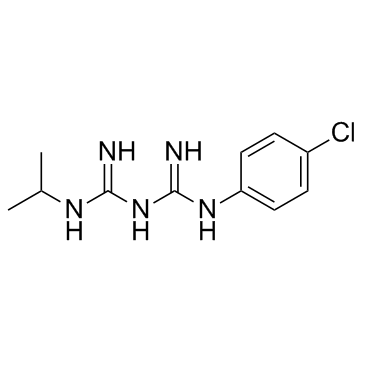
Cas No.: 500-92-5
Sample solution is provided at 25 µL, 10mM.
_1-3.$$$39978408@51.jpg');)
_1-9.$$$38538795@65.jpg');)
_1-9.$$$39112701@51.jpg');)
_1-7.$$$37316672@70.jpg');)
_366-372.$$$36198801@70.jpg');)
.$$$38565142@65.jpg');)
_1867-1883.$$$33248023@67.jpg');)
_eads6055.$$$39977546@45.jpg');)
_eadm9805.$$$40080571@45.jpg');)
_eadj3020.$$$39666821@45.jpg');)
_1-20.$$$39757301@28.jpg');)
_1-24.$$$38898113@28.jpg');)
_273-287.$$$36806353@46.jpg');)
_1-16.$$$37156877@44.jpg');)
_1-19.$$$37460805@44.jpg');)
_1291-1307.$$$34518654@46.jpg');)
Proguanil is an antimalarial prodrug that is metabolized to the active metabolite cycloguanil, a dihydrofolate reductase (DHFR) inhibitor.
Proguanil per se has only weak antimalarial activity in vitro (IC50=2.4-19 μM), and its effectiveness depends on the active metabolite cycloguanil (IC50=0.5-2.5 nM). The cycloguanil is a dihydrofolate reductase (DHFR) inhibitor. The combination of atovaquone and proguanil is synergistic in vitro. Both drugs also have activity against gametocytes and pre-erythrocytic (hepatic) stages of malaria parasites[1]. Proguanil acts as a biguanide rather than as its metabolite cycloguanil (a parasite dihydrofolate reductase [DHFR] inhibitor) to enhance the atovaquone effect; proguanil-mediated enhancement is specific for atovaquone, since the effects of other mitochondrial electron transport inhibitors, such as myxothiazole and antimycin, are not altered by inclusion of proguanil[2]. 5-HT3 receptor responses are reversibly inhibited by proguanil, the metabolite 4-chlorophenyl-1-biguanide (CPB) and the active metabolite cycloguanil (CG), with an IC50 of 1.81, 1.48 and 4.36 μM, respectively[3].
Proguanil could induce infertility in rats which may act by distorting the blood-testis barrier formed by the Sertoli cells. Duration dependent significant decrease in body and organ weights and also in sperm parameters is observed. Serum testosterone level is significantly decreased for proguanil treatment rats[4]. Administration of Malarone (atovaquone and proguanil) to experimentally B. gibsoni infected two dogs in chronic stage and three dogs in acute stage results in decrease in parasitemia, and clinical improvements are observed[5].
[1]. Pudney M, et al. Atovaquone and proguanil hydrochloride: a review of nonclinical studies. J Travel Med. 1999 May;6 Suppl 1:S8-12. [2]. Srivastava IK, et al. A mechanism for the synergistic antimalarial action of atovaquone and proguanil. Antimicrob Agents Chemother. 1999 Jun;43(6):1334-9. [3]. Lochner M, et al. The antimalarial drug proguanil is an antagonist at 5-HT3 receptors. J Pharmacol Exp Ther. 2014 Dec;351(3):674-84. [4]. Stephen AO, et al. Prolonged administration of proguanil induces reproductive toxicity in male rats. J Toxicol Sci. 2011 Oct;36(5):587-99. [5]. Iguchi A, et al. The in vitro interactions and in vivo efficacy of atovaquone and proguanil against Babesia gibsoni infection in dogs. Vet Parasitol. 2013 Nov 8;197(3-4):527-33.
|
Cell experiment: |
Sertoli cells obtained from sixteen to eighteen day-old-rats are cultured and treated with 0.3 μM to 10 μM of proguanil for 5 days after which Sertoli cell viability and nuclei integrity are determined. Also, the genetic expressions of transferrin and Glial cell line-derived neurotrophic factor are assessed[4]. |
|
Animal experiment: |
Rats: Groups of ten to twelve-week-old rats are administered proguanil (2.9 mg/kg body weight) daily for 5 days and 6 weeks respectively. Thereafter, body and reproductive organ weights are taken, sperm parameters are analyzed, while the histology of the testis and epididymis are carried out. Also, serum levels of testosterone, luteinizing hormone and follicle stimulating hormone are determined[4]. |
|
References: [1]. Pudney M, et al. Atovaquone and proguanil hydrochloride: a review of nonclinical studies. J Travel Med. 1999 May;6 Suppl 1:S8-12. |
|
| Cas No. | 500-92-5 | SDF | |
| 同義語 | Chlorguanide, Chloroguanide | ||
| Canonical SMILES | N=C(NC1=CC=C(Cl)C=C1)NC(NC(C)C)=N | ||
| Formula | C11H16ClN5 | M.Wt | 253.73 |
| 溶解度 | DMSO : ≥ 33 mg/mL (130.06 mM) | Storage | Store at -20°C, protect from light |
| General tips | Please select the appropriate solvent to prepare the stock solution according to the
solubility of the product in different solvents; once the solution is prepared, please store it in
separate packages to avoid product failure caused by repeated freezing and thawing.Storage method
and period of the stock solution: When stored at -80°C, please use it within 6 months; when stored
at -20°C, please use it within 1 month. To increase solubility, heat the tube to 37°C and then oscillate in an ultrasonic bath for some time. |
||
| Shipping Condition | Evaluation sample solution: shipped with blue ice. All other sizes available: with RT, or with Blue Ice upon request. | ||
| Prepare stock solution | |||

|
1 mg | 5 mg | 10 mg |
| 1 mM | 3.9412 mL | 19.706 mL | 39.412 mL |
| 5 mM | 788.2 μL | 3.9412 mL | 7.8824 mL |
| 10 mM | 394.1 μL | 1.9706 mL | 3.9412 mL |
Step 1: Enter information below (Recommended: An additional animal making an allowance for loss during the experiment)
 g
μL
g
μL
Step 2: Enter the in vivo formulation (This is only the calculator, not formulation. Please contact us first if there is no in vivo formulation at the solubility Section.)
Calculation results:
Working concentration: mg/ml;
Method for preparing DMSO master liquid: mg drug pre-dissolved in μL DMSO ( Master liquid concentration mg/mL, Please contact us first if the concentration exceeds the DMSO solubility of the batch of drug. )
Method for preparing in vivo formulation: Take μL DMSO master liquid, next addμL PEG300, mix and clarify, next addμL Tween 80, mix and clarify, next add μL saline, mix and clarify.
Method for preparing in vivo formulation: Take μL DMSO master liquid, next add μL Corn oil, mix and clarify.
Note: 1. Please make sure the liquid is clear before adding the next solvent.
2. Be sure to add the solvent(s) in order. You must ensure that the solution obtained, in the previous addition, is a clear solution before proceeding to add the next solvent. Physical methods such as vortex, ultrasound or hot water bath can be used to aid dissolving.
3. All of the above co-solvents are available for purchase on the GlpBio website.
Quality Control & SDS
- View current batch:
- Purity: >98.00% Appearance: A solid
- COA (Certificate of Analysis)
- SDS (Safety Data Sheet)
- Datasheet
Average Rating: 5 (Based on Reviews and 27 reference(s) in Google Scholar.)