

3-arylisoquinolinamine derivative |
Catalog No.GC33084
 One-Click Copy Product Info
|

3-아릴이소퀴놀린아민 유도체는 항종양 활성이 있는 3-아릴이소퀴놀린아민 유도체입니다.
Products are for research use only. Not for human use. We do not sell to patients.
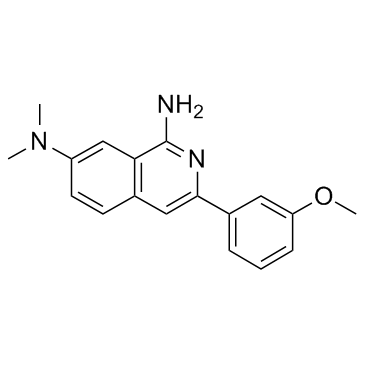
Cas No.: 1029008-71-6
Sample solution is provided at 25 µL, 10mM.
_1-3.$$$39978408@51.jpg');)
_1-9.$$$38538795@65.jpg');)
_1-9.$$$39112701@51.jpg');)
_1-7.$$$37316672@70.jpg');)
_366-372.$$$36198801@70.jpg');)
.$$$38565142@65.jpg');)
_1867-1883.$$$33248023@67.jpg');)
_eads6055.$$$39977546@45.jpg');)
_eadm9805.$$$40080571@45.jpg');)
_eadj3020.$$$39666821@45.jpg');)
_1-20.$$$39757301@28.jpg');)
_1-24.$$$38898113@28.jpg');)
_273-287.$$$36806353@46.jpg');)
_1-16.$$$37156877@44.jpg');)
_1-19.$$$37460805@44.jpg');)
_1291-1307.$$$34518654@46.jpg');)
3-arylisoquinolinamine derivative is a 3-arylisoquinolinamine derivative with antitumor activity.
3-arylisoquinolinamine derivative is a 3-arylisoquinolinamine derivative, extracted from the reference[1], compound 7b.3-arylisoquinolinamine derivative (7b) shows more effective activity against Paclitaxel-resistant HCT-15 human colorectal cancer cell lines when compared to the original cytotoxic cancer drug, Paclitaxel. The cell cycle dynamics is analyzed by flow cytometry. Treatment of human HCT-15 cells with 3-arylisoquinolinamine derivative (7b) blocks or delays the progression of cells from G0/G1 phase into S phase, and induces cell death. Treatment with 3-arylisoquinolinamine derivative (7b) also significantly inhibits the growth of tumors and enhances tumor regression in a Paclitaxel-resistant HCT-15 xenograft model. 3-arylisoquinolinamine derivative (7b) inhibits the cell growth at IC50 value ranges from 14 nM to 32 nM in the human cancer cells tested. In cell cycle analysis using HCT-15 cells, treatment of 1 nM of 3-arylisoquinolinamine derivative (7b) displays a significant increase in G0/G1 phase at 24 h with a decrease in G2/M phase, but the increase of G0/G1 phase at 48 h is not significant. At higher concentration of 3-arylisoquinolinamine derivative (7b) (10 nM), there are a significant increase in G0/G1 phase and decrease in G2/M phase, and an emergence of sub-G1phase, at both 24 h and 48 h. 3-arylisoquinolinamine derivative (7b) blocks or delays the progression of cells from G0/G1 phase into S phase, and induces cell death[1]. 3-arylisoquinolinamine derivative is a 3-arylisoquinolinamine derivative, extracted from the reference[1], compound 13. 3-arylisoquinolinamine derivative (compound 13) is tested in colon cancer cells and its antitumor activity is compared with Paclitaxel. 3-arylisoquinolinamine derivative (IC50: 15 nM in HCT-15 cells, 17 nM in HCT116 cells) shows potent antiproliferative activities with IC50 value in the low nanomolar range in both cells and higher antitumor activities than that of Paclitaxel against Paclitaxel-resistant HCT-15 colorectal cancer cells[2].
3-arylisoquinolinamine derivative (Compound 13) has higher antitumor efficacy (69.2 % inhibition) than that of the control drug, Paclitaxel (48.8 % inhibition) in the inhibition of growth of tumor in an animal model[2].
[1]. Yang SH, et al. Synthesis, in vitro and in vivo evaluation of 3-arylisoquinolinamines as potent antitumor agents. Bioorg Med Chem Lett. 2010 Sep 1;20(17):5277-81. [2]. Young Bok Lee, et al. 5, 6, or 7-substituted-s- (hetero)arylisoquinolinamine derivatives as antitumor agents. WO 2008063548 A2.
Animal experiment: | Mice[2]The six-week-old female athymic mice (BALB/c nu/nu) are used. All study medications (vehicle control, Paclitaxel: 10 mg/kg/day, 3-arylisoquinolinamine derivative: 10 mg/kg/day) are given by intraperitoneal injections three times per week starting from day 10 and ending on day 29 after inoculation of HCT 15 cells. To quantify tumor growth, three perpendicular diameters of the tumors are measured with calipers every 3-5 days, and the body weight of the mice was monitored for toxicity. The tumor volume is calculated[2]. |
References: [1]. Yang SH, et al. Synthesis, in vitro and in vivo evaluation of 3-arylisoquinolinamines as potent antitumor agents. Bioorg Med Chem Lett. 2010 Sep 1;20(17):5277-81. | |
| Cas No. | 1029008-71-6 | SDF | |
| Canonical SMILES | NC1=NC(C2=CC=CC(OC)=C2)=CC(C=C3)=C1C=C3N(C)C | ||
| Formula | C18H19N3O | M.Wt | 293.36 |
| Solubility | DMSO : ≥ 50 mg/mL (170.44 mM);Water : < 0.1 mg/mL (insoluble) | Storage | Store at -20°C |
| General tips | Please select the appropriate solvent to prepare the stock solution according to the
solubility of the product in different solvents; once the solution is prepared, please store it in
separate packages to avoid product failure caused by repeated freezing and thawing.Storage method
and period of the stock solution: When stored at -80°C, please use it within 6 months; when stored
at -20°C, please use it within 1 month. To increase solubility, heat the tube to 37°C and then oscillate in an ultrasonic bath for some time. |
||
| Shipping Condition | Evaluation sample solution: shipped with blue ice. All other sizes available: with RT, or with Blue Ice upon request. | ||
| Prepare stock solution | |||

|
1 mg | 5 mg | 10 mg |
| 1 mM | 3.4088 mL | 17.0439 mL | 34.0878 mL |
| 5 mM | 681.8 μL | 3.4088 mL | 6.8176 mL |
| 10 mM | 340.9 μL | 1.7044 mL | 3.4088 mL |
Step 1: Enter information below (Recommended: An additional animal making an allowance for loss during the experiment)
 g
μL
g
μL
Step 2: Enter the in vivo formulation (This is only the calculator, not formulation. Please contact us first if there is no in vivo formulation at the solubility Section.)
Calculation results:
Working concentration: mg/ml;
Method for preparing DMSO master liquid: mg drug pre-dissolved in μL DMSO ( Master liquid concentration mg/mL, Please contact us first if the concentration exceeds the DMSO solubility of the batch of drug. )
Method for preparing in vivo formulation: Take μL DMSO master liquid, next addμL PEG300, mix and clarify, next addμL Tween 80, mix and clarify, next add μL saline, mix and clarify.
Method for preparing in vivo formulation: Take μL DMSO master liquid, next add μL Corn oil, mix and clarify.
Note: 1. Please make sure the liquid is clear before adding the next solvent.
2. Be sure to add the solvent(s) in order. You must ensure that the solution obtained, in the previous addition, is a clear solution before proceeding to add the next solvent. Physical methods such as vortex, ultrasound or hot water bath can be used to aid dissolving.
3. All of the above co-solvents are available for purchase on the GlpBio website.
Quality Control & SDS
- View current batch:
- Purity: >99.00% Appearance: A solid
- COA (Certificate of Analysis)
- SDS (Safety Data Sheet)
- Datasheet
Average Rating: 5 (Based on Reviews and 23 reference(s) in Google Scholar.)