
Asapiprant (S-555739) (Synonyms: S-555739) |
| Catalog No.GC31702 |
Asapiprant(S-555739)는 Ki가 0.44nM인 강력하고 선택적인 DP1 수용체 길항제입니다.
Products are for research use only. Not for human use. We do not sell to patients.
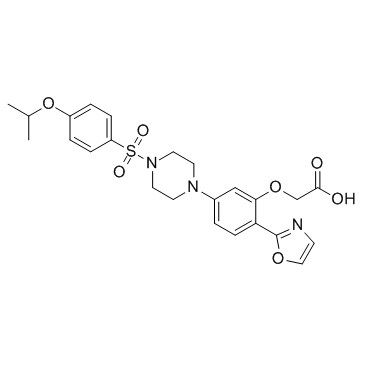
Cas No.: 932372-01-5
Sample solution is provided at 25 µL, 10mM.
Asapiprant is a potent and selective DP1 receptor antagonist with a Ki of 0.44 nM.
Oral administration of Asapiprant to sheep at 1 and 3 mg/kg significantly (P<0.01) suppresses the increase in nasal resistance by 82% and 92%, respectively. Oral administration of Asapiprant to sheep at 5 mg/kg suppresses Prostaglandin (PG) D2 (PGD)2-induced nasal resistance by 86%. When orally administered 1 h before the antigen challenge in pigs, Asapiprant (3, 10, and 30 mg/kg) suppresses immediate airway response (IAR) by 52%, 57%, and 96%, and late airway response (LAR) by 67%, 50%, and 79%, respectively. Orally administered with Asapiprant (5 mg/kg) for 4 days, the Asapiprant significantly (P<0.01) suppresses antigen-induced nasal resistance by 73% in sheep. Treatment with 3 and 30 mg/kg of Asapiprant in pigs significantly (P<0.01) suppresses nasal secretion by 53% and 72%, respectively. Treatment with Asapiprant in rats at 10 mg/kg significantly (P<0.05) reduces airway hyper-responsiveness (AHR), infiltration of inflammatory cells, and mucin production in bronchoalveolar lavage fluid (BALF), although treatment with Asapiprant at 0.1 mg/kg does not have a significant effect on any responses[1].
[1]. Takahashi G, et al. Effect of the potent and selective DP1 receptor antagonist, asapiprant (S-555739), in animal models of allergic rhinitis and allergic asthma. Eur J Pharmacol. 2015 Oct 15;765:15-23.

Animal experiment: | Male Hartley guinea pigs (300 to 400 g) and male brown Norway rats (240 to 400 g) are used in this study. The guinea pigs and rats are housed in an air-conditioned room at 20 to 26°C with a relative humidity of 30 to 70%, and are fed standard laboratory chow and given water ad libitum. Female sheep (32 to 46 kg) naturally sensitive to ascaris suum antigen are also used. After the oral administration of Asapiprant to rats, guinea pigs, and sheep at 10 mg/kg in suspension with 0.5% methylcellulose solution, the plasma concentrations of the drugs are measured[1]. |
References: [1]. Takahashi G, et al. Effect of the potent and selective DP1 receptor antagonist, asapiprant (S-555739), in animal models of allergic rhinitis and allergic asthma. Eur J Pharmacol. 2015 Oct 15;765:15-23. | |
| Cas No. | 932372-01-5 | SDF | |
| Synonyms | S-555739 | ||
| Canonical SMILES | O=C(O)COC1=CC(N2CCN(S(=O)(C3=CC=C(OC(C)C)C=C3)=O)CC2)=CC=C1C4=NC=CO4 | ||
| Formula | C24H27N3O7S | M.Wt | 501.55 |
| Solubility | DMSO : 11.11 mg/mL (22.15 mM) | Storage | Store at -20°C |
| General tips | Please select the appropriate solvent to prepare the stock solution according to the
solubility of the product in different solvents; once the solution is prepared, please store it in
separate packages to avoid product failure caused by repeated freezing and thawing.Storage method
and period of the stock solution: When stored at -80°C, please use it within 6 months; when stored
at -20°C, please use it within 1 month. To increase solubility, heat the tube to 37°C and then oscillate in an ultrasonic bath for some time. |
||
| Shipping Condition | Evaluation sample solution: shipped with blue ice. All other sizes available: with RT, or with Blue Ice upon request. | ||
| Prepare stock solution | |||
|
1 mg | 5 mg | 10 mg |
| 1 mM | 1.9938 mL | 9.9691 mL | 19.9382 mL |
| 5 mM | 398.8 μL | 1.9938 mL | 3.9876 mL |
| 10 mM | 199.4 μL | 996.9 μL | 1.9938 mL |
Step 1: Enter information below (Recommended: An additional animal making an allowance for loss during the experiment)
Step 2: Enter the in vivo formulation (This is only the calculator, not formulation. Please contact us first if there is no in vivo formulation at the solubility Section.)
Calculation results:
Working concentration: mg/ml;
Method for preparing DMSO master liquid: mg drug pre-dissolved in μL DMSO ( Master liquid concentration mg/mL, Please contact us first if the concentration exceeds the DMSO solubility of the batch of drug. )
Method for preparing in vivo formulation: Take μL DMSO master liquid, next addμL PEG300, mix and clarify, next addμL Tween 80, mix and clarify, next add μL ddH2O, mix and clarify.
Method for preparing in vivo formulation: Take μL DMSO master liquid, next add μL Corn oil, mix and clarify.
Note: 1. Please make sure the liquid is clear before adding the next solvent.
2. Be sure to add the solvent(s) in order. You must ensure that the solution obtained, in the previous addition, is a clear solution before proceeding to add the next solvent. Physical methods such as vortex, ultrasound or hot water bath can be used to aid dissolving.
3. All of the above co-solvents are available for purchase on the GlpBio website.
Quality Control & SDS
- View current batch:
- Purity: >99.50%
- COA (Certificate Of Analysis)
- SDS (Safety Data Sheet)
- Datasheet
Average Rating: 5 (Based on Reviews and 18 reference(s) in Google Scholar.)
GLPBIO products are for RESEARCH USE ONLY. Please make sure your review or question is research based.
Required fields are marked with *


