
CH5183284 (Debio-1347) (Synonyms: Debio 1347) |
| Catalog No.GC10759 |
CH5183284(Debio-1347)(Debio 1347)는 FGFR1, FGFR2, FGFR3 및 FGFR4에 대해 각각 9.3, 7.6 및 22nM의 IC50을 갖는 경구 이용 가능한 선택적 FGFR 억제제입니다.
Products are for research use only. Not for human use. We do not sell to patients.
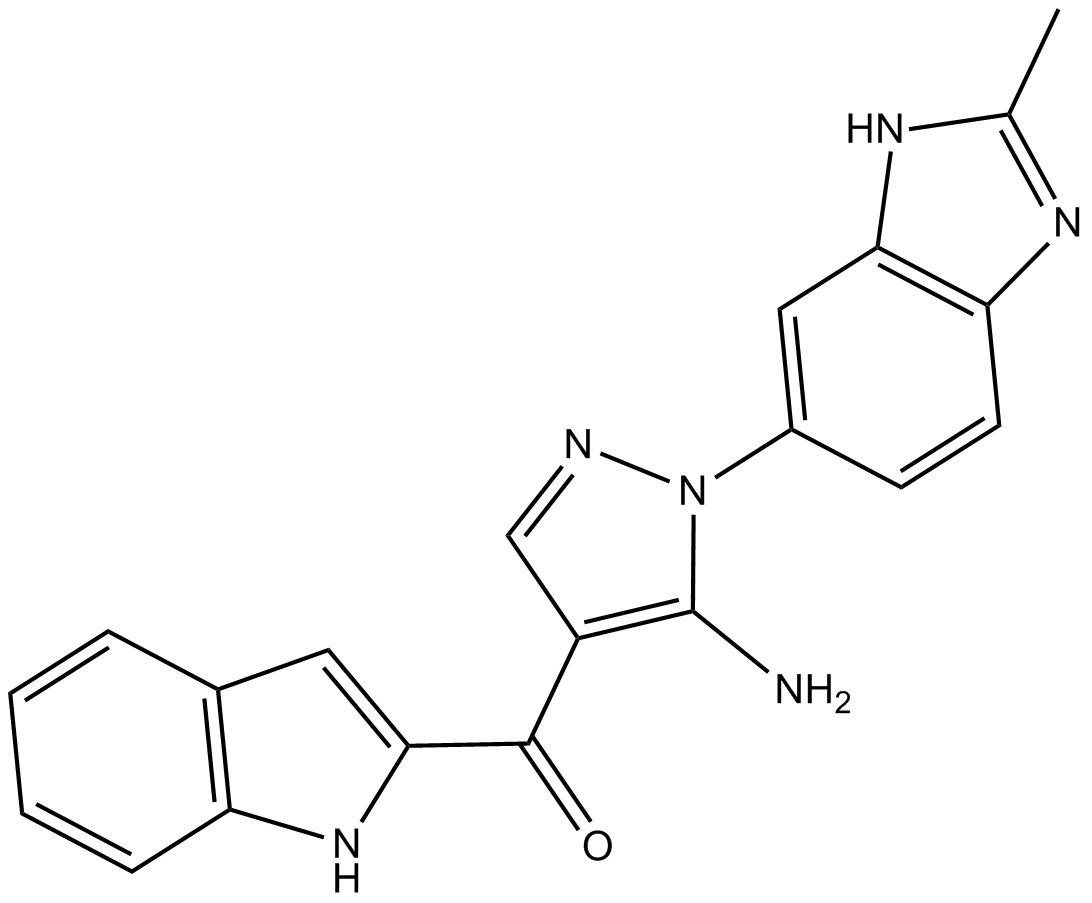
Cas No.: 1265229-25-1
Sample solution is provided at 25 µL, 10mM.
CH5183284 (Debio-1347) is a selective and novel inhibitor of FGFR with IC50 value of 9.3, 7.6, 22 and 290 nM for FGFR1, FGFR2, FGFR3 and FGFR4, respectively [1].
Fibroblast growth factor receptors (FGFRs) are tyrosine kinases and receptors for fibroblast growth factors and consist of FGFR1, FGFR2, FGFR3 and FGFR4. In cancer, FGFR is activated by point mutations, gene amplification or chromosomal translocations/rearrangements and is involved in angiogenesis, cell growth, cell migration, invasion and metastasis [1].
CH5183284 (Debio-1347) is a selective and novel FGFR inhibitor. In a competitive binding assay, CH5183284 (Debio-1347) binding with FGFR1, FGFR2, FGFR3, FGFR4 and KDR with Kd values of 20, 20, 25, 740 and 960 nM, respectively. In DMS114, SNU-16 and KMS11 cell lines, CH5183284 (Debio-1347) (100-300 nM) inhibited autophosphorylation of FGFR1, FGFR2 and FGFR3. In cancer cell lines with the FGFR genetic alterations, CH5183284 (Debio-1347) showed antiproliferative activity [1].
In xenograft mouse models, CH5183284 (Debio-1347) inhibited tumor growth against xenografts with FGFR genetic alterations such as KG1 (leukemia, FGFR1OP-FGFR1 fusion), MFE-280 (endometrial cancer, FGFR2 S252W mutation), SNU-16 (gastric cancer, FGFR2 amplification), RT112/84 (bladder cancer, FGFR3-TACC3 fusion) and UM-UC-14 (bladder cancer, FGFR3 S249C mutation) by 134%, 100%, 147%, 125% and 116%, respectively [1].
Reference:
[1]. Nakanishi Y, Akiyama N, Tsukaguchi T, et al. The fibroblast growth factor receptor genetic status as a potential predictor of the sensitivity to CH5183284/Debio 1347, a novel selective FGFR inhibitor. Mol Cancer Ther, 2014, 13(11): 2547-2558.

| Kinase experiment [1]: | |
|
Protein kinase assay |
The inhibitory activity of CH5183284/Debio 1347 against FGFR1 was evaluated using a radiometric filter assay by measuring the incorporation of 33Pi with a microplate scintillation counter. The phosphorylation activities of LCK, EGFR, KIT, MET, SRC, BRK, FGFR2, Flt3, LTK, INSR, YES, ABL, EPHA2, ZAP70, Fyn, IGF1R, KDR and PDGFR on substrate peptides were determined by homogeneous time-resolved fluorescence assay with LANCE Eu-W1024 labeled anti-phosphotyrosine PT66 antibody according to standard methods. Time-resolved fluorescence was measured with an EnVision HTS microplate reader. The activities of Aurora A, Akt1/PKBα, PKA, Cdk1/cyclin B, Cdk2/cyclin A, PKCα, PKCβ1 and PKCβ2 on substrate peptides were determined by IMAP FP Screening Express Progressive Binding System. Fluorescence polarization was measured with an EnVision HTS microplate reader. |
| Cell experiment [1]: | |
|
Cell lines |
327 human tumor cell lines |
|
Preparation method |
The solubility of this compound in DMSO is > 17.8 mg/mL. General tips for obtaining a higher concentration: Please warm the tube at 37 °C for 10 minutes and/or shake it in the ultrasonic bath for a while. Stock solution can be stored below - 20 °C for several months. |
|
Reacting condition |
0.076 ~ 10,000 nM; 4 days |
|
Applications |
In DMS114 (FGFR1 amplification), SNU-16 (FGFR2 amplification) and KMS11 [t(4;14) translocation and FGFR3 Y373C mutation] cells, CH5183284 inhibited autophosphorylation of FGFR1, FGFR2 and FGFR3 at the dose range of 100 ~ 300 nM. Thus, CH5183284 selectively inhibited proliferation of cancer cell lines with genetic alterations in FGFR. In addition, CH5183284 also inhibited FGFR2-harboring cancer cells with V564F mutation which are resistant to other FGFR inhibitors. |
| Animal experiment [1]: | |
|
Animal models |
Mice bearing KG1, MFE280, SNU-16, RT112/84 or UM-UC-14 xenografts |
|
Dosage form |
100 mg/kg/day; p.o. |
|
Applications |
CH5183284 exhibited selective and significant antitumor activities against various xenografts with FGFR genetic alterations such as KG1 (leukemia, FGFR1OP-FGFR1 fusion), MFE-280 (endometrial cancer, FGFR2 S252W mutation), SNU-16 (gastric cancer, FGFR2 amplification), RT112/84 (bladder cancer, FGFR3-TACC3 fusion) and UM-UC-14 (bladder cancer, FGFR3 S249C mutation). |
|
Other notes |
Please test the solubility of all compounds indoor, and the actual solubility may slightly differ with the theoretical value. This is caused by an experimental system error and it is normal. |
|
References: [1]. Nakanishi Y, Akiyama N, Tsukaguchi T, et al. The fibroblast growth factor receptor genetic status as a potential predictor of the sensitivity to CH5183284/Debio 1347, a novel selective FGFR inhibitor. Mol Cancer Ther, 2014, 13(11): 2547-2558. | |
| Cas No. | 1265229-25-1 | SDF | |
| Synonyms | Debio 1347 | ||
| Canonical SMILES | CC1=NC(C=C2)=C(N1)C=C2N3N=CC(C(C(N4)=CC5=C4C=CC=C5)=O)=C3N | ||
| Formula | C20H16N6O | M.Wt | 356.38 |
| Solubility | ≥ 35.6mg/mL in DMSO | Storage | Store at -20°C |
| General tips | Please select the appropriate solvent to prepare the stock solution according to the
solubility of the product in different solvents; once the solution is prepared, please store it in
separate packages to avoid product failure caused by repeated freezing and thawing.Storage method
and period of the stock solution: When stored at -80°C, please use it within 6 months; when stored
at -20°C, please use it within 1 month. To increase solubility, heat the tube to 37°C and then oscillate in an ultrasonic bath for some time. |
||
| Shipping Condition | Evaluation sample solution: shipped with blue ice. All other sizes available: with RT, or with Blue Ice upon request. | ||
| Prepare stock solution | |||
|
1 mg | 5 mg | 10 mg |
| 1 mM | 2.806 mL | 14.03 mL | 28.0599 mL |
| 5 mM | 561.2 μL | 2.806 mL | 5.612 mL |
| 10 mM | 280.6 μL | 1.403 mL | 2.806 mL |
Step 1: Enter information below (Recommended: An additional animal making an allowance for loss during the experiment)
Step 2: Enter the in vivo formulation (This is only the calculator, not formulation. Please contact us first if there is no in vivo formulation at the solubility Section.)
Calculation results:
Working concentration: mg/ml;
Method for preparing DMSO master liquid: mg drug pre-dissolved in μL DMSO ( Master liquid concentration mg/mL, Please contact us first if the concentration exceeds the DMSO solubility of the batch of drug. )
Method for preparing in vivo formulation: Take μL DMSO master liquid, next addμL PEG300, mix and clarify, next addμL Tween 80, mix and clarify, next add μL ddH2O, mix and clarify.
Method for preparing in vivo formulation: Take μL DMSO master liquid, next add μL Corn oil, mix and clarify.
Note: 1. Please make sure the liquid is clear before adding the next solvent.
2. Be sure to add the solvent(s) in order. You must ensure that the solution obtained, in the previous addition, is a clear solution before proceeding to add the next solvent. Physical methods such as vortex, ultrasound or hot water bath can be used to aid dissolving.
3. All of the above co-solvents are available for purchase on the GlpBio website.
Quality Control & SDS
- View current batch:
- Purity: >99.00%
- COA (Certificate Of Analysis)
- SDS (Safety Data Sheet)
- Datasheet
Average Rating: 5 (Based on Reviews and 14 reference(s) in Google Scholar.)
GLPBIO products are for RESEARCH USE ONLY. Please make sure your review or question is research based.
Required fields are marked with *


