

DMP 696 |
Catalog No.GC31030
 One-Click Copy Product Info
|

DMP 696은 불안과 우울증의 치료에 사용되는 선택적 코르티코트로핀 방출 호르몬 수용체 1(CRHR1) 길항제입니다.
Products are for research use only. Not for human use. We do not sell to patients.
Cas No.: 202578-52-7
Sample solution is provided at 25 µL, 10mM.
_1-3.$$$39978408@51.jpg');)
_1-9.$$$38538795@65.jpg');)
_1-9.$$$39112701@51.jpg');)
_1-7.$$$37316672@70.jpg');)
_366-372.$$$36198801@70.jpg');)
.$$$38565142@65.jpg');)
_1867-1883.$$$33248023@67.jpg');)
_eads6055.$$$39977546@45.jpg');)
_eadm9805.$$$40080571@45.jpg');)
_eadj3020.$$$39666821@45.jpg');)
_1-20.$$$39757301@28.jpg');)
_1-24.$$$38898113@28.jpg');)
_273-287.$$$36806353@46.jpg');)
_1-16.$$$37156877@44.jpg');)
_1-19.$$$37460805@44.jpg');)
_1291-1307.$$$34518654@46.jpg');)
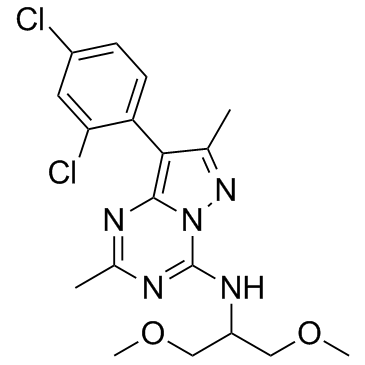
DMP 696 is a selective corticotropin-releasing hormone receptor 1 (CRHR1) antagonist. DMP 696 displays high affinity for CRHR1, with Ki values of 3.3nM for the human cloned receptor and 4.6nM for the rat cortical receptor. Functionally, DMP 696 inhibits cAMP accumulation and Adrenocorticotropic Hormone (ACTH) release with IC₅₀ values of 83nM and 59nM, respectively. DMP 696 has potential therapeutic applications for anxiety and depression, with a low risk of behavioral side effects[1][2].
In vivo, an oral dose of 10mg/kg DMP 696 in rats produce over 90% brain CRHR1 occupancy, which peaks at 90min postdosing and cleared from brain receptor occupancy by 22h after administration[3]. DMP 696 (1-30mg/kg; 1h pretreatment; p.o.) significantly increased the duration of contextual freezing (a stationary posture characterized by cessation of movement except that required for respiration) in a dose dependent manner in conditioned fear test[3]. DMP 696 (10mg/kg; 1h pretreatment; p.o.) exhibited a significant overall reduction in cAMP response element-binding protein phosphorylation (pCREB), in both the Lateral nucleus of the amygdala (LA) and Basolateral Amygdala (BLA), but not in the Central nucleus of the Amygdala (CeA)[3]. In C57BL/6N mice, administration of DMP 696 (3mg/kg/d; p.o.; 7d) starting as late as 24 hours after foot-shock exposure attenuates the consolidation of remote fear memory, without affecting its expression or retention[1].
References:
[1] Thoeringer, Christoph K et al. “Consolidation of remote fear memories involves Corticotropin-Releasing Hormone (CRH) receptor type 1-mediated enhancement of AMPA receptor GluR1 signaling in the dentate gyrus.” Neuropsychopharmacology : official publication of the American College of Neuropsychopharmacology vol. 37,3 (2012): 787-96.
[2] Li YW, Fitzgerald L, Wong H, et al. The pharmacology of DMP696 and DMP904, non-peptidergic CRF1 receptor antagonists. CNS Drug Rev. 2005;11(1):21-52.
[3] Hubbard DT, Nakashima BR, Lee I, Takahashi LK. Activation of basolateral amygdala corticotropin-releasing factor 1 receptors modulates the consolidation of contextual fear. Neuroscience. 2007;150(4):818-828.
| Animal experiment [1]: | |
Animal models | C57BL/6N mice |
Preparation Method | DMP 696 was dissolved in saccharose-flavored NaCl 0.9% containing 10% DMSO, 10% PEG 400, and Tween-80 (1drop/ml). DMP 696 suspension was delivered on an oat flakeand then fed to animals at a final dose of 3mg/kg. Control sreceived an oat flake soaked with saccharose-flavored vehicle only. Treated C57BL/6N mice with the specific DMP 696 at different time points after foot shock |
Dosage form | 3mg/kg; p.o.; twice daily |
Applications | Acute administration of DMP696 1h before testing did not affect the expression ofsensitized fear 28 days after trauma. Administration of DMP 696 for 1 week starting either immediately or 24h after foot shock delivery resulted in a significant reduction of remote, trauma-related fear as assessed 21 days later. Treatment with DMP 696 over the course of 2 weeks, starting 28 days after foot shock, followed by an additional week of drug wash out, had no influence on sensitized and contextual fear. |
References: | |
| Cas No. | 202578-52-7 | SDF | |
| Canonical SMILES | CC1=NN2C(N=C(C)N=C2NC(COC)COC)=C1C3=CC=C(Cl)C=C3Cl | ||
| Formula | C18H21Cl2N5O2 | M.Wt | 410.3 |
| Solubility | DMSO : 100 mg/mL (243.72 mM; Need ultrasonic) | Storage | Store at -20°C |
| General tips | Please select the appropriate solvent to prepare the stock solution according to the
solubility of the product in different solvents; once the solution is prepared, please store it in
separate packages to avoid product failure caused by repeated freezing and thawing.Storage method
and period of the stock solution: When stored at -80°C, please use it within 6 months; when stored
at -20°C, please use it within 1 month. To increase solubility, heat the tube to 37°C and then oscillate in an ultrasonic bath for some time. |
||
| Shipping Condition | Evaluation sample solution: shipped with blue ice. All other sizes available: with RT, or with Blue Ice upon request. | ||
| Prepare stock solution | |||

|
1 mg | 5 mg | 10 mg |
| 1 mM | 2.4372 mL | 12.1862 mL | 24.3724 mL |
| 5 mM | 487.4 μL | 2.4372 mL | 4.8745 mL |
| 10 mM | 243.7 μL | 1.2186 mL | 2.4372 mL |
Step 1: Enter information below (Recommended: An additional animal making an allowance for loss during the experiment)
 g
μL
g
μL
Step 2: Enter the in vivo formulation (This is only the calculator, not formulation. Please contact us first if there is no in vivo formulation at the solubility Section.)
Calculation results:
Working concentration: mg/ml;
Method for preparing DMSO master liquid: mg drug pre-dissolved in μL DMSO ( Master liquid concentration mg/mL, Please contact us first if the concentration exceeds the DMSO solubility of the batch of drug. )
Method for preparing in vivo formulation: Take μL DMSO master liquid, next addμL PEG300, mix and clarify, next addμL Tween 80, mix and clarify, next add μL saline, mix and clarify.
Method for preparing in vivo formulation: Take μL DMSO master liquid, next add μL Corn oil, mix and clarify.
Note: 1. Please make sure the liquid is clear before adding the next solvent.
2. Be sure to add the solvent(s) in order. You must ensure that the solution obtained, in the previous addition, is a clear solution before proceeding to add the next solvent. Physical methods such as vortex, ultrasound or hot water bath can be used to aid dissolving.
3. All of the above co-solvents are available for purchase on the GlpBio website.
Quality Control & SDS
- View current batch:
- Purity: >99.00% Appearance: A solid
- COA (Certificate of Analysis)
- SDS (Safety Data Sheet)
- Datasheet
Average Rating: 5 (Based on Reviews and 37 reference(s) in Google Scholar.)