

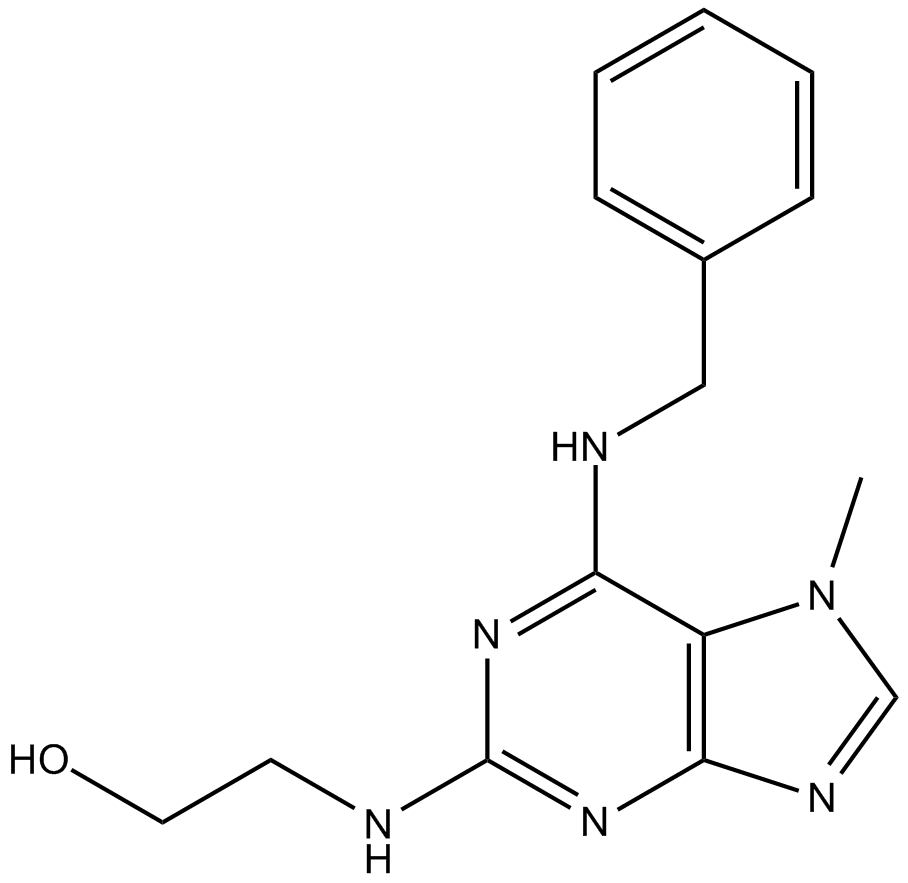
Iso-Olomoucine |
Catalog No.GC15215
 One-Click Copy Product Info
|

inactive stereoisomer of the Cdk5 inhibitor olomoucine
Products are for research use only. Not for human use. We do not sell to patients.
Cas No.: 101622-50-8
Sample solution is provided at 25 µL, 10mM.
_1-3.$$$39978408@51.jpg');)
_1-9.$$$38538795@65.jpg');)
_1-9.$$$39112701@51.jpg');)
_1-7.$$$37316672@70.jpg');)
_366-372.$$$36198801@70.jpg');)
.$$$38565142@65.jpg');)
_1867-1883.$$$33248023@67.jpg');)
_eads6055.$$$39977546@45.jpg');)
_eadm9805.$$$40080571@45.jpg');)
_eadj3020.$$$39666821@45.jpg');)
_1-20.$$$39757301@28.jpg');)
_1-24.$$$38898113@28.jpg');)
_273-287.$$$36806353@46.jpg');)
_1-16.$$$37156877@44.jpg');)
_1-19.$$$37460805@44.jpg');)
_1291-1307.$$$34518654@46.jpg');)
IC50: ≥ 1 mM for Cdk5
Iso-Olomoucine is an inactive stereoisomer of the Cdk5 inhibitor olomoucine.
Cyclin-dependent kinases (CDKs) are reported to be key regulators of cell cycle progression whose function/dysfunction has been implicated in cancer, human neurodegenerative diseases, as well as the response of addictive drugs through alteration of postsynaptic dopamine receptor signaling.
In vitro: In a previous study, rat dorsal striatal synaptosomes were incubation with the Cdk5 inhibitors roscovitine, olomoucine, and GW8510 or the inactive congener iso-olomoucine, which led to a rapid, concentration-dependent inhibition of specific [3H]DA uptake. However, roscovitine was the only inhibitor that did not decrease [3H]2beta-carbomethoxy-3beta-(4-fluorophenyl)tropane binding to dSTR DATs. Roscovitine-induced inhibition of dSTR [3H]DA uptake was demonstrated by decreased maximal uptake velocity, without a change in cell-surface DAT levels. Moreover, roscovitine did not enhance [3H]DA release mediated by either DAT reverse-transport. Instead, roscovitine could enhance spontaneous [3H]DA outflow and inhibit DAT-mediated [3H]DA reaccumulation into dSTR slices. Additionally, in a Cdk5-independent manner, iso-olomoucine was able to rapidly inhibit dopamine transporter activity in rat dorsal striatal synaptosomes with a potency similar to that of olomoucine (IC50 ~37 μM) [1]
In vivo: Up to now, there is no animal in vivo data reported.
Clinical trial: So far, no clinical study has been conducted.
Reference:
[1] Price, D. A.,Sorkin, A. and Zahniser, N.R. Cyclin-dependent kinase 5 inhibitors: Inhibition of dopamine transporter activity. Molecular Pharmacology 76(4), 812-823 (2009).
| Cas No. | 101622-50-8 | SDF | |
| Chemical Name | 2-[[7-methyl-6-[(phenylmethyl)amino]-7H-purin-2-yl]amino]-ethanol | ||
| Canonical SMILES | OCCNC1=NC(N=CN2C)=C2C(NCC3=CC=CC=C3)=N1 | ||
| Formula | C15H18N6O | M.Wt | 298.3 |
| Solubility | ≤0.3mg/ml in ethanol;15mg/ml in DMSO;15mg/ml in dimethyl formamide | Storage | Store at -20°C |
| General tips | Please select the appropriate solvent to prepare the stock solution according to the
solubility of the product in different solvents; once the solution is prepared, please store it in
separate packages to avoid product failure caused by repeated freezing and thawing.Storage method
and period of the stock solution: When stored at -80°C, please use it within 6 months; when stored
at -20°C, please use it within 1 month. To increase solubility, heat the tube to 37°C and then oscillate in an ultrasonic bath for some time. |
||
| Shipping Condition | Evaluation sample solution: shipped with blue ice. All other sizes available: with RT, or with Blue Ice upon request. | ||
| Prepare stock solution | |||

|
1 mg | 5 mg | 10 mg |
| 1 mM | 3.3523 mL | 16.7616 mL | 33.5233 mL |
| 5 mM | 670.5 μL | 3.3523 mL | 6.7047 mL |
| 10 mM | 335.2 μL | 1.6762 mL | 3.3523 mL |
Step 1: Enter information below (Recommended: An additional animal making an allowance for loss during the experiment)
 g
μL
g
μL
Step 2: Enter the in vivo formulation (This is only the calculator, not formulation. Please contact us first if there is no in vivo formulation at the solubility Section.)
Calculation results:
Working concentration: mg/ml;
Method for preparing DMSO master liquid: mg drug pre-dissolved in μL DMSO ( Master liquid concentration mg/mL, Please contact us first if the concentration exceeds the DMSO solubility of the batch of drug. )
Method for preparing in vivo formulation: Take μL DMSO master liquid, next addμL PEG300, mix and clarify, next addμL Tween 80, mix and clarify, next add μL saline, mix and clarify.
Method for preparing in vivo formulation: Take μL DMSO master liquid, next add μL Corn oil, mix and clarify.
Note: 1. Please make sure the liquid is clear before adding the next solvent.
2. Be sure to add the solvent(s) in order. You must ensure that the solution obtained, in the previous addition, is a clear solution before proceeding to add the next solvent. Physical methods such as vortex, ultrasound or hot water bath can be used to aid dissolving.
3. All of the above co-solvents are available for purchase on the GlpBio website.
Quality Control & SDS
- View current batch:
- Purity: >98.00% Appearance: A solid
- COA (Certificate of Analysis)
- SDS (Safety Data Sheet)
- Datasheet
Average Rating: 5 (Based on Reviews and 38 reference(s) in Google Scholar.)