

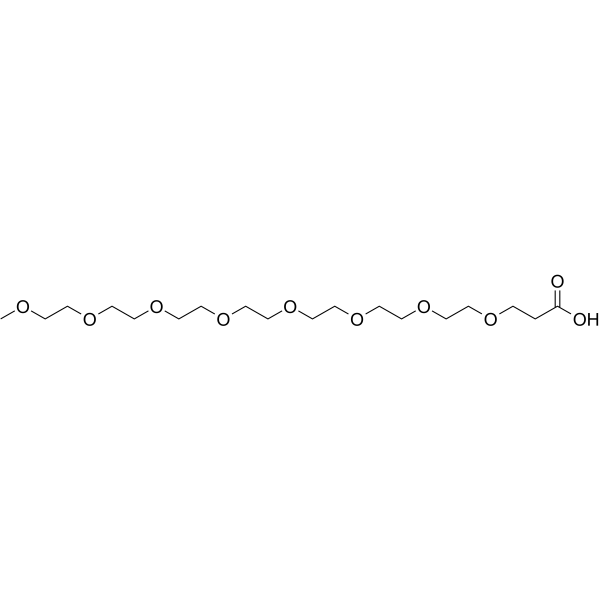
m-PEG7-CH2CH2COOH |
Catalog No.GC65151
 One-Click Copy Product Info
|

m-PEG7-CH2CH2COOH는 항체-약물 접합체(ADC)의 합성에 사용되는 절단 불가능한 ADC 링커입니다. m-PEG7-CH2CH2COOH는 또한 PROTAC 합성에 사용할 수 있는 PEG 기반 PROTAC 링커입니다.
Products are for research use only. Not for human use. We do not sell to patients.
Cas No.: 1093647-41-6
Sample solution is provided at 25 µL, 10mM.
_1-3.$$$39978408@51.jpg');)
_1-9.$$$38538795@65.jpg');)
_1-9.$$$39112701@51.jpg');)
_1-7.$$$37316672@70.jpg');)
_366-372.$$$36198801@70.jpg');)
.$$$38565142@65.jpg');)
_1867-1883.$$$33248023@67.jpg');)
_eads6055.$$$39977546@45.jpg');)
_eadm9805.$$$40080571@45.jpg');)
_eadj3020.$$$39666821@45.jpg');)
_1-20.$$$39757301@28.jpg');)
_1-24.$$$38898113@28.jpg');)
_273-287.$$$36806353@46.jpg');)
_1-16.$$$37156877@44.jpg');)
_1-19.$$$37460805@44.jpg');)
_1291-1307.$$$34518654@46.jpg');)
m-PEG7-CH2CH2COOH is a monomethoxy-terminated PEG carboxylic acid linker. m-PEG7-CH2CH2COOH is a monomethoxylated m-PEG7 consisting of seven ethoxy repeating units, providing hydrophilicity and a flexible spacer arm; the other end is a -CH2CH2COOH carboxylic acid group, which, after activation into an NHS ester, can undergo amide coupling reactions with amino-containing molecules[1]. m-PEG7-CH2CH2COOH, as a synthetic intermediate, can be used in the synthesis of antibody-drug conjugates (ADCs)[2]. m-PEG7-CH2CH2COOH is also a PEG-based PROTAC linker that can be used in the synthesis of PROTACs.
[1] Smith AAA, Maikawa CL, Roth GA, Appel EA. Site-selective modification of proteins using cucurbit[7]uril as supramolecular protection for N-terminal aromatic amino acids. Org Biomol Chem. Published online May 27, 2020.
[2] https://patents.google.com/patent/WO2016203432A1
This plan is based on literature, please modify it to meet your specific needs.
Synthesis of Compound (A-11)[1]
1. Intermediates 11-1A (Mc-Val-Ala-OH; 2.4g; 6.29mmol) and 11-1B (3.18g; 6.29mmol) were dissolved in dichloromethane and methanol (v:v=2:1; 90mL) in a mixed solvent. Para-EEDQ (1.86g; 7.55mmol) was added at room temperature. The reaction solution was stirred at room temperature for 24 hours, the reaction solution was evaporated to dryness under reduced pressure, and 11-1 (3.9g; yield 71%) was obtained by column chromatography.
2. Intermediate 11-1 (2g; 2.3mmol) was dissolved in 50mL of anhydrous tetrahydrofuran, cooled in an ice bath under argon atmosphere, pyridine hydrofluoric acid complex (4.6g; 46mmol) was added, and the reaction solution was stirred at 0 degrees for 2 After 1 hour, water was added to quench the reaction, extracted with dichloromethane, the organic layer was separated, dried over anhydrous sodium sulfate, and intermediate 11-2 (1.1g; yield 76%) was obtained by column chromatography.
3. Intermediate 11-2 (700mg; 1.11mmol) was dissolved in 4mL of anhydrous DMF, and DIPEA (0.39mL; 2.23mmol) and bis(4-nitrophenyl) carbonate (406mg; 1.33mmol) were added at room temperature, respectively. ). Stir overnight at room temperature under argon, evaporate the solvent under reduced pressure, then add methyl tert-butyl ether and stir until the solid is precipitated, filter, rinse the solid with ether several times, and dry the solid to obtain intermediate 11-3, which is directly used in the following one-step reaction.
4. Intermediate 11-3 (300mg; 0.44mmol) was dissolved in 400μL of anhydrous DMF, 100μL of anhydrous pyridine was added, and then ixatecan mesylate (234mg; 0.44mmol) and 100μL of anhydrous pyridine were added. HOBt (60mg; 0.44mmol). The mixture was stirred overnight at room temperature under argon, and the reaction solution was prepared and purified by reverse-phase HPLC to obtain Intermediate 11-4 (230mg; yield 48%).
5. Intermediate 11-4 (200mg; 0.183mmol) was dissolved in 1mL of anhydrous dichloromethane, 300μL of trifluoroacetic acid was added under ice bath, returned to room temperature and stirred for 30 minutes, and the solvent was removed under reduced pressure to obtain intermediate 11-5 without further purification.
6. Compound 11-5 (120mg; 0.109mmol) was dissolved in 1mL of anhydrous DMF, and m-PEG7-CH2CH2COOH (44.96mg; 0.109mmol) and HATU (50mg; 0.130mmol) were added respectively. After mixing with DIPEA (38μL; 0.22mmol), the mixture was stirred at room temperature overnight, and the solvent was removed under reduced pressure to obtain the final product, which was then prepared and purified by reverse-phase HPLC to obtain compound (A-11) (74mg; yield 38%).
References:
[1] https://patents.google.com/patent/WO2016203432A1
| Cas No. | 1093647-41-6 | SDF | |
| Formula | C18H36O10 | M.Wt | 412.47 |
| Solubility | Storage | Store at -20°C | |
| General tips | Please select the appropriate solvent to prepare the stock solution according to the
solubility of the product in different solvents; once the solution is prepared, please store it in
separate packages to avoid product failure caused by repeated freezing and thawing.Storage method
and period of the stock solution: When stored at -80°C, please use it within 6 months; when stored
at -20°C, please use it within 1 month. To increase solubility, heat the tube to 37°C and then oscillate in an ultrasonic bath for some time. |
||
| Shipping Condition | Evaluation sample solution: shipped with blue ice. All other sizes available: with RT, or with Blue Ice upon request. | ||
| Prepare stock solution | |||

|
1 mg | 5 mg | 10 mg |
| 1 mM | 2.4244 mL | 12.1221 mL | 24.2442 mL |
| 5 mM | 484.9 μL | 2.4244 mL | 4.8488 mL |
| 10 mM | 242.4 μL | 1.2122 mL | 2.4244 mL |
Step 1: Enter information below (Recommended: An additional animal making an allowance for loss during the experiment)
 g
μL
g
μL
Step 2: Enter the in vivo formulation (This is only the calculator, not formulation. Please contact us first if there is no in vivo formulation at the solubility Section.)
Calculation results:
Working concentration: mg/ml;
Method for preparing DMSO master liquid: mg drug pre-dissolved in μL DMSO ( Master liquid concentration mg/mL, Please contact us first if the concentration exceeds the DMSO solubility of the batch of drug. )
Method for preparing in vivo formulation: Take μL DMSO master liquid, next addμL PEG300, mix and clarify, next addμL Tween 80, mix and clarify, next add μL saline, mix and clarify.
Method for preparing in vivo formulation: Take μL DMSO master liquid, next add μL Corn oil, mix and clarify.
Note: 1. Please make sure the liquid is clear before adding the next solvent.
2. Be sure to add the solvent(s) in order. You must ensure that the solution obtained, in the previous addition, is a clear solution before proceeding to add the next solvent. Physical methods such as vortex, ultrasound or hot water bath can be used to aid dissolving.
3. All of the above co-solvents are available for purchase on the GlpBio website.
Quality Control & SDS
- View current batch:
- Purity: >99.50% Appearance: A liquid
- COA (Certificate of Analysis)
- SDS (Safety Data Sheet)
- Datasheet
Average Rating: 5 (Based on Reviews and 30 reference(s) in Google Scholar.)