

MRE-269 (ACT-333679) |
Catalog No.GC34015
 One-Click Copy Product Info
|

MRE-269(ACT-333679)는 selexipag의 활성 대사산물이며 선택적 IP 수용체 작용제로 작용합니다.
Products are for research use only. Not for human use. We do not sell to patients.
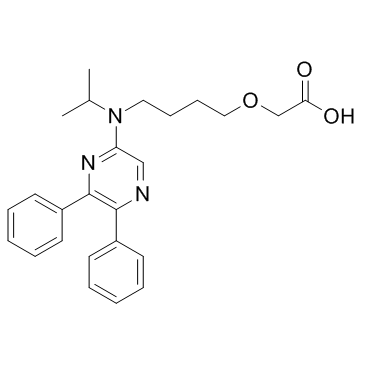
Cas No.: 475085-57-5
Sample solution is provided at 25 µL, 10mM.
_1-3.$$$39978408@51.jpg');)
_1-9.$$$38538795@65.jpg');)
_1-9.$$$39112701@51.jpg');)
_1-7.$$$37316672@70.jpg');)
_366-372.$$$36198801@70.jpg');)
.$$$38565142@65.jpg');)
_1867-1883.$$$33248023@67.jpg');)
_eads6055.$$$39977546@45.jpg');)
_eadm9805.$$$40080571@45.jpg');)
_eadj3020.$$$39666821@45.jpg');)
_1-20.$$$39757301@28.jpg');)
_1-24.$$$38898113@28.jpg');)
_273-287.$$$36806353@46.jpg');)
_1-16.$$$37156877@44.jpg');)
_1-19.$$$37460805@44.jpg');)
_1291-1307.$$$34518654@46.jpg');)
MRE-269 is an active metabolite of selexipag, and acts as a selective IP receptor agonist.
MRE-269 induces endothelium-independent vasodilation of rat extralobar pulmonary artery (EPA). MRE-269 or other IP receptor agonists including epoprostenol, iloprost, treprostinil and beraprost increase cAMP levels in hPASMC[1]. MRE-269 induces concentration-dependent vasodilation in LPA(+), LPA(-), and SPA(-)[3].
The vasorelaxant effects of MRE-269 on rat small intralobar pulmonary artery (SIPA) and EPA are the same, while the other IP receptor agonists induce less vasodilation in SIPA than in EPA[1]. MRE-269 produces substantial relaxation of rat small pulmonary artery, although its effects are only significant at high concentrations of above 10 μM (pEC50, 4.98±0.22). By contrast, in rat small pulmonary veins, MRE-269 only produces minimal relaxation over the whole concentration range, with only significant relaxation occurring at the two highest doses of MRE-269 of 10 and 100 μM[2].
[1]. Fuchikami C, et al. A comparison of vasodilation mode among selexipag (NS-304; [2-{4-[(5,6-diphenylpyrazin-2-yl)(isopropyl)amino]butoxy}-N-(methylsulfonyl)acetamide]), its active metabolite MRE-269 and various prostacyclin receptor agonists in rat, porcin [2]. Orie NN, et al. Differential actions of the prostacyclin analogues treprostinil and iloprost and the selexipag metabolite, MRE-269 (ACT-333679) in rat small pulmonary arteries and veins. Prostaglandins Other Lipid Mediat. 2013 Oct;106:1-7 [3]. Kuwano K, et al. A long-acting and highly selective prostacyclin receptor agonist prodrug, 2-{4-[(5,6-diphenylpyrazin-2-yl)(isopropyl)amino]butoxy}-N-(methylsulfonyl)acetamide (NS-304), ameliorates rat pulmonary hypertension with unique relaxant responses
| Cas No. | 475085-57-5 | SDF | |
| Canonical SMILES | OC(COCCCCN(C(C)C)C1=NC(C2=CC=CC=C2)=C(C3=CC=CC=C3)N=C1)=O | ||
| Formula | C25H29N3O3 | M.Wt | 419.52 |
| Solubility | DMSO : ≥ 50 mg/mL (119.18 mM);Water : < 0.1 mg/mL (insoluble) | Storage | Store at -20°C |
| General tips | Please select the appropriate solvent to prepare the stock solution according to the
solubility of the product in different solvents; once the solution is prepared, please store it in
separate packages to avoid product failure caused by repeated freezing and thawing.Storage method
and period of the stock solution: When stored at -80°C, please use it within 6 months; when stored
at -20°C, please use it within 1 month. To increase solubility, heat the tube to 37°C and then oscillate in an ultrasonic bath for some time. |
||
| Shipping Condition | Evaluation sample solution: shipped with blue ice. All other sizes available: with RT, or with Blue Ice upon request. | ||
| Prepare stock solution | |||

|
1 mg | 5 mg | 10 mg |
| 1 mM | 2.3837 mL | 11.9184 mL | 23.8368 mL |
| 5 mM | 476.7 μL | 2.3837 mL | 4.7674 mL |
| 10 mM | 238.4 μL | 1.1918 mL | 2.3837 mL |
Step 1: Enter information below (Recommended: An additional animal making an allowance for loss during the experiment)
 g
μL
g
μL
Step 2: Enter the in vivo formulation (This is only the calculator, not formulation. Please contact us first if there is no in vivo formulation at the solubility Section.)
Calculation results:
Working concentration: mg/ml;
Method for preparing DMSO master liquid: mg drug pre-dissolved in μL DMSO ( Master liquid concentration mg/mL, Please contact us first if the concentration exceeds the DMSO solubility of the batch of drug. )
Method for preparing in vivo formulation: Take μL DMSO master liquid, next addμL PEG300, mix and clarify, next addμL Tween 80, mix and clarify, next add μL saline, mix and clarify.
Method for preparing in vivo formulation: Take μL DMSO master liquid, next add μL Corn oil, mix and clarify.
Note: 1. Please make sure the liquid is clear before adding the next solvent.
2. Be sure to add the solvent(s) in order. You must ensure that the solution obtained, in the previous addition, is a clear solution before proceeding to add the next solvent. Physical methods such as vortex, ultrasound or hot water bath can be used to aid dissolving.
3. All of the above co-solvents are available for purchase on the GlpBio website.
Quality Control & SDS
- View current batch:
- Purity: >98.00% Appearance: A solid
- COA (Certificate of Analysis)
- SDS (Safety Data Sheet)
- Datasheet
Average Rating: 5 (Based on Reviews and 14 reference(s) in Google Scholar.)