

Ozanimod (RPC1063) |
Catalog No.GC14360
 One-Click Copy Product Info
|

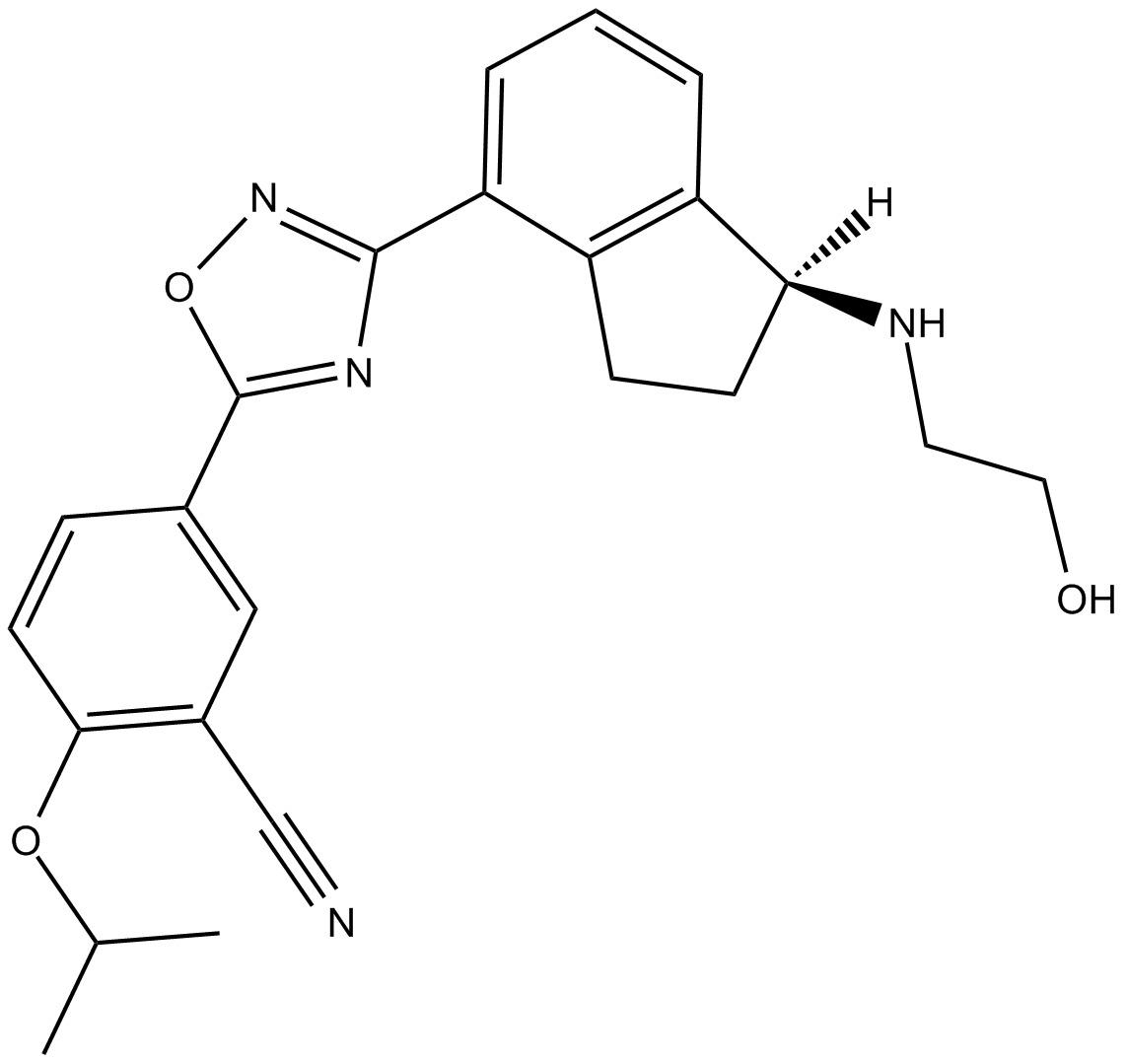
Ozanimod(RPC1063)(RPC-1063), S1P 수용체 아형 1(S1P1) 및 5(S1P5)에 선택적으로 높은 친화도로 결합하는 스핑고신 1-인산(S1P) 수용체 조절제.
Products are for research use only. Not for human use. We do not sell to patients.
Cas No.: 1306760-87-1
Sample solution is provided at 25 µL, 10mM.
_1-3.$$$39978408@51.jpg');)
_1-9.$$$38538795@65.jpg');)
_1-9.$$$39112701@51.jpg');)
_1-7.$$$37316672@70.jpg');)
_366-372.$$$36198801@70.jpg');)
.$$$38565142@65.jpg');)
_1867-1883.$$$33248023@67.jpg');)
_eads6055.$$$39977546@45.jpg');)
_eadm9805.$$$40080571@45.jpg');)
_eadj3020.$$$39666821@45.jpg');)
_1-20.$$$39757301@28.jpg');)
_1-24.$$$38898113@28.jpg');)
_273-287.$$$36806353@46.jpg');)
_1-16.$$$37156877@44.jpg');)
_1-19.$$$37460805@44.jpg');)
_1291-1307.$$$34518654@46.jpg');)
Ozanimod (RPC1063) is a sphingosine-1-phosphate (S1P) receptor modulator that can cross the blood-brain barrier. Ozanimod selectively binds to S1P1 (EC50=1.03nM) and S1P5 (EC50=8.6nM) receptors. Ozanimod is used for the treatment of relapsing multiple sclerosis and ulcerative colitis[1-4].
In vitro, Ozanimod (0.5-60μM) treated 501Mel, 1205LU, and M249R melanoma cell lines for 6 days. Ozanimod significantly increased cell confluency and promoted cell proliferation[5]. Ozanimod (1nM-1mM) treated HUVEC cells for 60 minutes, followed by stimulation with S1P (80nM) for 60 minutes. Ozanimod produced a rapid and concentration-dependent increase in baseline normalized cell index and was able to desensitize the S1P1 receptor[6].
In vivo, Ozanimod (1mg/kg; once daily) was administered by oral gavage to intracerebral hemorrhage model C57BL/6J mice (8-10 weeks old) for 4 consecutive days. Ozanimod significantly improved neurobehavioral deficits and reduced weight loss in the mice[7]. Ozanimod (0.3-3.0mg/kg; once daily) was administered by oral gavage to systemic lupus erythematosus NZBWF1 mice for 20 weeks. Ozanimod significantly improved renal pathological damage in the mice[8].
References:
[1] Selkirk JV, Dines KC, Yan YG, et al. Deconstructing the Pharmacological Contribution of Sphingosine-1 Phosphate Receptors to Mouse Models of Multiple Sclerosis Using the Species Selectivity of Ozanimod, a Dual Modulator of Human Sphingosine 1-Phosphate Receptor Subtypes 1 and 5. J Pharmacol Exp Ther. 2021 Dec;379(3):386-399.
[2] Sandborn WJ, Feagan BG, D'Haens G, et al. Ozanimod as Induction and Maintenance Therapy for Ulcerative Colitis. N Engl J Med. 2021 Sep 30;385(14):1280-1291.
[3] Lamb YN. Ozanimod: First Approval. Drugs. 2020 Jun;80(8):841-848.
[4] Paik J. Ozanimod: A Review in Ulcerative Colitis. Drugs. 2022 Aug;82(12):1303-1313.
[5] Ruetsch-Chelli C, Okuda DT, Rocher F, et al. Sphingosine-1 Phosphate Receptor Modulators Increase In Vitro Melanoma Cell Line Proliferation at Therapeutic Doses Used in Patients with Multiple Sclerosis. Neurol Ther. 2023 Feb;12(1):289-302.
[6] Grailhe P, Boutarfa-Madec A, Beauverger P, et al. A label-free impedance assay in endothelial cells differentiates the activation and desensitization properties of clinical S1P1 agonists. FEBS Open Bio. 2020 Oct;10(10):2010-2020.
[7] Wang F, Zhang X, Liu Y, et al. Neuroprotection by Ozanimod Following Intracerebral Hemorrhage in Mice. Front Mol Neurosci. 2022 Jun 15;15:927150.
[8] Taylor Meadows KR, Steinberg MW, Clemons B, et al. Ozanimod (RPC1063), a selective S1PR1 and S1PR5 modulator, reduces chronic inflammation and alleviates kidney pathology in murine systemic lupus erythematosus. PLoS One. 2018 Apr 2;13(4):e0193236.
| Cell experiment [1]: | |
Cell lines | 501Mel cells, 1205LU cells, and M249R cells (human melanoma cell lines) |
Preparation Method | Melanoma cell lines were transduced with NucLight Red lentivirus reagent and selected with puromycin (1mg/ml). Cells were treated with different concentrations of Ozanimod (0.5, 1.6, 5.5, 18, and 60μM) using clinical doses for in vitro cell cultures. |
Reaction Conditions | 0.5-60μM; 6 days |
Applications | Ozanimod significantly increased median confluence overall for all lineages. Ozanimod-treated cells increased confluency in 501Mel, 1205LU, and M249R cell lines. |
| Animal experiment [2]: | |
Animal models | C57BL/6J mice (8-10 weeks old) |
Preparation Method | The collagenase-induced intracerebral hemorrhage (ICH) model was established by injecting collagenase type VII (0.075U in 0.5μL saline) into the basal ganglia. Ozanimod was administered by gavage 2h after surgery and once a day thereafter until sacrifice at 3 days post-ICH. |
Dosage form | 1mg/kg; oral gavage; once daily for 4 days |
Applications | Ozanimod treatment improved neurobehavioral deficits and decreased weight loss after ICH. Ozanimod significantly reduced hematoma volume and brain water content. Ozanimod reduced the density of activated microglia and infiltrated neutrophils in the perihematoma region. Ozanimod mitigated brain cell death and reduced Evans blue dye leakage, indicating improved blood-brain barrier integrity. |
References: | |
| Cas No. | 1306760-87-1 | SDF | |
| Chemical Name | (S)-5-(3-(1-((2-hydroxyethyl)amino)-2,3-dihydro-1H-inden-4-yl)-1,2,4-oxadiazol-5-yl)-2-isopropoxybenzonitrile | ||
| Canonical SMILES | CC(OC1=C(C#N)C=C(C2=NC(C3=CC=CC4=C3CC[C@]4([H])NCCO)=NO2)C=C1)C | ||
| Formula | C23H24N4O3 | M.Wt | 404.46 |
| Solubility | ≥ 40.4mg/mL in DMSO | Storage | Store at -20°C |
| General tips | Please select the appropriate solvent to prepare the stock solution according to the
solubility of the product in different solvents; once the solution is prepared, please store it in
separate packages to avoid product failure caused by repeated freezing and thawing.Storage method
and period of the stock solution: When stored at -80°C, please use it within 6 months; when stored
at -20°C, please use it within 1 month. To increase solubility, heat the tube to 37°C and then oscillate in an ultrasonic bath for some time. |
||
| Shipping Condition | Evaluation sample solution: shipped with blue ice. All other sizes available: with RT, or with Blue Ice upon request. | ||
| Prepare stock solution | |||

|
1 mg | 5 mg | 10 mg |
| 1 mM | 2.4724 mL | 12.3622 mL | 24.7243 mL |
| 5 mM | 494.5 μL | 2.4724 mL | 4.9449 mL |
| 10 mM | 247.2 μL | 1.2362 mL | 2.4724 mL |
Step 1: Enter information below (Recommended: An additional animal making an allowance for loss during the experiment)
 g
μL
g
μL
Step 2: Enter the in vivo formulation (This is only the calculator, not formulation. Please contact us first if there is no in vivo formulation at the solubility Section.)
Calculation results:
Working concentration: mg/ml;
Method for preparing DMSO master liquid: mg drug pre-dissolved in μL DMSO ( Master liquid concentration mg/mL, Please contact us first if the concentration exceeds the DMSO solubility of the batch of drug. )
Method for preparing in vivo formulation: Take μL DMSO master liquid, next addμL PEG300, mix and clarify, next addμL Tween 80, mix and clarify, next add μL saline, mix and clarify.
Method for preparing in vivo formulation: Take μL DMSO master liquid, next add μL Corn oil, mix and clarify.
Note: 1. Please make sure the liquid is clear before adding the next solvent.
2. Be sure to add the solvent(s) in order. You must ensure that the solution obtained, in the previous addition, is a clear solution before proceeding to add the next solvent. Physical methods such as vortex, ultrasound or hot water bath can be used to aid dissolving.
3. All of the above co-solvents are available for purchase on the GlpBio website.
Quality Control & SDS
- View current batch:
- Purity: >99.50% Appearance: A solid
- COA (Certificate of Analysis)
- SDS (Safety Data Sheet)
- Datasheet
Average Rating: 5 (Based on Reviews and 21 reference(s) in Google Scholar.)