

PyBrOP |
Catalog No.GA10696
 One-Click Copy Product Info
|

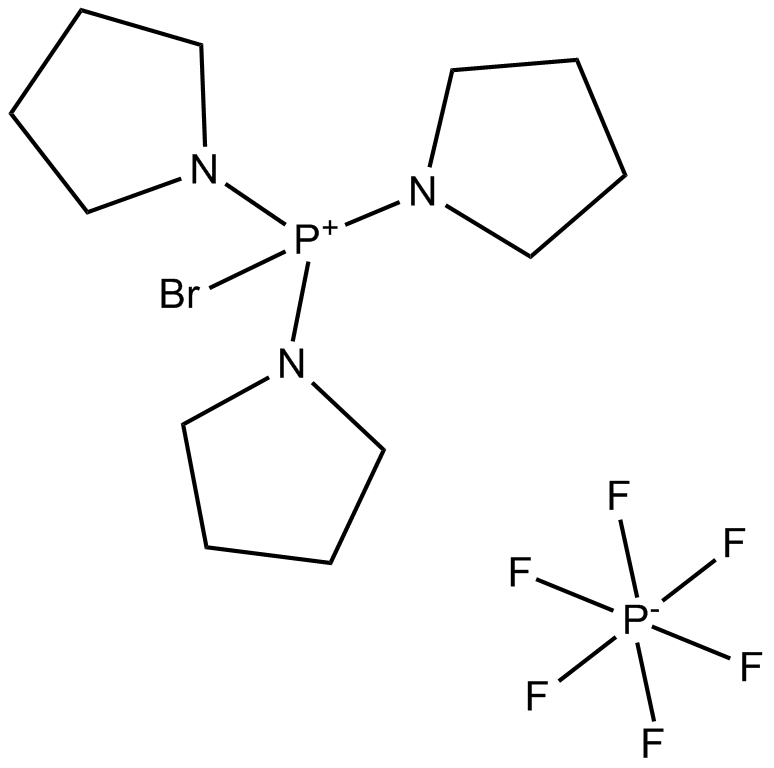
PyBroP는 펩타이드 결합 화학에서 사용되는 인화합물이고 PyCloP와 유사하다.
Products are for research use only. Not for human use. We do not sell to patients.
Cas No.: 132705-51-2
Sample solution is provided at 25 µL, 10mM.
_1-3.$$$39978408@51.jpg');)
_1-9.$$$38538795@65.jpg');)
_1-9.$$$39112701@51.jpg');)
_1-7.$$$37316672@70.jpg');)
_366-372.$$$36198801@70.jpg');)
.$$$38565142@65.jpg');)
_1867-1883.$$$33248023@67.jpg');)
_eads6055.$$$39977546@45.jpg');)
_eadm9805.$$$40080571@45.jpg');)
_eadj3020.$$$39666821@45.jpg');)
_1-20.$$$39757301@28.jpg');)
_1-24.$$$38898113@28.jpg');)
_273-287.$$$36806353@46.jpg');)
_1-16.$$$37156877@44.jpg');)
_1-19.$$$37460805@44.jpg');)
_1291-1307.$$$34518654@46.jpg');)
PyBroP는 펩타이드 결합 화학에서 사용되는 인화합물이고 PyCloP와 유사하다. PyBroP는 N-methylated 아미노산과 α,α-이중치환 아미노산의 결합에서 높은 효율성, 높은 수율, 이성질체의화 부재 및 빠른 반응 속도의 이점을 가지고 있다[2]. PyBroP는 이 결합 시약 BOP의 유도체이지만 BOP의 디메틸아민 대신 피롤리딘을 포함하고 있다[3]. PyBroP는 활성화 단계 동안 독성 HMPA가 방출되는 것을 피하기 위해 BOP 시약의 대안으로 개발되었다[4, 5].
References:
[1] Coste J, Frerot E, Jouin P. Coupling N-methylated amino acids using PyBroP and PyCloP halogenophosphonium salts: mechanism and fields of application[J]. The Journal of Organic Chemistry, 1994, 59(9): 2437-2446.
[2] Humphrey J M, Chamberlin A R. Chemical synthesis of natural product peptides: coupling methods for the incorporation of noncoded amino acids into peptides[J]. Chemical Reviews, 1997, 97(6): 2243-2266.
[3] El-Faham A, Albericio F. Peptide coupling reagents, more than a letter soup[J]. Chemical reviews, 2011, 111(11): 6557-6602.
[4] Han S Y, Kim Y A. Recent development of peptide coupling reagents in organic synthesis[J]. Tetrahedron, 2004, 60(11): 2447-2467.
[5] Valeur E, Bradley M. Amide bond formation: beyond the myth of coupling reagents[J]. Chemical Society Reviews, 2009, 38(2): 606-631.
| Cas No. | 132705-51-2 | SDF | |
| Chemical Name | bromo(tripyrrolidin-1-yl)phosphanium;hexafluorophosphate | ||
| Canonical SMILES | C1CCN(C1)[P+](N2CCCC2)(N3CCCC3)Br.F[P-](F)(F)(F)(F)F | ||
| Formula | C12H24N3P2BrF6 | M.Wt | 466.2 |
| Solubility | Soluble in water or 1% acetic acid | Storage | Desiccate at -20°C |
| General tips | Please select the appropriate solvent to prepare the stock solution according to the
solubility of the product in different solvents; once the solution is prepared, please store it in
separate packages to avoid product failure caused by repeated freezing and thawing.Storage method
and period of the stock solution: When stored at -80°C, please use it within 6 months; when stored
at -20°C, please use it within 1 month. To increase solubility, heat the tube to 37°C and then oscillate in an ultrasonic bath for some time. |
||
| Shipping Condition | Evaluation sample solution: shipped with blue ice. All other sizes available: with RT, or with Blue Ice upon request. | ||
| Prepare stock solution | |||

|
1 mg | 5 mg | 10 mg |
| 1 mM | 2.145 mL | 10.725 mL | 21.45 mL |
| 5 mM | 429 μL | 2.145 mL | 4.29 mL |
| 10 mM | 214.5 μL | 1.0725 mL | 2.145 mL |
Step 1: Enter information below (Recommended: An additional animal making an allowance for loss during the experiment)
 g
μL
g
μL
Step 2: Enter the in vivo formulation (This is only the calculator, not formulation. Please contact us first if there is no in vivo formulation at the solubility Section.)
Calculation results:
Working concentration: mg/ml;
Method for preparing DMSO master liquid: mg drug pre-dissolved in μL DMSO ( Master liquid concentration mg/mL, Please contact us first if the concentration exceeds the DMSO solubility of the batch of drug. )
Method for preparing in vivo formulation: Take μL DMSO master liquid, next addμL PEG300, mix and clarify, next addμL Tween 80, mix and clarify, next add μL saline, mix and clarify.
Method for preparing in vivo formulation: Take μL DMSO master liquid, next add μL Corn oil, mix and clarify.
Note: 1. Please make sure the liquid is clear before adding the next solvent.
2. Be sure to add the solvent(s) in order. You must ensure that the solution obtained, in the previous addition, is a clear solution before proceeding to add the next solvent. Physical methods such as vortex, ultrasound or hot water bath can be used to aid dissolving.
3. All of the above co-solvents are available for purchase on the GlpBio website.
Quality Control & SDS
- View current batch:
- Purity: >99.00% Appearance: A solid
- COA (Certificate of Analysis)
- SDS (Safety Data Sheet)
- Datasheet
Average Rating: 5 (Based on Reviews and 30 reference(s) in Google Scholar.)