

RD162 |
Catalog No.GC11957
 One-Click Copy Product Info
|

디아릴티오히단토인인 RD162는 경구 활성 비스테로이드성 항안드로겐(NSAA)입니다. RD162는 안드로겐 수용체(AR)에 특이적으로 결합합니다. RD162는 거세 저항성 인간 전립선암의 마우스 모델에서 종양 퇴행을 유도합니다.
Products are for research use only. Not for human use. We do not sell to patients.
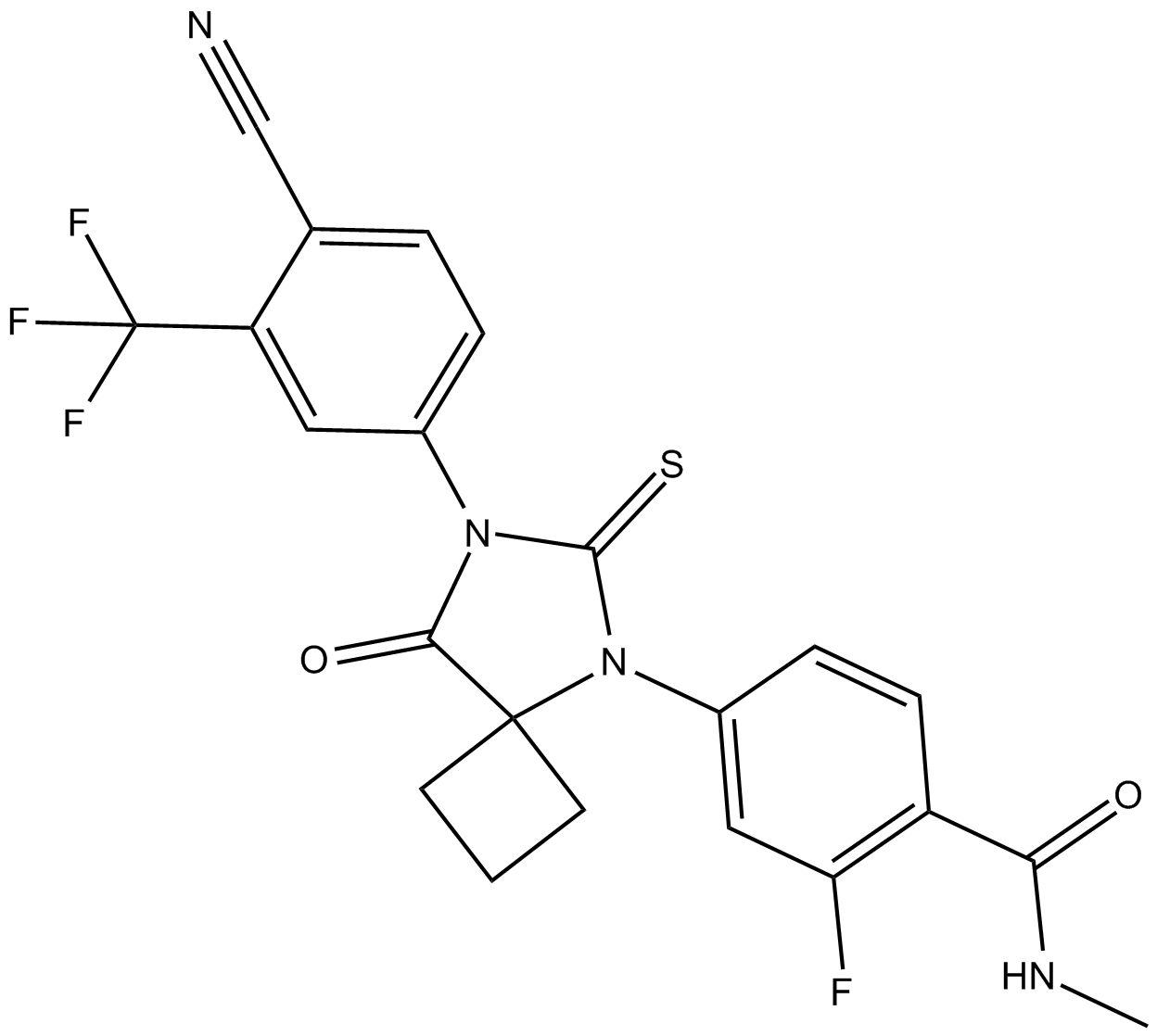
Cas No.: 915087-27-3
Sample solution is provided at 25 µL, 10mM.
_1-3.$$$39978408@51.jpg');)
_1-9.$$$38538795@65.jpg');)
_1-9.$$$39112701@51.jpg');)
_1-7.$$$37316672@70.jpg');)
_366-372.$$$36198801@70.jpg');)
.$$$38565142@65.jpg');)
_1867-1883.$$$33248023@67.jpg');)
_eads6055.$$$39977546@45.jpg');)
_eadm9805.$$$40080571@45.jpg');)
_eadj3020.$$$39666821@45.jpg');)
_1-20.$$$39757301@28.jpg');)
_1-24.$$$38898113@28.jpg');)
_273-287.$$$36806353@46.jpg');)
_1-16.$$$37156877@44.jpg');)
_1-19.$$$37460805@44.jpg');)
_1291-1307.$$$34518654@46.jpg');)
IC50: 30.9 nM
RD162 is an androgen receptor (AR) antagonist.
Metastatic prostate cancer is treated with drugs antagonizinf androgen action, but most patients progress to a more aggressive form of the disease named castration-resistant prostate cancer, driven by elevated expression of the androgen receptor (AR).
In vitro: RD162 was optimized from a screen for nonsteroidal antiandrogens retaining activity in the setting of increased androgen receptor expression. RD162 could bind to the androgen receptor with greater relative affinity than the clinically used bicalutamide, reduce the efficiency of the nuclear translocation, and impair both DNA binding to androgen response elements and recruitment of coactivators [1].
In vivo: Previous evidence suggested that the activity of RD162 in these mice was mediated through AR inhibition. The antitumor activity in the LNCaP/AR model was dose-dependent, with some slowing of tumor growth at 0.1 mg/kg RD162 and a few tumor regressions at 1 mg/kg, correlating closely with the effect of these same doses on AR transcriptional activity in the luciferase imaging experiment. In addition, neither bicalutamide nor RD162 impaired the growth of AR-negative DU145 prostate cancer xenografts [1].
Clinical trial: In a phase I/II clinical trial, of the first 30 patients treated with MDV3100, 13 (43%) showed sustained declines in serum concentrations of prostate-specific antigen, a biomarker of prostate cancer [1].
Reference:
[1] C. Tran, S. Ouk, N. J. Clegg, et al. Development of a second-generation antiandrogen for treatment of advanced prostate cancer. Science 324(5928), 787-790(2009).
| Cas No. | 915087-27-3 | SDF | |
| Chemical Name | 4-[7-[4-cyano-3-(trifluoromethyl)phenyl]-8-oxo-6-thioxo-5,7-diazaspiro[3.4]oct-5-yl]-2-fluoro-N-methyl-benzamide | ||
| Canonical SMILES | S=C1N(C2=CC=C(C#N)C(C(F)(F)F)=C2)C(C3(CCC3)N1C4=CC(F)=C(C(NC)=O)C=C4)=O | ||
| Formula | C22H16F4N4O2S | M.Wt | 476.4 |
| Solubility | ≤30mg/ml in DMSO;30mg/ml in dimethyl formamide | Storage | Store at 4°C |
| General tips | Please select the appropriate solvent to prepare the stock solution according to the
solubility of the product in different solvents; once the solution is prepared, please store it in
separate packages to avoid product failure caused by repeated freezing and thawing.Storage method
and period of the stock solution: When stored at -80°C, please use it within 6 months; when stored
at -20°C, please use it within 1 month. To increase solubility, heat the tube to 37°C and then oscillate in an ultrasonic bath for some time. |
||
| Shipping Condition | Evaluation sample solution: shipped with blue ice. All other sizes available: with RT, or with Blue Ice upon request. | ||
| Prepare stock solution | |||

|
1 mg | 5 mg | 10 mg |
| 1 mM | 2.0991 mL | 10.4954 mL | 20.9908 mL |
| 5 mM | 419.8 μL | 2.0991 mL | 4.1982 mL |
| 10 mM | 209.9 μL | 1.0495 mL | 2.0991 mL |
Step 1: Enter information below (Recommended: An additional animal making an allowance for loss during the experiment)
 g
μL
g
μL
Step 2: Enter the in vivo formulation (This is only the calculator, not formulation. Please contact us first if there is no in vivo formulation at the solubility Section.)
Calculation results:
Working concentration: mg/ml;
Method for preparing DMSO master liquid: mg drug pre-dissolved in μL DMSO ( Master liquid concentration mg/mL, Please contact us first if the concentration exceeds the DMSO solubility of the batch of drug. )
Method for preparing in vivo formulation: Take μL DMSO master liquid, next addμL PEG300, mix and clarify, next addμL Tween 80, mix and clarify, next add μL saline, mix and clarify.
Method for preparing in vivo formulation: Take μL DMSO master liquid, next add μL Corn oil, mix and clarify.
Note: 1. Please make sure the liquid is clear before adding the next solvent.
2. Be sure to add the solvent(s) in order. You must ensure that the solution obtained, in the previous addition, is a clear solution before proceeding to add the next solvent. Physical methods such as vortex, ultrasound or hot water bath can be used to aid dissolving.
3. All of the above co-solvents are available for purchase on the GlpBio website.
Quality Control & SDS
- View current batch:
- Purity: >98.00% Appearance: A solid
- COA (Certificate of Analysis)
- SDS (Safety Data Sheet)
- Datasheet
Average Rating: 5 (Based on Reviews and 13 reference(s) in Google Scholar.)