

Ribitol (Synonyms: Adonitol, NSC 16868) |
Catalog No.GC15755
 One-Click Copy Product Info
|

리비톨은 리보오스가 환원되어 형성된 결정질 오탄당 알코올입니다.
Products are for research use only. Not for human use. We do not sell to patients.
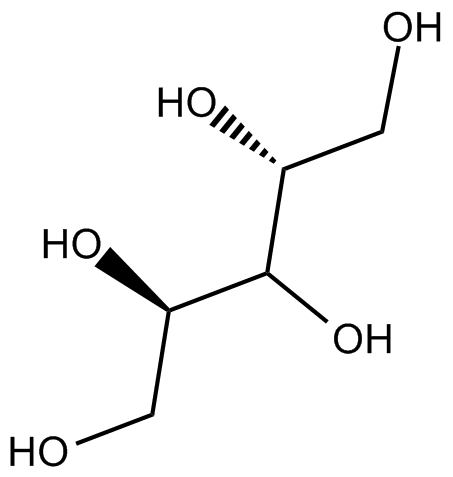
Cas No.: 488-81-3
Sample solution is provided at 25 µL, 10mM.
_1-3.$$$39978408@51.jpg');)
_1-9.$$$38538795@65.jpg');)
_1-9.$$$39112701@51.jpg');)
_1-7.$$$37316672@70.jpg');)
_366-372.$$$36198801@70.jpg');)
.$$$38565142@65.jpg');)
_1867-1883.$$$33248023@67.jpg');)
_eads6055.$$$39977546@45.jpg');)
_eadm9805.$$$40080571@45.jpg');)
_eadj3020.$$$39666821@45.jpg');)
_1-20.$$$39757301@28.jpg');)
_1-24.$$$38898113@28.jpg');)
_273-287.$$$36806353@46.jpg');)
_1-16.$$$37156877@44.jpg');)
_1-19.$$$37460805@44.jpg');)
_1291-1307.$$$34518654@46.jpg');)
Ribitol is a crystalline pentose alcohol formed by the reduction of ribose. Enhancing the flux of D-glucose to the pentose phosphate pathway in Saccharomyces cerevisiae for the production of D-ribose and ribitol.
Ribitol is a reduced sugar[1]. Phosphoglucose isomerase-deficient (pgi1) strains of Saccharomyces cerevisiae are studied for the production of D-ribose and Ribitol from D-glucose via the intermediates of the pentose phosphate pathway. Overexpression of the gene encoding sugar phosphate phosphatase (DOG1) of S. cerevisiae is needed for the production of D-ribose and Ribitol. The engineered strains are compared for their ability to produce the PPP-derived 5-carbon compounds Ribitol and D-ribose from D-glucose[2].
References:
[1]. Praissman JL, et al. The functional O-mannose glycan on α-dystroglycan contains a phospho-Ribitol primed for matriglycan addition. Elife. 2016 Apr 29;5. pii: e14473.
[2]. Toivari MH, et al. Enhancing the flux of D-glucose to the pentose phosphate pathway in Saccharomyces cerevisiae for the production of D-ribose and ribitol. Appl Microbiol Biotechnol. 2010 Jan;85(3):731-9.
Kinase experiment: | The high-performance liquid chromatography (HPLC) analyses are carried out using a Fast Acid Column (100×7.8 mm) and a HPX-87H Ion Exclusion Column (300 mm×7.8 mm) in series with 2.5 mM H2SO4 in water as the mobile phase at a flow rate of 0.3 mL/min, at 55°C. This method enabled quantification of D-glucose, ethanol, glycerol, D-xylulose, Ribitol, and xylitol. D-ribose, D-ribulose, and D-arabitol coeluted on the Aminex HPX-87H column. The CarboPac MA-1 column of Dionex ICS-3000 is used to analyze representative culture supernatant samples for the presence of arabitol and xylitol. Samples are run at column temperature of 30°C with 480 mM NaOH at flow rate 0.4 mL/min. The CarboPac MA-1 column separated D-arabitol from D-ribose and D-ribulose, but the alkaline conditions degraded D-ribulose interfering with the quantification of D-ribose.Yeast cells are disrupted with glass beads in 100 mM sodium phosphate buffer pH 7.0 containing phenylmethylsulfonyl fluoride and pepstatin A in final concentrations of 0.17 mg/mL and 0.01 mg/mL, respectively.The activity of NAD+-dependent Gdh2p is measured in a reaction buffer of 0.5 M triethanol amine pH 7.7 and 2 mM NADH. After addition of the cell lysate, the reaction is started by adding a mixture of α-ketoglutarate (100 mM) and NH4Cl (200 mM) to a final concentration of 2.4 mM and 4.9 mM, respectively. The GapB activity is measured. Shortly, the reaction mixture is 500 mM triethanol amine pH 7.8, 1 mM ATP, 2 mM MgCl2, 200 μM NADPH, and 10 μg/mL of phosphoglycerate kinase. 3-phosphoglycerate is added to a final concentration of 5 mM to start the reaction. Activity measurements are performed with a Cobas Mira Plus automated analyzer[2]. |
References: [1]. Praissman JL, et al. The functional O-mannose glycan on α-dystroglycan contains a phospho-Ribitol primed for matriglycan addition. Elife. 2016 Apr 29;5. pii: e14473. | |
| Cas No. | 488-81-3 | SDF | |
| Synonyms | Adonitol, NSC 16868 | ||
| Chemical Name | pentane-1,2,3,4,5-pentol | ||
| Canonical SMILES | C(C(C(C(CO)O)O)O)O | ||
| Formula | C5H12O5 | M.Wt | 152.15 |
| Solubility | DMF: 5mg/mL,DMSO: 25mg/mL,PBS (pH 7.2): 5mg/mL | Storage | Store at -20°C |
| General tips | Please select the appropriate solvent to prepare the stock solution according to the
solubility of the product in different solvents; once the solution is prepared, please store it in
separate packages to avoid product failure caused by repeated freezing and thawing.Storage method
and period of the stock solution: When stored at -80°C, please use it within 6 months; when stored
at -20°C, please use it within 1 month. To increase solubility, heat the tube to 37°C and then oscillate in an ultrasonic bath for some time. |
||
| Shipping Condition | Evaluation sample solution: shipped with blue ice. All other sizes available: with RT, or with Blue Ice upon request. | ||
| Prepare stock solution | |||

|
1 mg | 5 mg | 10 mg |
| 1 mM | 6.5725 mL | 32.8623 mL | 65.7246 mL |
| 5 mM | 1.3145 mL | 6.5725 mL | 13.1449 mL |
| 10 mM | 657.2 μL | 3.2862 mL | 6.5725 mL |
Step 1: Enter information below (Recommended: An additional animal making an allowance for loss during the experiment)
 g
μL
g
μL
Step 2: Enter the in vivo formulation (This is only the calculator, not formulation. Please contact us first if there is no in vivo formulation at the solubility Section.)
Calculation results:
Working concentration: mg/ml;
Method for preparing DMSO master liquid: mg drug pre-dissolved in μL DMSO ( Master liquid concentration mg/mL, Please contact us first if the concentration exceeds the DMSO solubility of the batch of drug. )
Method for preparing in vivo formulation: Take μL DMSO master liquid, next addμL PEG300, mix and clarify, next addμL Tween 80, mix and clarify, next add μL saline, mix and clarify.
Method for preparing in vivo formulation: Take μL DMSO master liquid, next add μL Corn oil, mix and clarify.
Note: 1. Please make sure the liquid is clear before adding the next solvent.
2. Be sure to add the solvent(s) in order. You must ensure that the solution obtained, in the previous addition, is a clear solution before proceeding to add the next solvent. Physical methods such as vortex, ultrasound or hot water bath can be used to aid dissolving.
3. All of the above co-solvents are available for purchase on the GlpBio website.
Quality Control & SDS
- View current batch:
- Purity: >98.00% Appearance: A solid
- COA (Certificate of Analysis)
- SDS (Safety Data Sheet)
- Datasheet
Average Rating: 5 (Based on Reviews and 25 reference(s) in Google Scholar.)