

A922500 (Synonyms: (1R,2R)2(4'(3phenylureido)biphenylcarbonyl)cyclopentanecarboxylic acid) |
Catalog No.GC15614
 One-Click Copy Product Info
|

A922500 es un inhibidor potente, selectivo y biodisponible por vía oral de diacilglicerol aciltransferasa 1 (DGAT-1) con valores de IC50 de 9 y 22nM contra DGAT-1 humano y ratón, respectivamente
Products are for research use only. Not for human use. We do not sell to patients.
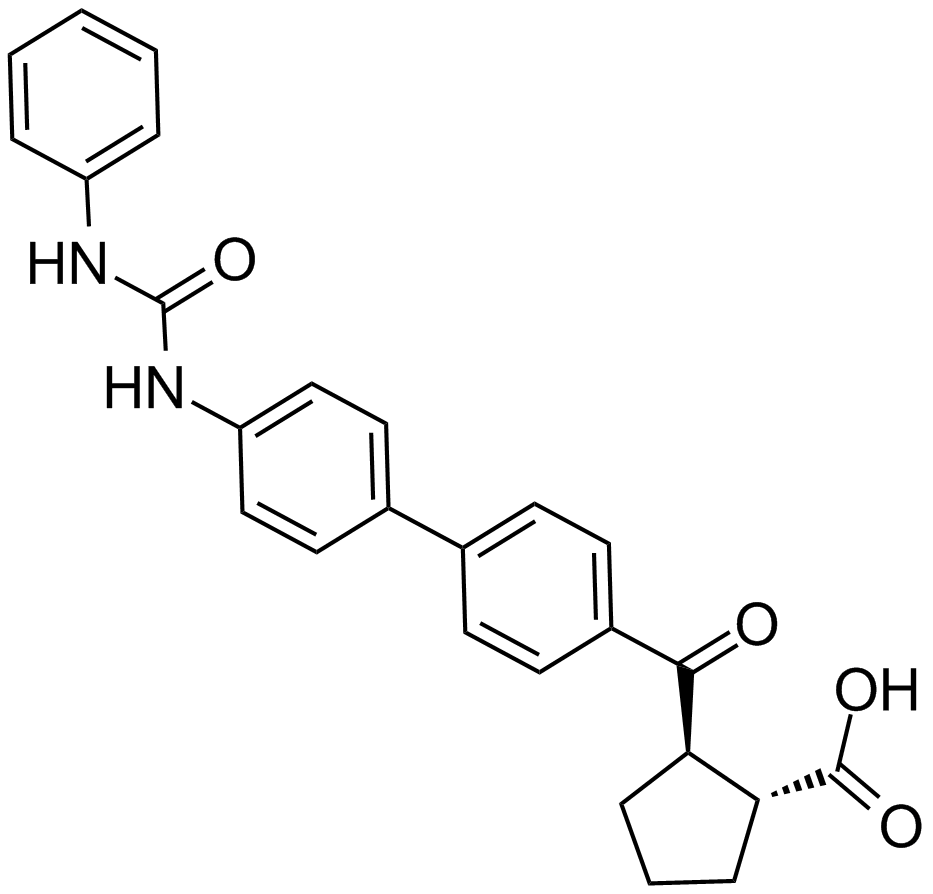
Cas No.: 959122-11-3
Sample solution is provided at 25 µL, 10mM.
_1-3.$$$39978408@51.jpg');)
_1-9.$$$38538795@65.jpg');)
_1-9.$$$39112701@51.jpg');)
_1-7.$$$37316672@70.jpg');)
_366-372.$$$36198801@70.jpg');)
.$$$38565142@65.jpg');)
_1867-1883.$$$33248023@67.jpg');)
_eads6055.$$$39977546@45.jpg');)
_eadm9805.$$$40080571@45.jpg');)
_eadj3020.$$$39666821@45.jpg');)
_1-20.$$$39757301@28.jpg');)
_1-24.$$$38898113@28.jpg');)
_273-287.$$$36806353@46.jpg');)
_1-16.$$$37156877@44.jpg');)
_1-19.$$$37460805@44.jpg');)
_1291-1307.$$$34518654@46.jpg');)
A922500 es un inhibidor potente, selectivo y biodisponible por vía oral de diacilglicerol aciltransferasa 1 (DGAT-1) con valores de IC50 de 9 y 22nM contra DGAT-1 humano y ratón, respectivamente[1]. DGAT-1 es la enzima clave que limita la velocidad que cataliza el paso final de la síntesis de triglicéridos transfiriendo grupos de acilo grasos al diacilglicerol para formar triglicéridos[2]. A922500 se utiliza generalmente en estudios de diabetes tipo 2, obesidad y trastornos del metabolismo lipídico [3].
In vitro, A922500(10 o 50μM; 54 hpi al día 8)reduce el área de gotas lipídicas citoplasmáticas, aumenta la actividad mitocondrial y el número total de células, y mejora la supervivencia 3posterior a la vitrificación en blastocistos bovinos IVP sin afectar el rendimiento del blastocisto [4].A922500 (40μM; 24h) redujo la formación de gotas de lípidos neutros y disminuyó significativamente la viabilidad celular en los hepatocitos HuH7 bajo carga de ácido oleico no tóxico [5].
In vivo, A922500 (30mg/kg/día; 6 semanas; p.o.) redujo el contenido de triglicéridos en los macrófagos de lavado broncoalveolar, pero no disminuyó la carga bacilar pulmonar o la inflamación en ratones C3HeB/FeJ infectados con Mycobacterium tuberculosis[6]. A922500 (3mg/kg; p.o.) invitió la acumulación de gotitas lipídicas hepáticas inducidas por sepsis, redujo los niveles de AST/ALT y suprimió los marcadores de peroxidación lipídica 4-HNE y 3-NT en el modelo de ratón de ligadura y punción cecal (CLP)[7].
References:
[1] King AJ, Segreti JA, Larson KJ, et al. Diacylglycerol acyltransferase 1 inhibition lowers serum triglycerides in the Zucker fatty rat and the hyperlipidemic hamster. J Pharmacol Exp Ther. 2009;330(2):526-531.
[2] Lee K, Goo JI, Jung HY, et al. Discovery of a novel series of benzimidazole derivatives as diacylglycerol acyltransferase inhibitors. Bioorg Med Chem Lett. 2012;22(24):7456-7460.
[3] Tsuda N, Kumadaki S, Higashi C, et al. Intestine-targeted DGAT1 inhibition improves obesity and insulin resistance without skin aberrations in mice. PLoS One. 2014;9(11):e112027.
[4] Cañón-Beltrán K, Giraldo-Giraldo J, Cajas YN, et al. Inhibiting diacylglycerol acyltransferase-1 reduces lipid biosynthesis in bovine blastocysts produced in vitro. Theriogenology. 2020;158:267-276.
[5] Moliterni C, Vari F, Schifano E, et al. Lipotoxicity of palmitic acid is associated with DGAT1 downregulation and abolished by PPARα activation in liver cells. J Lipid Res. 2024;65(12):100692.
[6] Ruelas Castillo J, Guerrini V, Quijada D, et al. Pharmacologic Inhibition of Macrophage Triglyceride Biosynthesis Pathways Does Not Improve Mycobacterium tuberculosis Control in Infected Mice. J Infect Dis. 2025;231(5):1141-1149.
[7] Teixeira L, Pereira-Dutra FS, Reis PA, et al. Prevention of lipid droplet accumulation by DGAT1 inhibition ameliorates sepsis-induced liver injury and inflammation. JHEP Rep. 2023;6(2):100984.
| Experimentos celulares [1]: | |
Líneas celulares | Células de carcinoma hepatocelular humano Huh-7 |
Método de preparación | Las células Huh-7 del carcinoma hepatocelular humano se mantuvieron en el medio de águila modificado (DMEM) de Dulbecco con bajo contenido de glucosa con un 10% de suero bovino fetal (FBS), 100U/ml de penicilina, 100 μg/ml de estreptomicina y 2mM de glutamina. Las células se cultivaron a 37 °C con una presión parcial del 5% de CO2 en una atmósfera humidificada. El ácido oleico (OA) se disolvió en BSA libre de ácidos grasos a una proporción molar final de 2:1 de ácidos grasos/BSA, cercano al valor observado en suero humano, y se diluyó a una concentración final adecuada en DMEM justo antes de los tratamientos celulares. Las células fueron tratadas con BSA, o 200μM OA, 200μM OA + 40μM A922500 durante 24 horas. Se utilizaron los protocolos de tinción Oil Red O (ORO) y BODIPY para el análisis de LD. Después de los tratamientos con ácidos grasos, las células HuH-7 se lavaron con PBS, se fijaron con paraformaldehído al 4% en PBS pH 7,4 durante 20 minutos, a temperatura ambiente, y se tiñeron con solución de ORO al 0,5% en isopropanol durante 1 hora. Después del lavado de PBS, se cuantificaron el número de LD y el área. |
Condiciones de reacción | 40 μM; 24h |
Áreas de aplicación | A922500 redujo la formación de gotas lipídicas neutras y disminuyó significativamente la viabilidad celular en los hepatocitos HuH7 bajo carga de ácido oleico no tóxico. |
| Experimentos con animales [2]: | |
Modelos animales | Ratones hembra C57BL/6J |
Método de preparación | Los ratones hembra C57BL/6J de 8-12 semanas se mantuvieron en una dieta estándar para roedores con acceso ad libitum al agua bajo un ciclo de luz/oscuridad de 12 horas y temperatura controlada (23±1°C). La sepsis fue inducida por ligadura y punción cecal (CLP). El número de punciones realizadas se varió según el grado de gravedad buscado, con dos perforaciones (sepsis moderada) o nueve perforaciones (sepsis grave) realizadas con una aguja de calibre 22. Los animales simulados se sometieron a una laparotomía idéntica, pero sin ligadura ni pinchazos. A las 6h y 24h después de la cirugía, los ratones sin forma y CLP fueron tratados por vía oral con 3 mg/kg de A922500. Los animales fueron monitoreados durante 48 horas para la supervivencia, la puntuación clínica y el análisis de la temperatura corporal. La evaluación clínica se basó en un protocolo SHIRPA multifactorial. Se recogieron sangre y tejidos hepáticos para su posterior análisis. |
Forma de dosificación | 3 mg/kg; p.o. |
Áreas de aplicación | A922500 (3 mg/kg; p.o.) revirtió la acumulación de gotitas lipídicas hepáticas inducidas por sepsis, redujo los niveles de AST/ALT y suprimió los marcadores de peroxidación lipídica 4-HNE y 3-NT en el modelo de ratón de ligadura y punción cecal (CLP). |
References: | |
| Cas No. | 959122-11-3 | SDF | |
| Sinónimos | (1R,2R)2(4'(3phenylureido)biphenylcarbonyl)cyclopentanecarboxylic acid | ||
| Chemical Name | (1R,2R)-2-[4-[4-(phenylcarbamoylamino)phenyl]benzoyl]cyclopentane-1-carboxylic acid | ||
| Canonical SMILES | C1CC(C(C1)C(=O)O)C(=O)C2=CC=C(C=C2)C3=CC=C(C=C3)NC(=O)NC4=CC=CC=C4 | ||
| Formula | C26H24N2O4 | M.Wt | 428.48 |
| Solubility | ≥ 21.25mg/mL in DMSO | Storage | Store at -20°C |
| General tips | Please select the appropriate solvent to prepare the stock solution according to the
solubility of the product in different solvents; once the solution is prepared, please store it in
separate packages to avoid product failure caused by repeated freezing and thawing.Storage method
and period of the stock solution: When stored at -80°C, please use it within 6 months; when stored
at -20°C, please use it within 1 month. To increase solubility, heat the tube to 37°C and then oscillate in an ultrasonic bath for some time. |
||
| Shipping Condition | Evaluation sample solution: shipped with blue ice. All other sizes available: with RT, or with Blue Ice upon request. | ||
| Prepare stock solution | |||

|
1 mg | 5 mg | 10 mg |
| 1 mM | 2.3338 mL | 11.6692 mL | 23.3383 mL |
| 5 mM | 466.8 μL | 2.3338 mL | 4.6677 mL |
| 10 mM | 233.4 μL | 1.1669 mL | 2.3338 mL |
Step 1: Enter information below (Recommended: An additional animal making an allowance for loss during the experiment)
 g
μL
g
μL
Step 2: Enter the in vivo formulation (This is only the calculator, not formulation. Please contact us first if there is no in vivo formulation at the solubility Section.)
Calculation results:
Working concentration: mg/ml;
Method for preparing DMSO master liquid: mg drug pre-dissolved in μL DMSO ( Master liquid concentration mg/mL, Please contact us first if the concentration exceeds the DMSO solubility of the batch of drug. )
Method for preparing in vivo formulation: Take μL DMSO master liquid, next addμL PEG300, mix and clarify, next addμL Tween 80, mix and clarify, next add μL saline, mix and clarify.
Method for preparing in vivo formulation: Take μL DMSO master liquid, next add μL Corn oil, mix and clarify.
Note: 1. Please make sure the liquid is clear before adding the next solvent.
2. Be sure to add the solvent(s) in order. You must ensure that the solution obtained, in the previous addition, is a clear solution before proceeding to add the next solvent. Physical methods such as vortex, ultrasound or hot water bath can be used to aid dissolving.
3. All of the above co-solvents are available for purchase on the GlpBio website.
Quality Control & SDS
- View current batch:
- Purity: >98.50% Appearance: A solid
- COA (Certificate of Analysis)
- SDS (Safety Data Sheet)
- Datasheet
Average Rating: 5 (Based on Reviews and 30 reference(s) in Google Scholar.)