

A922500 (Synonyms: (1R,2R)2(4'(3phenylureido)biphenylcarbonyl)cyclopentanecarboxylic acid) |
Catalog No.GC15614
 One-Click Copy Product Info
|

A922500 is a potent, selective, and orally bioavailable diacylglycerol acyltransferase 1 (DGAT-1) inhibitor with IC50 values of 9 and 22nM against human and mouse DGAT-1, respectively.
Products are for research use only. Not for human use. We do not sell to patients.
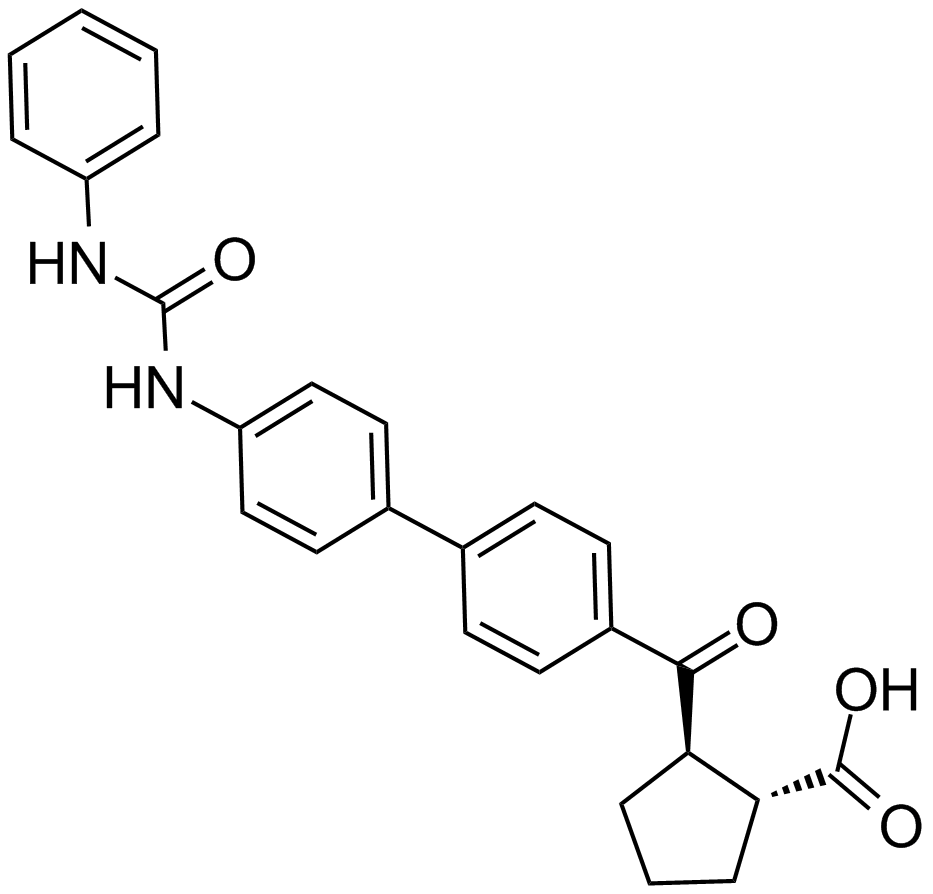
Cas No.: 959122-11-3
Sample solution is provided at 25 µL, 10mM.
_1-3.$$$39978408@51.jpg');)
_1-9.$$$38538795@65.jpg');)
_1-9.$$$39112701@51.jpg');)
_1-7.$$$37316672@70.jpg');)
_366-372.$$$36198801@70.jpg');)
.$$$38565142@65.jpg');)
_1867-1883.$$$33248023@67.jpg');)
_eads6055.$$$39977546@45.jpg');)
_eadm9805.$$$40080571@45.jpg');)
_eadj3020.$$$39666821@45.jpg');)
_1-20.$$$39757301@28.jpg');)
_1-24.$$$38898113@28.jpg');)
_273-287.$$$36806353@46.jpg');)
_1-16.$$$37156877@44.jpg');)
_1-19.$$$37460805@44.jpg');)
_1291-1307.$$$34518654@46.jpg');)
A922500 is a potent, selective, and orally bioavailable diacylglycerol acyltransferase 1 (DGAT-1) inhibitor with IC50 values of 9 and 22nM against human and mouse DGAT-1, respectively[1]. DGAT-1 is the key rate-limiting enzyme that catalyzes the final step of triglyceride synthesis by transferring fatty acyl groups to diacylglycerol to form triglycerides[2]. A922500 is usualy used in studies of type 2 diabetes, obesity, and lipid-metabolism disorders[3].
In vitro, A922500(10 or 50μM; 54 hpi to Day 8)reduces cytoplasmic lipid droplet area, increases mitochondrial activity and total cell number, and improves post-vitrification survival in bovine IVP blastocysts without affecting blastocyst yield[4].A922500 (40μM; 24h) reduced neutral lipid droplet formation and significantly decreased cell viability in HuH7 hepatocytes under non-toxic oleic acid loading[5].
In vivo, A922500 (30mg/kg/day; 6 weeks; p.o.) reduced triglyceride content in bronchoalveolar lavage macrophages but did not decrease lung bacillary burden or inflammation in Mycobacterium tuberculosis-infected C3HeB/FeJ mice[6]. A922500 (3mg/kg; p.o.) reversed sepsis-induced hepatic lipid droplet accumulation, reduced AST/ALT levels, and suppressed lipid peroxidation markers 4-HNE and 3-NT in caecal ligation and puncture (CLP) mouse model[7].
References:
[1] King AJ, Segreti JA, Larson KJ, et al. Diacylglycerol acyltransferase 1 inhibition lowers serum triglycerides in the Zucker fatty rat and the hyperlipidemic hamster. J Pharmacol Exp Ther. 2009;330(2):526-531.
[2] Lee K, Goo JI, Jung HY, et al. Discovery of a novel series of benzimidazole derivatives as diacylglycerol acyltransferase inhibitors. Bioorg Med Chem Lett. 2012;22(24):7456-7460.
[3] Tsuda N, Kumadaki S, Higashi C, et al. Intestine-targeted DGAT1 inhibition improves obesity and insulin resistance without skin aberrations in mice. PLoS One. 2014;9(11):e112027.
[4] Cañón-Beltrán K, Giraldo-Giraldo J, Cajas YN, et al. Inhibiting diacylglycerol acyltransferase-1 reduces lipid biosynthesis in bovine blastocysts produced in vitro. Theriogenology. 2020;158:267-276.
[5] Moliterni C, Vari F, Schifano E, et al. Lipotoxicity of palmitic acid is associated with DGAT1 downregulation and abolished by PPARα activation in liver cells. J Lipid Res. 2024;65(12):100692.
[6] Ruelas Castillo J, Guerrini V, Quijada D, et al. Pharmacologic Inhibition of Macrophage Triglyceride Biosynthesis Pathways Does Not Improve Mycobacterium tuberculosis Control in Infected Mice. J Infect Dis. 2025;231(5):1141-1149.
[7] Teixeira L, Pereira-Dutra FS, Reis PA, et al. Prevention of lipid droplet accumulation by DGAT1 inhibition ameliorates sepsis-induced liver injury and inflammation. JHEP Rep. 2023;6(2):100984.
| Cell experiment [1]: | |
Cell lines | Human hepatocellular carcinoma Huh-7 cells |
Preparation Method | Human hepatocellular carcinoma Huh-7 cells were maintained in Dulbecco's Modified Eagle Medium (DMEM) low glucose with 10% fetal bovine serum (FBS), 100U/ml penicillin, 100μg/ml streptomycin, and 2mM glutamine. Cells were cultured at 37°C with 5% partial pressure of CO2 in a humidified atmosphere. Oleic acid(OA) was dissolved in fatty-acid-free BSA at a final molar ratio of 2:1 fatty acids/BSA, close to the value observed in human serum, and diluted to a proper final concentration in DMEM just before cell treatments. Cells were treated with BSA, or 200μM OA, 200μM OA + 40μM A922500 for 24h. Oil Red O (ORO) and BODIPY stain protocols were used for LD analysis. Following fatty acid treatments, HuH-7 cells were washed with PBS, fixed with 4% paraformaldehyde in PBS pH 7.4 for 20min, at room temperature, and stained with 0.5% ORO solution in isopropanol for 1h. After PBS washing, the LD number and area were quantified. |
Reaction Conditions | 40μM; 24h |
Applications | A922500 reduced neutral lipid droplet formation and significantly decreased cell viability in HuH7 hepatocytes under non-toxic oleic acid loading. |
| Animal experiment [2]: | |
Animal models | Female C57BL/6J mice |
Preparation Method | 8–12 weeks Female C57BL/6J mice were maintained on a standard rodent diet with ad libitum access to water under a 12h light/dark cycle and controlled temperature (23±1°C). Sepsis was induced by caecal ligation and puncture (CLP) . The number of punctures performed was varied according to the degree of severity sought, with either two perforations (moderate sepsis) or nine perforations (severe sepsis) made using a 22-gauge needle. Sham-operated animals underwent identical laparotomy but without ligation and punctures. At 6h and 24h postsurgery, sham and CLP mice were orally treated with 3mg/kg A922500. Animals were monitored for 48h for survival, clinical score, and body temperature analysis. The clinical evaluation was based on a multifactorial SHIRPA protocol. Blood and liver tissues were collected for further analysis. |
Dosage form | 3mg/kg; p.o. |
Applications | A922500 (3mg/kg; p.o.) reversed sepsis-induced hepatic lipid droplet accumulation, reduced AST/ALT levels, and suppressed lipid peroxidation markers 4-HNE and 3-NT in caecal ligation and puncture (CLP) mouse model. |
References: | |
| Cas No. | 959122-11-3 | SDF | |
| Synonyms | (1R,2R)2(4'(3phenylureido)biphenylcarbonyl)cyclopentanecarboxylic acid | ||
| Chemical Name | (1R,2R)-2-[4-[4-(phenylcarbamoylamino)phenyl]benzoyl]cyclopentane-1-carboxylic acid | ||
| Canonical SMILES | C1CC(C(C1)C(=O)O)C(=O)C2=CC=C(C=C2)C3=CC=C(C=C3)NC(=O)NC4=CC=CC=C4 | ||
| Formula | C26H24N2O4 | M.Wt | 428.48 |
| Solubility | ≥ 21.25mg/mL in DMSO | Storage | Store at -20°C |
| General tips | Please select the appropriate solvent to prepare the stock solution according to the
solubility of the product in different solvents; once the solution is prepared, please store it in
separate packages to avoid product failure caused by repeated freezing and thawing.Storage method
and period of the stock solution: When stored at -80°C, please use it within 6 months; when stored
at -20°C, please use it within 1 month. To increase solubility, heat the tube to 37°C and then oscillate in an ultrasonic bath for some time. |
||
| Shipping Condition | Evaluation sample solution: shipped with blue ice. All other sizes available: with RT, or with Blue Ice upon request. | ||
| Prepare stock solution | |||

|
1 mg | 5 mg | 10 mg |
| 1 mM | 2.3338 mL | 11.6692 mL | 23.3383 mL |
| 5 mM | 466.8 μL | 2.3338 mL | 4.6677 mL |
| 10 mM | 233.4 μL | 1.1669 mL | 2.3338 mL |
Step 1: Enter information below (Recommended: An additional animal making an allowance for loss during the experiment)
 g
μL
g
μL
Step 2: Enter the in vivo formulation (This is only the calculator, not formulation. Please contact us first if there is no in vivo formulation at the solubility Section.)
Calculation results:
Working concentration: mg/ml;
Method for preparing DMSO master liquid: mg drug pre-dissolved in μL DMSO ( Master liquid concentration mg/mL, Please contact us first if the concentration exceeds the DMSO solubility of the batch of drug. )
Method for preparing in vivo formulation: Take μL DMSO master liquid, next addμL PEG300, mix and clarify, next addμL Tween 80, mix and clarify, next add μL saline, mix and clarify.
Method for preparing in vivo formulation: Take μL DMSO master liquid, next add μL Corn oil, mix and clarify.
Note: 1. Please make sure the liquid is clear before adding the next solvent.
2. Be sure to add the solvent(s) in order. You must ensure that the solution obtained, in the previous addition, is a clear solution before proceeding to add the next solvent. Physical methods such as vortex, ultrasound or hot water bath can be used to aid dissolving.
3. All of the above co-solvents are available for purchase on the GlpBio website.
Quality Control & SDS
- View current batch:
- Purity: >98.50% Appearance: A solid
- COA (Certificate of Analysis)
- SDS (Safety Data Sheet)
- Datasheet
Average Rating: 5 (Based on Reviews and 30 reference(s) in Google Scholar.)