

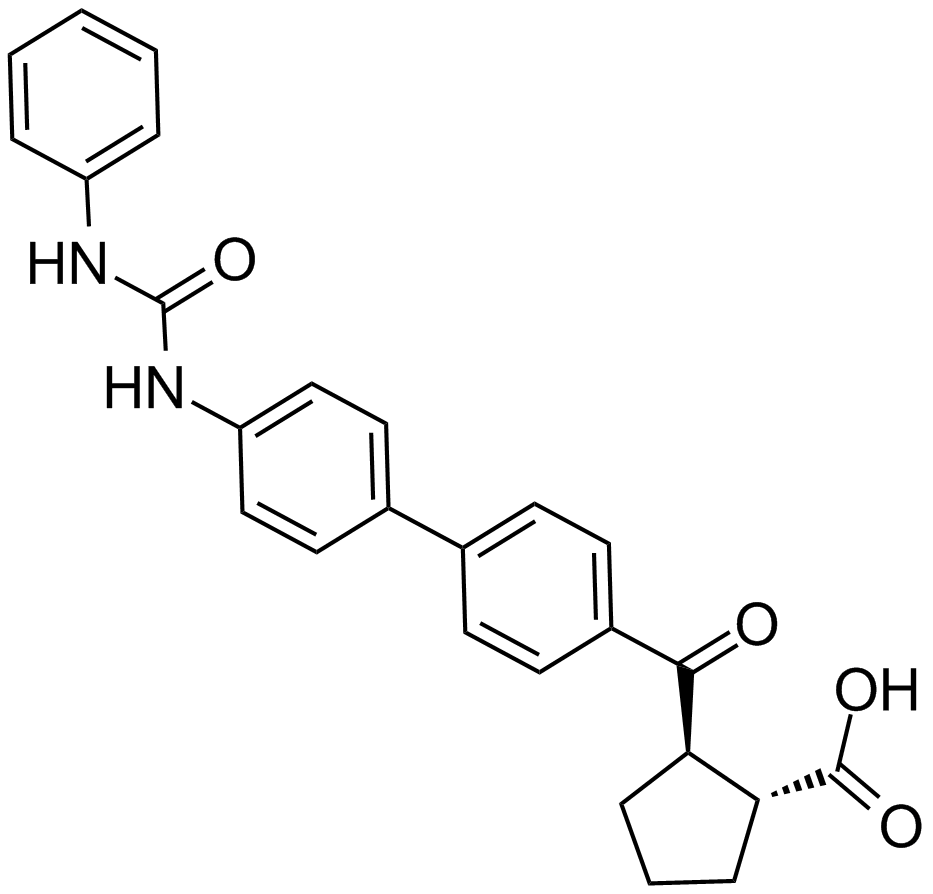
A922500 (Synonyms: (1R,2R)2(4'(3phenylureido)biphenylcarbonyl)cyclopentanecarboxylic acid) |
カタログ番号GC15614
 One-Click Copy Product Info
|

A922500は強力で選択的で経口活性のあるジアシルグリセロールアシルトランスフェラーゼ1(DGAT-1)阻害剤であり、9および22nMのIC50値でそれぞれヒトおよびマウスDGAT-1を阻害する
Products are for research use only. Not for human use. We do not sell to patients.
Cas No.: 959122-11-3
Sample solution is provided at 25 µL, 10mM.
_1-3.$$$39978408@51.jpg');)
_1-9.$$$38538795@65.jpg');)
_1-9.$$$39112701@51.jpg');)
_1-7.$$$37316672@70.jpg');)
_366-372.$$$36198801@70.jpg');)
.$$$38565142@65.jpg');)
_1867-1883.$$$33248023@67.jpg');)
_eads6055.$$$39977546@45.jpg');)
_eadm9805.$$$40080571@45.jpg');)
_eadj3020.$$$39666821@45.jpg');)
_1-20.$$$39757301@28.jpg');)
_1-24.$$$38898113@28.jpg');)
_273-287.$$$36806353@46.jpg');)
_1-16.$$$37156877@44.jpg');)
_1-19.$$$37460805@44.jpg');)
_1291-1307.$$$34518654@46.jpg');)
A922500は強力で選択的で経口活性のあるジアシルグリセロールアシルトランスフェラーゼ1(DGAT-1)阻害剤であり、9および22nMのIC50値でそれぞれヒトおよびマウスDGAT-1を阻害する。DGAT-1は脂肪アシル基をジアシルグリセロールに移行させてトリグリセリドを形成することでトリグリセリド合成の最終段階を触媒する主要な律速因子(酵素)である。A922500は2型糖尿病、肥満、脂質代謝異常に関する研究に使われている。
In vitroでは、A922500(10または50μM; 感染後54時間から8日目)は牛IVP(体外生産胚)において、胚盤胞収量に影響を与えることなく、細胞質内脂質滴の面積を減少させ、ミトコンドリアの活性と総細胞数を増加させ、凍結保存後の生存率を改善する。A922500 (40μM; 24h)は中性脂質滴形成を減少させ、非毒性オレイン酸負荷下においてHuH7肝細胞における細胞生存率を有意に減少させた。
In vivoでは、A922500 (30mg/kg/日; 6週間; p.o.)は結核菌に感染したC3HeB/FeJマウスにおいて肺の細菌負荷や炎症を減少しなかったが、気管支肺胞洗浄液マクロファージ中のトリグリセリド含有量を減少した。A922500 (3mg/kg; p.o.)は盲腸結紮穿刺(CLP)マウスモデルにおいて、敗血症による肝臓の脂質滴蓄積を逆転させ、AST/ALT値を低下させ、脂質過酸化マーカーである4-HNEおよび3-NTを抑制した。
References:
[1] King AJ, Segreti JA, Larson KJ, et al. Diacylglycerol acyltransferase 1 inhibition lowers serum triglycerides in the Zucker fatty rat and the hyperlipidemic hamster. J Pharmacol Exp Ther. 2009;330(2):526-531.
[2] Lee K, Goo JI, Jung HY, et al. Discovery of a novel series of benzimidazole derivatives as diacylglycerol acyltransferase inhibitors. Bioorg Med Chem Lett. 2012;22(24):7456-7460.
[3] Tsuda N, Kumadaki S, Higashi C, et al. Intestine-targeted DGAT1 inhibition improves obesity and insulin resistance without skin aberrations in mice. PLoS One. 2014;9(11):e112027.
[4] Cañón-Beltrán K, Giraldo-Giraldo J, Cajas YN, et al. Inhibiting diacylglycerol acyltransferase-1 reduces lipid biosynthesis in bovine blastocysts produced in vitro. Theriogenology. 2020;158:267-276.
[5] Moliterni C, Vari F, Schifano E, et al. Lipotoxicity of palmitic acid is associated with DGAT1 downregulation and abolished by PPARα activation in liver cells. J Lipid Res. 2024;65(12):100692.
[6] Ruelas Castillo J, Guerrini V, Quijada D, et al. Pharmacologic Inhibition of Macrophage Triglyceride Biosynthesis Pathways Does Not Improve Mycobacterium tuberculosis Control in Infected Mice. J Infect Dis. 2025;231(5):1141-1149.
[7] Teixeira L, Pereira-Dutra FS, Reis PA, et al. Prevention of lipid droplet accumulation by DGAT1 inhibition ameliorates sepsis-induced liver injury and inflammation. JHEP Rep. 2023;6(2):100984.
| 細胞実験[1]: | |
細胞株 | ヒト肝細胞癌Huh-7細胞 |
準備方法 | ヒト肝細胞癌Huh-7細胞は、低グルコースDulbecco's Modified Eagle Medium(DMEM)に10%胎児牛血清(FBS)、100U/mlペニシリン、100μg/mlストレプトマイシン、2mMグルタミンを加えて維持した。細胞は37℃、5%CO₂分圧の加湿下で培養した。オレイン酸(OA)は、ヒト血清で観察される値に近い脂肪酸/BSAの最終モル比2:1となるよう、無脂肪酸BSAに溶解し、細胞処理直前にDMEM中で適切な最終濃度に希釈した。細胞は、BSA、または200μM OA、200μM OA + 40μM A922500で24時間処理した。脂質滴(LD)解析にはOil Red O(ORO)およびBODIPY染色プロトコルを用いた。脂肪酸処理後、HuH-7細胞をPBSで洗浄し、pH 7.4 PBS中の4%パラホルムアルデヒドで室温20分間固定後、イソプロパノール中の0.5% ORO溶液で1時間染色した。PBS洗浄後、脂質滴の数と面積を定量した。 |
反応条件 | 40μM; 24h |
アプリケーション | A922500は中性脂質滴形成を減少させ、非毒性オレイン酸負荷下においてHuH7肝細胞における細胞生存率を有意に減少させた。 |
| 動物実験 [2]: | |
動物モデル | 雌性C57BL/6Jマウス |
準備方法 | 8~12週齢の雌性C57BL/6Jマウスを、標準的なげっ歯類用飼料を与え、水は自由摂取可能とし、12時間明暗サイクルおよび温度管理(23±1℃)下で飼育した。敗血症は盲腸結紮穿孔(CLP)により誘導した。穿孔数は重症度に応じて調整し、22ゲージ針を用いて穿孔を2箇所(中等度敗血症)または9箇所(重度敗血症)行った。偽手術群は同様の開腹手術を実施したが、結紮および穿孔は行わなかった。手術後6時間および24時間に、偽手術群およびCLP群マウスに3mg/kgのA922500を経口投与した。生存率、臨床スコア、体温分析について48時間にわたり動物をモニタリングした。臨床評価は多因子SHIRPAプロトコルに基づいた。血液および肝臓組織を採取し、詳細な分析に供した。 |
投与形態 | 3mg/kg; p.o. |
アプリケーション | A922500 (3mg/kg; p.o.)は盲腸結紮穿刺(CLP)マウスモデルにおいて、敗血症による肝臓の脂質滴蓄積を逆転させ、AST/ALT値を低下させ、脂質過酸化マーカーである4-HNEおよび3-NTを抑制した。 |
References: | |
| Cas No. | 959122-11-3 | SDF | |
| 同義語 | (1R,2R)2(4'(3phenylureido)biphenylcarbonyl)cyclopentanecarboxylic acid | ||
| Chemical Name | (1R,2R)-2-[4-[4-(phenylcarbamoylamino)phenyl]benzoyl]cyclopentane-1-carboxylic acid | ||
| Canonical SMILES | C1CC(C(C1)C(=O)O)C(=O)C2=CC=C(C=C2)C3=CC=C(C=C3)NC(=O)NC4=CC=CC=C4 | ||
| Formula | C26H24N2O4 | M.Wt | 428.48 |
| 溶解度 | ≥ 21.25mg/mL in DMSO | Storage | Store at -20°C |
| General tips | Please select the appropriate solvent to prepare the stock solution according to the
solubility of the product in different solvents; once the solution is prepared, please store it in
separate packages to avoid product failure caused by repeated freezing and thawing.Storage method
and period of the stock solution: When stored at -80°C, please use it within 6 months; when stored
at -20°C, please use it within 1 month. To increase solubility, heat the tube to 37°C and then oscillate in an ultrasonic bath for some time. |
||
| Shipping Condition | Evaluation sample solution: shipped with blue ice. All other sizes available: with RT, or with Blue Ice upon request. | ||
| Prepare stock solution | |||

|
1 mg | 5 mg | 10 mg |
| 1 mM | 2.3338 mL | 11.6692 mL | 23.3383 mL |
| 5 mM | 466.8 μL | 2.3338 mL | 4.6677 mL |
| 10 mM | 233.4 μL | 1.1669 mL | 2.3338 mL |
Step 1: Enter information below (Recommended: An additional animal making an allowance for loss during the experiment)
 g
μL
g
μL
Step 2: Enter the in vivo formulation (This is only the calculator, not formulation. Please contact us first if there is no in vivo formulation at the solubility Section.)
Calculation results:
Working concentration: mg/ml;
Method for preparing DMSO master liquid: mg drug pre-dissolved in μL DMSO ( Master liquid concentration mg/mL, Please contact us first if the concentration exceeds the DMSO solubility of the batch of drug. )
Method for preparing in vivo formulation: Take μL DMSO master liquid, next addμL PEG300, mix and clarify, next addμL Tween 80, mix and clarify, next add μL saline, mix and clarify.
Method for preparing in vivo formulation: Take μL DMSO master liquid, next add μL Corn oil, mix and clarify.
Note: 1. Please make sure the liquid is clear before adding the next solvent.
2. Be sure to add the solvent(s) in order. You must ensure that the solution obtained, in the previous addition, is a clear solution before proceeding to add the next solvent. Physical methods such as vortex, ultrasound or hot water bath can be used to aid dissolving.
3. All of the above co-solvents are available for purchase on the GlpBio website.
Quality Control & SDS
- View current batch:
- Purity: >98.50% Appearance: A solid
- COA (Certificate of Analysis)
- SDS (Safety Data Sheet)
- Datasheet
Average Rating: 5 (Based on Reviews and 30 reference(s) in Google Scholar.)