

Baicalin (Synonyms: Baicalein 7-glucuronide) |
Catalog No.GN10018
 One-Click Copy Product Info
|

Baicalin es un glucósido flavonoide y un activador alostérico de la carnitina palmitoiltransferasa 1 (CPT1).
Products are for research use only. Not for human use. We do not sell to patients.
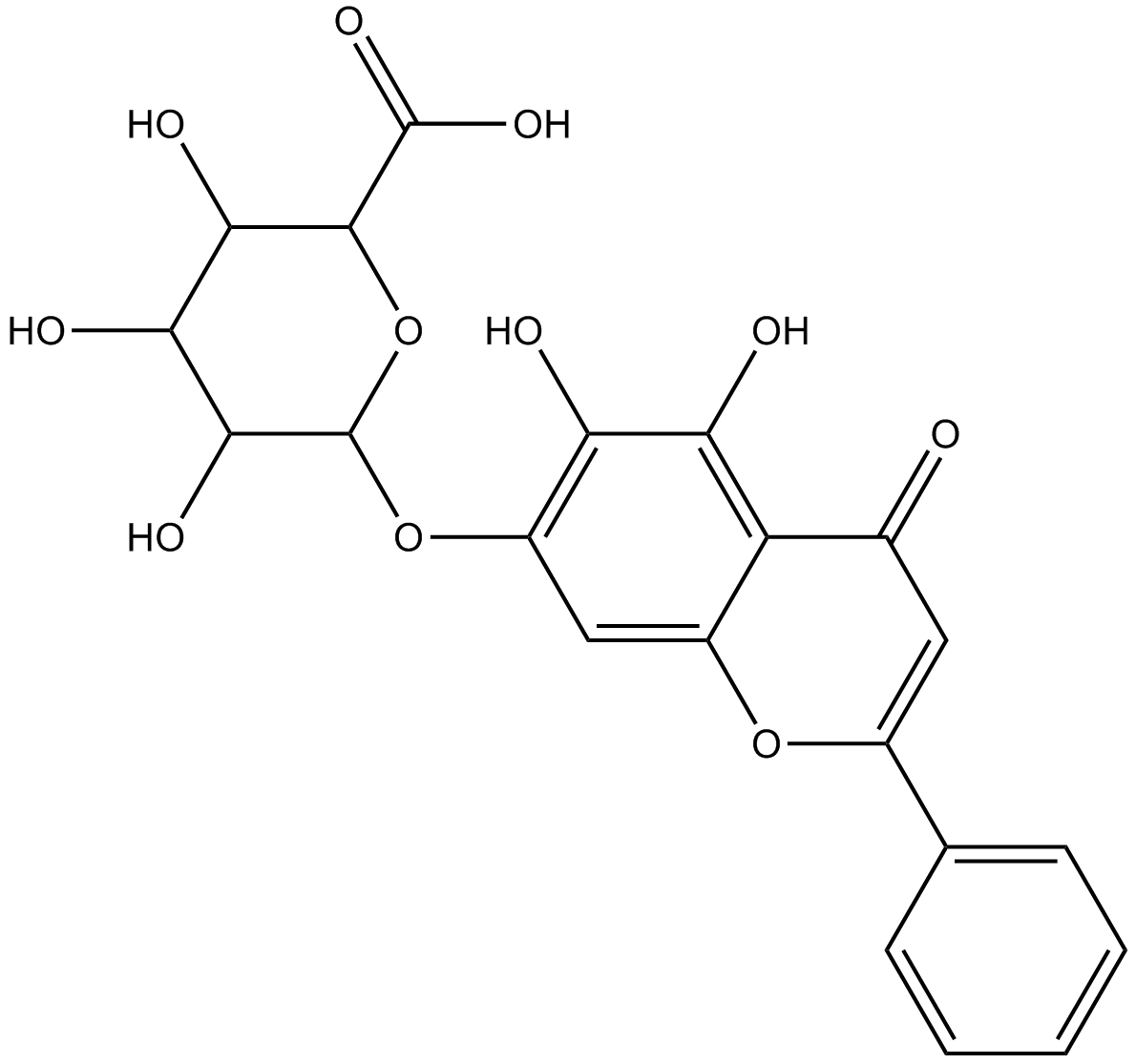
Cas No.: 21967-41-9
Sample solution is provided at 25 µL, 10mM.
Baicalin es un glucósido flavonoide y un activador alostérico de la carnitina palmitoiltransferasa 1 (CPT1)[1]. La baicalina puede inhibir la replicación del virus de la inmunodeficiencia humana tipo 1 (HIV-1)[2]. Además, la baicalina puede reducir la expresión de NF-κB y mediar la regulación de vías clave de señalización relacionadas con el cáncer[3].
In vitro, el tratamiento con baicalina (0.005-0.5nM) en células RAW264.7 inhibió la proliferación celular inducida por LPS y redujo la expresión de la molécula de adhesión intercelular-1 (ICAM-1), la proteína quimioatrayente de monocitos-1 (MCP-1) y las proteínas ciclooxigenasa-2 (Cox-2)[4]. El pretratamiento con baicalina (100μM) en células HK-2 durante 1 hora mejoró la viabilidad celular después de la estimulación con H2O2, redujo el estrés oxidativo e inhibió la activación de caspasa-3 y la apoptosis celular[5].
In vivo, la baicalina (10, 100 mg/kg) se inyectó intraperitonealmente en ratas con lesión por isquemia-reperfusión renal (IRI), lo que redujo el estrés oxidativo y el daño histológico, mejoró la función renal, inhibió la respuesta proinflamatoria y la apoptosis tubular, y redujo la expresión de proteínas como TLR2, TLR4, MyD88, p-NF-κB y p-IκB, así como la actividad de caspasa-3, mientras que aumentó la proporción Bcl-2/Bax[6]. Además, la baicalina (400 mg/kg) fue inyectada intraperitonealmente en ratones con nefropatía diabética (DN), lo que mejoró eficazmente las condiciones diabéticas, la proteinuria, los cambios histopatológicos renales y la apoptosis celular, inhibiendo la activación de la vía de señalización proinflamatoria clásica de la familia MAPK, como las vías de señalización de Erk1/2, JNK y P38MAPK[7].
References:
[1] Dai J, Liang K, Zhao S, et al. Chemoproteomics reveals baicalin activates hepatic CPT1 to ameliorate diet-induced obesity and hepatic steatosis[J]. Proceedings of the National Academy of Sciences, 2018, 115(26): E5896-E5905.
[2] Kitamura K, Honda M, Yoshizaki H, et al. Baicalin, an inhibitor of HIV-1 production in vitro[J]. Antiviral research, 1998, 37(2): 131-140.
[3] Yu X, Liu Y, Wang Y, et al. Baicalein induces cervical cancer apoptosis through the NF-κB signaling pathway[J]. Molecular Medicine Reports, 2018, 17(4): 5088-5094.
[4] Cui L, Feng L, Zhang Z H, et al. The anti-inflammation effect of baicalin on experimental colitis through inhibiting TLR4/NF-κB pathway activation[J]. International Immunopharmacology, 2014, 23(1): 294-303.
[5] Lin M, Li L, Zhang Y, et al. Baicalin ameliorates H2O2 induced cytotoxicity in HK-2 cells through the inhibition of ER stress and the activation of Nrf2 signaling[J]. International journal of molecular sciences, 2014, 15(7): 12507-12522.
[6] Lin M, Li L, Li L, et al. The protective effect of baicalin against renal ischemia-reperfusion injury through inhibition of inflammation and apoptosis[J]. BMC complementary and alternative medicine, 2014, 14: 1-9.
[7] Ma L, Wu F, Shao Q, et al. Baicalin alleviates oxidative stress and inflammation in diabetic nephropathy via Nrf2 and MAPK signaling pathway[J]. Drug design, development and therapy, 2021: 3207-3221.
| Experimentos celulares [1]: | |
Líneas celulares | Células RAW264.7 |
Método de preparación | Se trataron las células con 0.005-0.5nM de baicalina y LPS (1 μg/ml). Se añadió una solución de MTT de 10μl (5mg/ml) a cada pozo durante 4 horas. Al final de la incubación, se añadió 100μl de DMSO durante 10 minutos después de retirar el medio. |
Condiciones de reacción | 0.005-0.5nM; 4h |
Áreas de aplicación | La exposición a 1μg/ml de LPS aumentó significativamente la proliferación celular, mientras que la baicalina inhibió la proliferación de células RAW264.7 inducida por LPS. |
| Experimentos con animales [2]: | |
Modelos animales | Ratas Wistar machos |
Método de preparación | Las ratas fueron divididas aleatoriamente en cinco grupos de seis ratas cada uno. Se indujo la IRI renal mediante el pinzamiento de la arteria renal izquierda durante 45 minutos junto con una nefrectomía derecha. Los animales tratados con solución salina recibieron inyecciones intraperitoneales de 1 mL de NaCl estéril al 0.9% 30 minutos antes del pinzamiento renal. Las ratas tratadas con baicalina recibieron inyecciones intraperitoneales de baicalina, diluida en solución salina estéril a 1, 10 o 100 mg/kg de peso corporal, 30 minutos antes del pinzamiento renal. |
Forma de dosificación | 1, 10 o 100 mg/kg; i.p. |
Áreas de aplicación | El tratamiento con baicalina disminuyó el estrés oxidativo y el daño histológico, mejoró la función renal e inhibió las respuestas proinflamatorias y la apoptosis tubular. |
Referencias: [1] Cui L, Feng L, Zhang Z H, et al. The anti-inflammation effect of baicalin on experimental colitis through inhibiting TLR4/NF-κB pathway activation[J]. International Immunopharmacology, 2014, 23(1): 294-303. [2] Lin M, Li L, Li L, et al. The protective effect of baicalin against renal ischemia-reperfusion injury through inhibition of inflammation and apoptosis[J]. BMC complementary and alternative medicine, 2014, 14: 1-9. | |
| Cas No. | 21967-41-9 | SDF | |
| Sinónimos | Baicalein 7-glucuronide | ||
| Chemical Name | (2S,3S,4S,5R,6S)-6-(5,6-dihydroxy-4-oxo-2-phenylchromen-7-yl)oxy-3,4,5-trihydroxyoxane-2-carboxylic acid | ||
| Canonical SMILES | C1=CC=C(C=C1)C2=CC(=O)C3=C(C(=C(C=C3O2)OC4C(C(C(C(O4)C(=O)O)O)O)O)O)O | ||
| Formula | C21H18O11 | M.Wt | 446.37 |
| Solubility | DMSO: ≥ 100 mg/mL (224.03 mM) | Storage | Store at -20°C |
| General tips | Please select the appropriate solvent to prepare the stock solution according to the
solubility of the product in different solvents; once the solution is prepared, please store it in
separate packages to avoid product failure caused by repeated freezing and thawing.Storage method
and period of the stock solution: When stored at -80°C, please use it within 6 months; when stored
at -20°C, please use it within 1 month. To increase solubility, heat the tube to 37°C and then oscillate in an ultrasonic bath for some time. |
||
| Shipping Condition | Evaluation sample solution: shipped with blue ice. All other sizes available: with RT, or with Blue Ice upon request. | ||
| Prepare stock solution | |||

|
1 mg | 5 mg | 10 mg |
| 1 mM | 2.2403 mL | 11.2015 mL | 22.4029 mL |
| 5 mM | 448.1 μL | 2.2403 mL | 4.4806 mL |
| 10 mM | 224 μL | 1.1201 mL | 2.2403 mL |
Step 1: Enter information below (Recommended: An additional animal making an allowance for loss during the experiment)
 g
μL
g
μL
Step 2: Enter the in vivo formulation (This is only the calculator, not formulation. Please contact us first if there is no in vivo formulation at the solubility Section.)
Calculation results:
Working concentration: mg/ml;
Method for preparing DMSO master liquid: mg drug pre-dissolved in μL DMSO ( Master liquid concentration mg/mL, Please contact us first if the concentration exceeds the DMSO solubility of the batch of drug. )
Method for preparing in vivo formulation: Take μL DMSO master liquid, next addμL PEG300, mix and clarify, next addμL Tween 80, mix and clarify, next add μL saline, mix and clarify.
Method for preparing in vivo formulation: Take μL DMSO master liquid, next add μL Corn oil, mix and clarify.
Note: 1. Please make sure the liquid is clear before adding the next solvent.
2. Be sure to add the solvent(s) in order. You must ensure that the solution obtained, in the previous addition, is a clear solution before proceeding to add the next solvent. Physical methods such as vortex, ultrasound or hot water bath can be used to aid dissolving.
3. All of the above co-solvents are available for purchase on the GlpBio website.
Quality Control & SDS
- View current batch:
- Purity: >98.00% Appearance: A solid
- COA (Certificate of Analysis)
- SDS (Safety Data Sheet)
- Datasheet
-
Related Biological Data

Baicalin prevented ΔΨm loss and mitochondrial ROS generation that BLM-induced in MLE-12, 5-HD blocked the protective effect. (A) MitoTracker (red) probe indicated the change of mitochondrial membrane potential changes in MLE-12 cells.
For experiments, cells were seeded in plates and grown to 60%− 70% confluency before they were treated with 5-Hydroxydecanoate sodium was (100μM) for 30min, diazoxide (100μM) or baicalin (90μM,GLPBIO, USA) for 30min.
Toxicology (2023): 153638. PMID: 37783230 IF: 4.5003 -
Related Biological Data

Baicalin inhibited expression of FTH1 in OSCC cells. (I, J) Western blot analysis of FTH1 expression changes after overexpression and baicalin treatment.
The CCK8 assay was used to detect the cell viability of Cal27 and SCC25 cells treated with baicalin (GLPBIO, USA) at 0, 5, 10, 20, 4, and 60μM for 24h.
The Journal of Gene Medicine 26.2 (2024): e3669. PMID: 38380717 IF: 3.5
Average Rating: 5 (Based on Reviews and 30 reference(s) in Google Scholar.)