

CA 074 (Synonyms: CA-074,CA074) |
Catalog No.GC16317
 One-Click Copy Product Info
|

CA 074 es un inhibidor selectivo de la catepsina B con un valor de Ki de 2-5 nM. CA 074 es de 10,000 a 30,000 veces más potente contra la catepsina B purificada de rata que contra las catepsinas H y L.
Products are for research use only. Not for human use. We do not sell to patients.
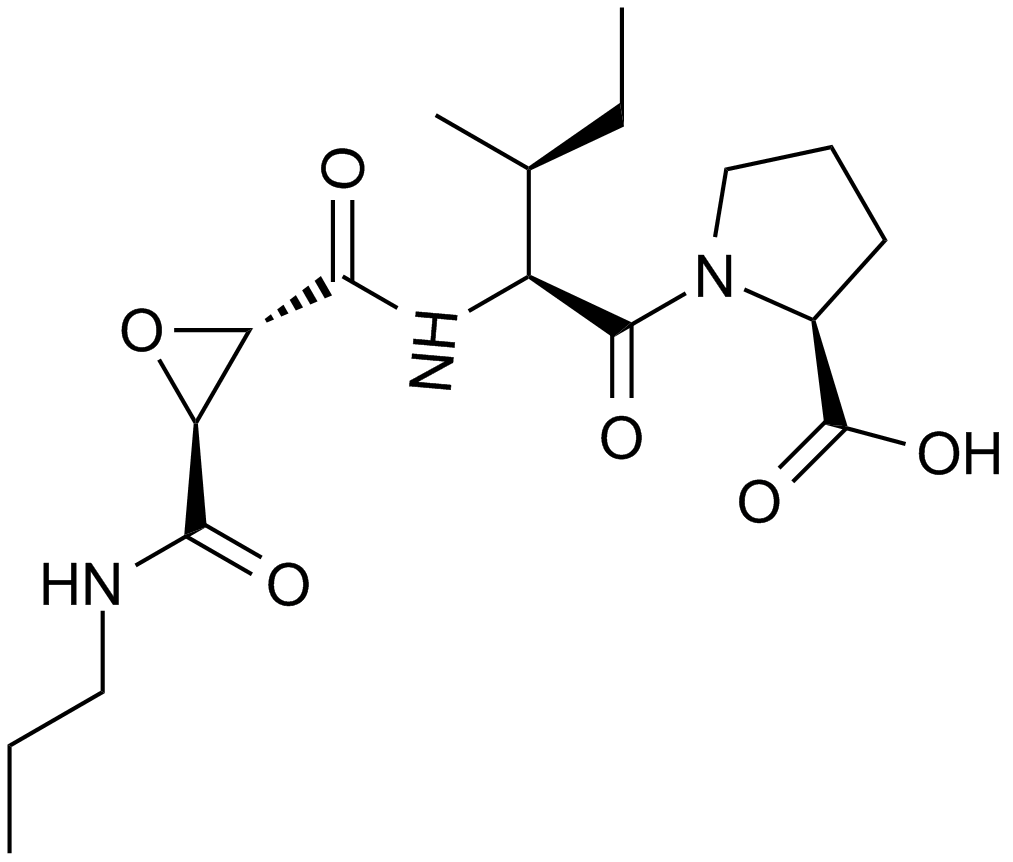
Cas No.: 134448-10-5
Sample solution is provided at 25 µL, 10mM.
CA 074 es un inhibidor selectivo de la catepsina B con un valor de Ki de 2-5 nM. CA 074 es de 10,000 a 30,000 veces más potente contra la catepsina B purificada de rata que contra las catepsinas H y L. CA 074 es un análogo sintético de E-64, un epóxido peptídico natural que inhibe de manera irreversible la mayoría de las cisteín proteasas lisosomales. CA 074 no puede cruzar las membranas celulares, pero su forma de éster metílico, CA-074 Me (GC15917), sí puede hacerlo.
In vitro, el tratamiento con CA 074 (10 μM) de células HT29, DLD1 y SW480 durante 2-3 semanas inhibió significativamente la invasión celular a través de Matrigel en aproximadamente un 45-60%.
In vivo, el tratamiento intravenoso con CA 074 (10 mg/kg) en ratones inoculados con células de melanoma humano inhibió significativamente el crecimiento tumoral y el número de metástasis pulmonares. CA 074 (50 mg/kg) se inyectó por vía intraperitoneal en ratones con tumores 4T1.2, lo que inhibió significativamente el crecimiento tumoral, redujo la actividad de la catepsina B en el tumor e inhibió las metástasis en pulmón y hueso. CA 074 (4 mg/kg) se inyectó por vía intravenosa en ratas con isquemia cerebral focal, lo que redujo significativamente los niveles de catepsina B y L y aumentó el número de neuronas eosinofílicas (necróticas) y apoptóticas en el tejido cerebral.
References:
[1] Towatari T, Nikawa T, Murata M, et al. Novel epoxysuccinyl peptides A selective inhibitor of cathepsin B, in vivo[J]. FEBS letters, 1991, 280(2): 311-315.
[2] Matsumoto K, Mizoue K, Kitamura K, et al. Structural basis of inhibition of cysteine proteases by E‐64 and its derivatives[J]. Peptide Science, 1999, 51(1): 99-107.
[3] Patel N, Nizami S, Song L, et al. CA‐074Me compound inhibits osteoclastogenesis via suppression of the NFATc1 and c‐FOS signaling pathways[J]. Journal of Orthopaedic Research, 2015, 33(10): 1474-1486.
[4] Bian B, Mongrain S, Cagnol S, et al. Cathepsin B promotes colorectal tumorigenesis, cell invasion, and metastasis[J]. Molecular carcinogenesis, 2016, 55(5): 671-687.
[5] Matarrese P, Ascione B, Ciarlo L, et al. Cathepsin B inhibition interferes with metastatic potential of human melanoma: an in vitro and in vivo study[J]. Molecular cancer, 2010, 9: 1-14.
[6] Withana N P, Blum G, Sameni M, et al. Cathepsin B inhibition limits bone metastasis in breast cancer[J]. Cancer research, 2012, 72(5): 1199-1209.
[7] Özkara E, Durmaz R, Özbek Z, et al. The Effect of Ca-074 (Cathepsın B Inhibitor) on Necrotic and Apoptotic Neuronal Cell Death in Model of Cerebral Ischemia[J]. Osmangazi Tıp Dergisi, 2023, 45(5): 781-790.
| Experimentos celulares [1]: | |
Líneas celulares | HT29, DLD1, células SW480 |
Método de preparación | Las células HT29, DLD1 y SW480 se cultivaron en agarosa blanda en presencia o ausencia de 10 μM de CA 074 durante 2–3 semanas. |
Condiciones de reacción | 10 μM; 2–3 semanas |
Áreas de aplicación | CA 074 inhibió significativamente la invasión celular a través de Matrigel en aproximadamente un 45–60%. |
| Experimentos con animales [2]: | |
Modelos animales | Ratones macho nude CD-1 (nu/nu) |
Método de preparación | Se inyectaron células MM4 en el músculo de la pierna trasera de los ratones. A partir del día 6 después de la implantación del tumor (masa tumoral aproximadamente 250 mg), los ratones fueron tratados con CA 074 a 10 mg/kg por vía intravenosa durante ocho días consecutivos. |
Forma de dosificación | 10 mg/kg; i.v. |
Áreas de aplicación | CA 074 inhibió significativamente el crecimiento tumoral y suprimió el número de metástasis en los pulmones artificiales. |
Referencias: [1] Bian B, Mongrain S, Cagnol S, et al. Cathepsin B promotes colorectal tumorigenesis, cell invasion, and metastasis. Molecular carcinogenesis, 2016, 55(5): 671-687. [2] Matarrese P, Ascione B, Ciarlo L, et al. Cathepsin B inhibition interferes with metastatic potential of human melanoma: an in vitro and in vivo study. Molecular cancer, 2010, 9: 1-14. | |
| Cas No. | 134448-10-5 | SDF | |
| Sinónimos | CA-074,CA074 | ||
| Chemical Name | (2S)-1-[(2S,3S)-3-methyl-2-[[(3S)-3-(propylcarbamoyl)oxirane-2-carbonyl]amino]pentanoyl]pyrrolidine-2-carboxylic acid | ||
| Canonical SMILES | CCCNC(=O)C1C(O1)C(=O)NC(C(C)CC)C(=O)N2CCCC2C(=O)O | ||
| Formula | C18H29N3O6 | M.Wt | 383.44 |
| Solubility | ≥ 19.17mg/mL in DMSO | Storage | Store at -20°C |
| General tips | Please select the appropriate solvent to prepare the stock solution according to the
solubility of the product in different solvents; once the solution is prepared, please store it in
separate packages to avoid product failure caused by repeated freezing and thawing.Storage method
and period of the stock solution: When stored at -80°C, please use it within 6 months; when stored
at -20°C, please use it within 1 month. To increase solubility, heat the tube to 37°C and then oscillate in an ultrasonic bath for some time. |
||
| Shipping Condition | Evaluation sample solution: shipped with blue ice. All other sizes available: with RT, or with Blue Ice upon request. | ||
| Prepare stock solution | |||

|
1 mg | 5 mg | 10 mg |
| 1 mM | 2.608 mL | 13.0398 mL | 26.0797 mL |
| 5 mM | 521.6 μL | 2.608 mL | 5.2159 mL |
| 10 mM | 260.8 μL | 1.304 mL | 2.608 mL |
Step 1: Enter information below (Recommended: An additional animal making an allowance for loss during the experiment)
 g
μL
g
μL
Step 2: Enter the in vivo formulation (This is only the calculator, not formulation. Please contact us first if there is no in vivo formulation at the solubility Section.)
Calculation results:
Working concentration: mg/ml;
Method for preparing DMSO master liquid: mg drug pre-dissolved in μL DMSO ( Master liquid concentration mg/mL, Please contact us first if the concentration exceeds the DMSO solubility of the batch of drug. )
Method for preparing in vivo formulation: Take μL DMSO master liquid, next addμL PEG300, mix and clarify, next addμL Tween 80, mix and clarify, next add μL saline, mix and clarify.
Method for preparing in vivo formulation: Take μL DMSO master liquid, next add μL Corn oil, mix and clarify.
Note: 1. Please make sure the liquid is clear before adding the next solvent.
2. Be sure to add the solvent(s) in order. You must ensure that the solution obtained, in the previous addition, is a clear solution before proceeding to add the next solvent. Physical methods such as vortex, ultrasound or hot water bath can be used to aid dissolving.
3. All of the above co-solvents are available for purchase on the GlpBio website.
Quality Control & SDS
- View current batch:
- Purity: >98.00% Appearance: A solid
- COA (Certificate of Analysis)
- SDS (Safety Data Sheet)
- Datasheet
Average Rating: 5 (Based on Reviews and 30 reference(s) in Google Scholar.)