

CHPG (Synonyms: Chlorohydroxyphenylglycine, CHPG) |
Catalog No.GC12532
 One-Click Copy Product Info
|

CHPG es un agonista selectivo de mGluR5 y atenÚa el estrés oxidativo y la inflamaciÓn inducidos por SO2 a través de la vÍa TSG-6/NF-κB en células microgliales BV2.
Products are for research use only. Not for human use. We do not sell to patients.
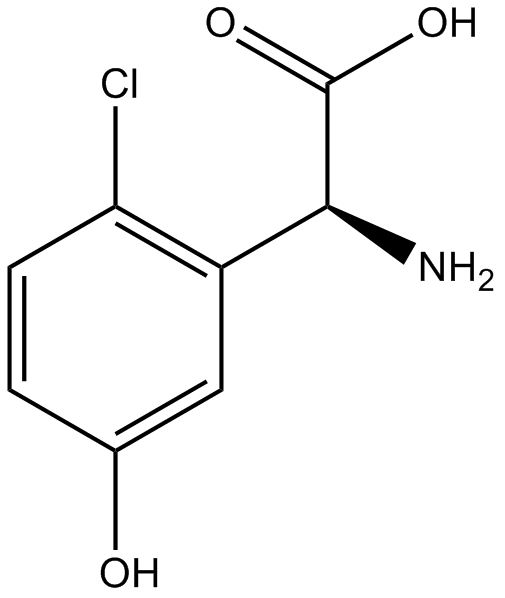
Cas No.: 170846-74-9
Sample solution is provided at 25 µL, 10mM.
_1-3.$$$39978408@51.jpg');)
_1-9.$$$38538795@65.jpg');)
_1-9.$$$39112701@51.jpg');)
_1-7.$$$37316672@70.jpg');)
_366-372.$$$36198801@70.jpg');)
.$$$38565142@65.jpg');)
_1867-1883.$$$33248023@67.jpg');)
_eads6055.$$$39977546@45.jpg');)
_eadm9805.$$$40080571@45.jpg');)
_eadj3020.$$$39666821@45.jpg');)
_1-20.$$$39757301@28.jpg');)
_1-24.$$$38898113@28.jpg');)
_273-287.$$$36806353@46.jpg');)
_1-16.$$$37156877@44.jpg');)
_1-19.$$$37460805@44.jpg');)
_1291-1307.$$$34518654@46.jpg');)
CHPG is a selective metabotropic glutamate receptor 5 (mGlu5) agonist[1]. Activation of mGlu5 suppresses oxidative stress and inflammation induced by lipopolysaccharide (LPS) or SO2 derivatives in microglia, thereby inhibiting neuronal apoptosis[1].
In vitro, CHPG (0.5mM; 30min) pretreatment showed no obvious cytotoxicity in BV2 cells, and significantly increased cell viability while reducing LDH release and apoptosis following SO2 derivatives treatment[1]. CHPG (0.5mM; 30min) attenuated SO2-induced oxidative stress, the expression of inflammatory cytokines, like IL-1β, IL-6 and TNF-α, in BV2 microglial cells[1]. CHPG (1mM; 30min) protected cultured cortical neurons against traumatic brain injury (TBI) and reduced the neuronal apoptotic rate[2].
In vivo, CHPG (250nM, 50µl; injected into the right lateral ventricle; 30min pretreatment) enhanced the activation of ERK and Akt, attenuated neuronal apoptosis, and reduced cerebral lesion volume in TBI rats[2].
References:
[1] Qiu, Jun-Ling et al. “The selective mGluR5 agonist CHPG attenuates SO2-induced oxidative stress and inflammation through TSG-6/NF-κB pathway in BV2 microglial cells.” Neurochemistry international vol. 85-86 (2015): 46-52.
[2] Chen, Tao et al. “The selective mGluR5 agonist CHPG protects against traumatic brain injury in vitro and in vivo via ERK and Akt pathway.” International journal of molecular medicine vol. 29,4 (2012): 630-6.
| Cell experiment [1]: | |
Cell lines | BV2 microglial cells |
Preparation Method | BV2 cells were pretreated with CHPG (0.5mM) for 30min before 100μM SO2 treatment. Cell viability was measured by WST-1 assay and cytotoxicity was measured by LDH assay. Apoptotic cell death was detected by TUNEL staining, and apoptotic rate was calculated. |
Reaction Conditions | 0.5mM; 30min |
Applications | CHPG alone has no obvious cytotoxicity in BV2 cells. CHPG significantly increased the cell viability and decreased the LDH release after SO2 derivatives treatment. CHPG protected BV2 cells against SO2-induced apoptosis. |
| Animal experiment [2]: | |
Animal models | Sprague-Dawley male rats |
Preparation Method | Rats were randomly divided into the following four groups, the vehicle group, the CHPG group, the TBI group and the TBI+CHPG group. Vehicle (1% DMSO in saline), CHPG (250nM) was injected in a volume of 5μl into right lateral ventricle (anteroposterior, 0.8mm; lateral, 1.5mm; depth, 3.5mm from bregma) 30min before traumatic brain injury (TBI). |
Dosage form | 250nM, 5μl; injected into right lateral ventricle |
Applications | There were no obvious TUNEL-positive cells in the vehicle group or the CHPG group. However, 24h after TBI, the number of TUNEL-positive cells significantly increased (117±5 for the TBI group). Pre-treatment with 250nM of CHPG attenuated this increase to 63±7 for the TBI+CHPG group. Cerebral lesion volume of the TBI+CHPG group was significantly smaller than that of the TBI group. |
References: | |
| Cas No. | 170846-74-9 | SDF | |
| Sinónimos | Chlorohydroxyphenylglycine, CHPG | ||
| Chemical Name | (S)-2-amino-2-(2-chloro-5-hydroxyphenyl)acetic acid | ||
| Canonical SMILES | ClC(C=C1)=C(C=C1O)[C@@H](C(O)=O)N | ||
| Formula | C8H8ClNO3 | M.Wt | 201.6 |
| Solubility | 1 M NaOH: Soluble | Storage | -20°C |
| General tips | Please select the appropriate solvent to prepare the stock solution according to the
solubility of the product in different solvents; once the solution is prepared, please store it in
separate packages to avoid product failure caused by repeated freezing and thawing.Storage method
and period of the stock solution: When stored at -80°C, please use it within 6 months; when stored
at -20°C, please use it within 1 month. To increase solubility, heat the tube to 37°C and then oscillate in an ultrasonic bath for some time. |
||
| Shipping Condition | Evaluation sample solution: shipped with blue ice. All other sizes available: with RT, or with Blue Ice upon request. | ||
| Prepare stock solution | |||

|
1 mg | 5 mg | 10 mg |
| 1 mM | 4.9603 mL | 24.8016 mL | 49.6032 mL |
| 5 mM | 992.1 μL | 4.9603 mL | 9.9206 mL |
| 10 mM | 496 μL | 2.4802 mL | 4.9603 mL |
Step 1: Enter information below (Recommended: An additional animal making an allowance for loss during the experiment)
 g
μL
g
μL
Step 2: Enter the in vivo formulation (This is only the calculator, not formulation. Please contact us first if there is no in vivo formulation at the solubility Section.)
Calculation results:
Working concentration: mg/ml;
Method for preparing DMSO master liquid: mg drug pre-dissolved in μL DMSO ( Master liquid concentration mg/mL, Please contact us first if the concentration exceeds the DMSO solubility of the batch of drug. )
Method for preparing in vivo formulation: Take μL DMSO master liquid, next addμL PEG300, mix and clarify, next addμL Tween 80, mix and clarify, next add μL saline, mix and clarify.
Method for preparing in vivo formulation: Take μL DMSO master liquid, next add μL Corn oil, mix and clarify.
Note: 1. Please make sure the liquid is clear before adding the next solvent.
2. Be sure to add the solvent(s) in order. You must ensure that the solution obtained, in the previous addition, is a clear solution before proceeding to add the next solvent. Physical methods such as vortex, ultrasound or hot water bath can be used to aid dissolving.
3. All of the above co-solvents are available for purchase on the GlpBio website.
Quality Control & SDS
- View current batch:
- Purity: >98.00% Appearance: A solid
- COA (Certificate of Analysis)
- SDS (Safety Data Sheet)
- Datasheet
Average Rating: 5 (Based on Reviews and 33 reference(s) in Google Scholar.)