

Cilengitide (Synonyms: EMD 121974) |
Catalog No.GC13559
 One-Click Copy Product Info
|

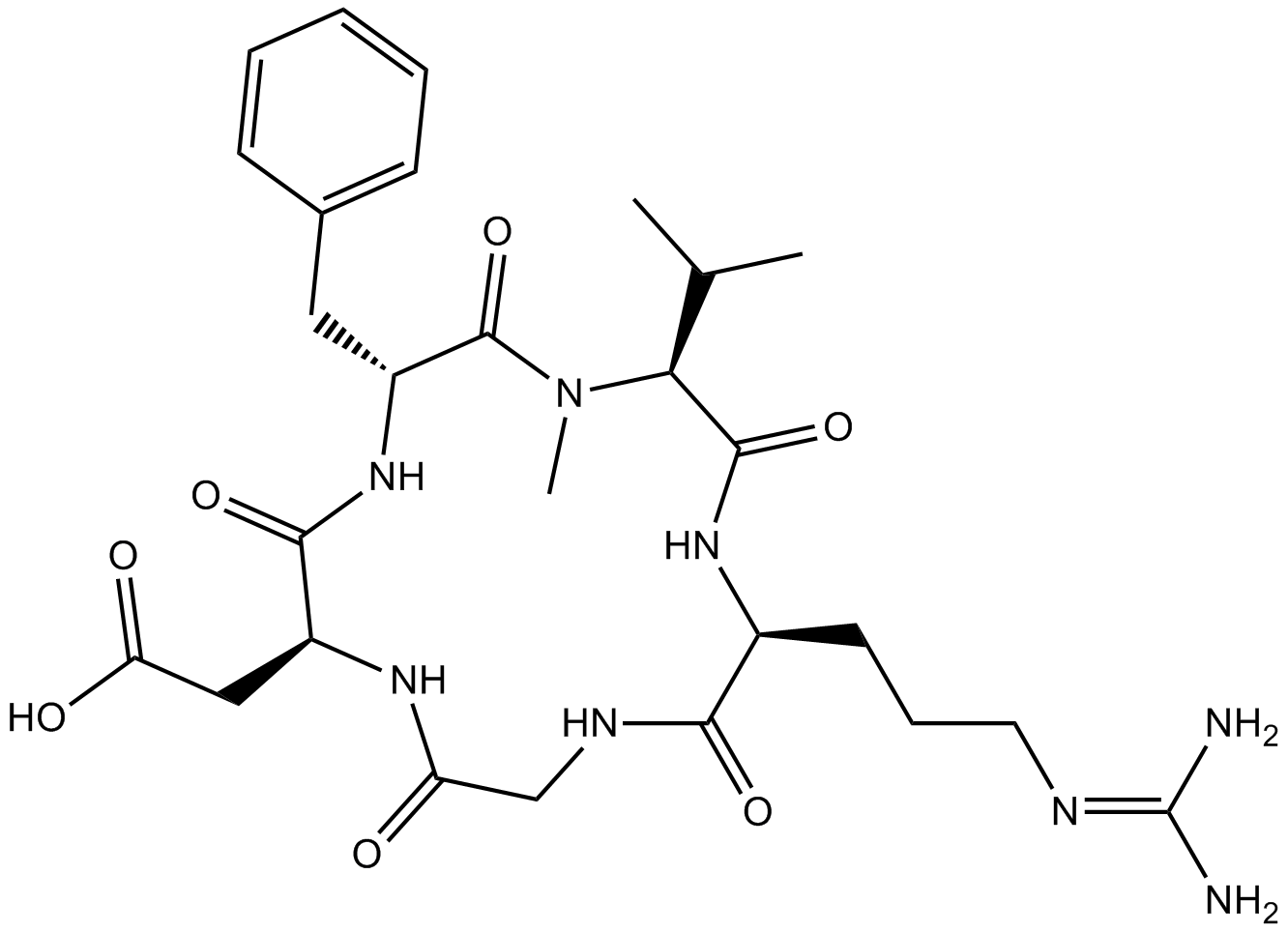
Cilengitide es un pentapéptido cíclico. Resultado un potente antagonista de las integrinas, con valores de IC50 de 0.61nM, 8.4nM y 14.9nM para ανβ3, ανβ5 y α5β1, respectivamente
Products are for research use only. Not for human use. We do not sell to patients.
Cas No.: 188968-51-6
Sample solution is provided at 25 µL, 10mM.
Cilengitide es un pentapéptido cíclico. Resultado un potente antagonista de las integrinas, con valores de IC50 de 0.61nM, 8.4nM y 14.9nM para ανβ3, ανβ5 y α5β1, respectivamente[1]. Impide la unión de las integrinas ανβ3 y ανβ5 a la vitronectina, con IC50 de 4 y 79nM, respectivamente[2]. Ataca a los dímeros ITGAV:ITGB3 e ITGAV:ITGB5. Y provoca la muerte en células de cáncer de mama con escasa presencia de integrinas[3]. Se utiliza mucho en múltiples modelos celulares para frenar la adhesión y la migración celular mediada por integrinas[4].
En estudios in vitro, el tratamiento con Cilengitide durante 24 horas redujo la viabilidad de las células A375, con un IC50 de 5µg/ml[5]. La exposición a 50μg/ml de Cilengitide durante 72 horas impidió la adhesión de células endoteliales HMEC-1 al plato de cultivo y provocó su apoptosis[6]. El tratamiento con 100μg/ml durante 3 días frenó la proliferación, migración e invasión de células MDA-MB-231[7].
En estudios in vivo, la inyección intraperitoneal diaria de 75mg/kg/día durante 10 días, junto con dos irradiaciones craneales (5Gy; en tercer y sexto día tras implantar el tumor), redujo el crecimiento de tumores cerebrales en ratones y disminuyó la invasión cerebral[8]. Cuarenta y ocho horas después de una sola inyección intraperitoneal de 4mg/kg en un modelo de glioma en ratas, se observó una clara activación de la autofagia en los tumores[9].
References:
[1] Kapp T G, Rechenmacher F, Neubauer S, et al. A comprehensive evaluation of the activity and selectivity profile of ligands for RGD-binding integrins[J]. Scientific reports, 2017, 7(1): 39805.
[2] Hariharan S, Gustafson D, Holden S, et al. Assessment of the biological and pharmacological effects of the ανβ3 and ανβ5 integrin receptor antagonist, cilengitide (EMD 121974), in patients with advanced solid tumors[J]. Annals of oncology, 2007, 18(8): 1400-1407.
[3] Girnius N, Henstridge A Z, Marks B, et al. Cilengitide sensitivity is predicted by overall integrin expression in breast cancer[J]. Breast Cancer Research, 2024, 26(1): 187.
[4] Reardon D A, Nabors L B, Stupp R, et al. Cilengitide: an integrin-targeting arginine–glycine–aspartic acid peptide with promising activity for glioblastoma multiforme[J]. Expert opinion on investigational drugs, 2008, 17(8): 1225-1235.
[5] Pan X, Yi M, Liu C, et al. Cilengitide, an αvβ3-integrin inhibitor, enhances the efficacy of anti-programmed cell death-1 therapy in a murine melanoma model[J]. Bioengineered, 2022, 13(2): 4557-4572.
[6] Oliveira-Ferrer L, Hauschild J, Fiedler W, et al. Cilengitide induces cellular detachment and apoptosis in endothelial and glioma cells mediated by inhibition of FAK/src/AKT pathway[J]. Journal of Experimental & Clinical Cancer Research, 2008, 27(1): 86.
[7] Bretschi M, Merz M, Komljenovic D, et al. Cilengitide inhibits metastatic bone colonization in a nude rat model[J]. Oncology reports, 2011, 26(4): 843-851.
[8] Wilisch-Neumann A, Kliese N, Pachow D, et al. The integrin inhibitor cilengitide affects meningioma cell motility and invasion[J]. Clinical Cancer Research, 2013, 19(19): 5402-5412.
[9] Lomonaco S L, Finniss S, Xiang C, et al. Cilengitide induces autophagy-mediated cell death in glioma cells[J]. Neuro-oncology, 2011, 13(8): 857-865.
| Experimentos celulares [1]: | |
Líneas celulares | Células A375 |
Método de preparación | Las células A375 se cultivaron en Dulbecco Modified Eagle Medium (DMEM) que contenía un 10% de suero bovino fetal (FBS) a 37°C y un 5% de CO2 en una incubadora de CO2. Las células (6×10³ por pozo) se sembraron en una placa de 96 pozos y se cultivaron durante la noche. Posteriormente, las células fueron tratadas con cilengitida en concentraciones de 0, 1, 10, 100 y 1000µg/ml. A las 24 horas, 48 horas y 72 horas después del tratamiento, se añadieron 10µl de reactivo de conteo de células CCK-8 a cada pozo. Después de la incubación a 37°C y 5% de CO2 durante 2 horas, el valor de absorbancia de onda de 450nm. |
Condiciones de reacción | 0, 1, 10, 100 y 1000µg/ml; 24, 48 y 72h |
Áreas de aplicación | El tratamiento con Cilengitide redujo la viabilidad celular de las células A375 de una manera dependiente de la dosis y el tiempo. |
| Experimentos con animales [2]: | |
Modelos animales | Ratas desnudos |
Método de preparación | Las células que expresan cadena ligera (LC) 3-proteína fluorescente verde (GFP) (4×10⁵ células/5µl PBS) se inyectaron a una velocidad de 0.5µl/min en el bregma derecho de ratas desnudas a una distancia de 3mm. El día 21 después de la inyección de células tumorales, se inyectó Cilengitide (4mg/kg) por vía intraperitoneal, y las ratas fueron sacrificadas 48 horas después y se extirparon los tejidos cerebrales. Los tejidos cerebrales se fijaron con un 10% de formalina durante la noche y se colocaron en una caja de portaobjetos de tejido cerebral coronal, luego se cortaron en secciones de 2mm de espesor. Las secciones de 2 mm que contenían tumores se congelaron en bloques de tejido de temperatura de corte óptima (OCT) y se sometieron a análisis de inmunofluorescencia relacionado con la autofagia. |
Forma de dosificación | 4mg/kg por una vez; i.p. |
Áreas de aplicación | Cilengitide indujo la autofagia en los tumores de xenoinjerto de rata. |
References: | |
| Cas No. | 188968-51-6 | SDF | |
| Sinónimos | EMD 121974 | ||
| Chemical Name | 2-[(2S,5R,8S,11S)-5-benzyl-11-[3-(diaminomethylideneamino)propyl]-7-methyl-3,6,9,12,15-pentaoxo-8-propan-2-yl-1,4,7,10,13-pentazacyclopentadec-2-yl]acetic acid | ||
| Canonical SMILES | CC(C)C1C(=O)NC(C(=O)NCC(=O)NC(C(=O)NC(C(=O)N1C)CC2=CC=CC=C2)CC(=O)O)CCCN=C(N)N | ||
| Formula | C27H40N8O7 | M.Wt | 588.66 |
| Solubility | ≥ 29.433mg/mL in DMSO | Storage | Store at -20°C |
| General tips | Please select the appropriate solvent to prepare the stock solution according to the
solubility of the product in different solvents; once the solution is prepared, please store it in
separate packages to avoid product failure caused by repeated freezing and thawing.Storage method
and period of the stock solution: When stored at -80°C, please use it within 6 months; when stored
at -20°C, please use it within 1 month. To increase solubility, heat the tube to 37°C and then oscillate in an ultrasonic bath for some time. |
||
| Shipping Condition | Evaluation sample solution: shipped with blue ice. All other sizes available: with RT, or with Blue Ice upon request. | ||
| Prepare stock solution | |||

|
1 mg | 5 mg | 10 mg |
| 1 mM | 1.6988 mL | 8.4939 mL | 16.9877 mL |
| 5 mM | 339.8 μL | 1.6988 mL | 3.3975 mL |
| 10 mM | 169.9 μL | 849.4 μL | 1.6988 mL |
Step 1: Enter information below (Recommended: An additional animal making an allowance for loss during the experiment)
 g
μL
g
μL
Step 2: Enter the in vivo formulation (This is only the calculator, not formulation. Please contact us first if there is no in vivo formulation at the solubility Section.)
Calculation results:
Working concentration: mg/ml;
Method for preparing DMSO master liquid: mg drug pre-dissolved in μL DMSO ( Master liquid concentration mg/mL, Please contact us first if the concentration exceeds the DMSO solubility of the batch of drug. )
Method for preparing in vivo formulation: Take μL DMSO master liquid, next addμL PEG300, mix and clarify, next addμL Tween 80, mix and clarify, next add μL saline, mix and clarify.
Method for preparing in vivo formulation: Take μL DMSO master liquid, next add μL Corn oil, mix and clarify.
Note: 1. Please make sure the liquid is clear before adding the next solvent.
2. Be sure to add the solvent(s) in order. You must ensure that the solution obtained, in the previous addition, is a clear solution before proceeding to add the next solvent. Physical methods such as vortex, ultrasound or hot water bath can be used to aid dissolving.
3. All of the above co-solvents are available for purchase on the GlpBio website.
Quality Control & SDS
- View current batch:
- Purity: >99.00% Appearance: A solid
- COA (Certificate of Analysis)
- SDS (Safety Data Sheet)
- Datasheet
Average Rating: 5 (Based on Reviews and 1 reference(s) in Google Scholar.)