

Citrinin (Synonyms: NSC 186) |
Catalog No.GC16661
 One-Click Copy Product Info
|

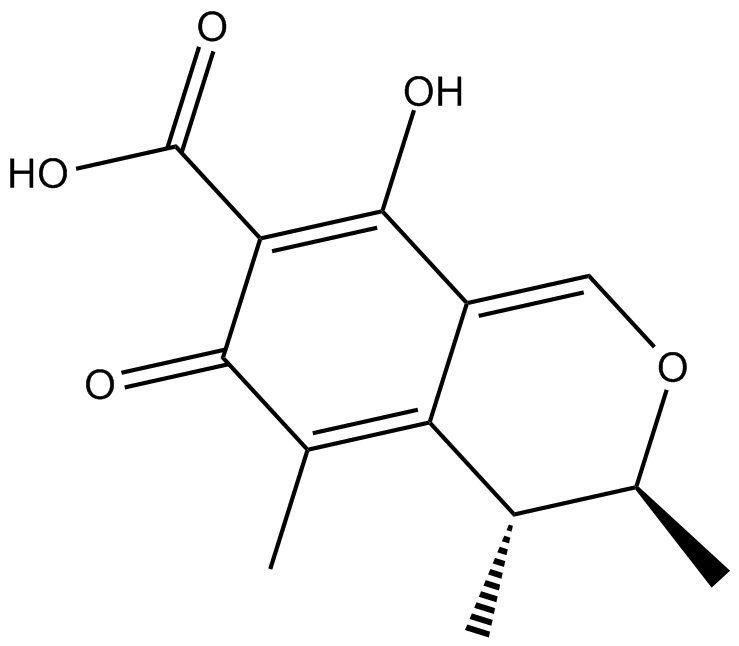
Citrinin es una micotoxina con múltiples actividades biológicas producidas por varias cepas fúngicas de los géneros Penicillium, Aspergillus, y Monascus.
Products are for research use only. Not for human use. We do not sell to patients.
Cas No.: 518-75-2
Sample solution is provided at 25 µL, 10mM.
_1-3.$$$39978408@51.jpg');)
_1-9.$$$38538795@65.jpg');)
_1-9.$$$39112701@51.jpg');)
_1-7.$$$37316672@70.jpg');)
_366-372.$$$36198801@70.jpg');)
.$$$38565142@65.jpg');)
_1867-1883.$$$33248023@67.jpg');)
_eads6055.$$$39977546@45.jpg');)
_eadm9805.$$$40080571@45.jpg');)
_eadj3020.$$$39666821@45.jpg');)
_1-20.$$$39757301@28.jpg');)
_1-24.$$$38898113@28.jpg');)
_273-287.$$$36806353@46.jpg');)
_1-16.$$$37156877@44.jpg');)
_1-19.$$$37460805@44.jpg');)
_1291-1307.$$$34518654@46.jpg');)
Citrinin es una micotoxina con múltiples actividades biológicas producidas por varias cepas fúngicas de los géneros Penicillium, Aspergillus, y Monascus [1]. Citrinin es un contaminante natural en varios alimentos que puede causar graves problemas de salud adversos y también tiene efectos citotóxicos y genotóxicos[2].
In vitro, las células ESC-B5 tratados con Citrinin (30 μM) durante 24 horas pueden estimular directamente la producción de ROS, induciendo así la producción de NO, lo que lleva a cambios en el potencial de la membrana mitocondrial y la activación de la caspase-3 [3]. Citrinin (10, 20μM) trató las células hRPTEC durante 3 y 30 días, promoviendo significativamente las anomalías del huso mitótico celular, la curación de heridas, la migración celular y el crecimiento dependiente del anclaje, y activando el cáncer y las vías de señalización relacionadas con el ciclo celular[4]. Citrinin (40μM) trata las células embrionarias e induce daño al DNA, la autofagia y la disfunción mitocondrial, afectando negativamente al desarrollo embrionario temprano durante la primera escisión[5].
In vivo, Citrinin (1, 3, 5 mg/kg) se alimentó por vía oral a ratas Wistar hembra durante 10 semanas, causando desarrollo anormal del peso fetal, los huesos y los órganos internos después del embarazo, lo que resultó en efectos teratogénicos serveros[6]. Citrinin (6.25mg/kg) trató a los ratones machos mediante inyección intraperitoneal durante 7 días, aumentó significativamente el peso relativo de los testículos, el epidídimo, las vesículas seminales y las glándulas preputiales, aumentó el número de espermatozoides anormales y redujo el número de espermatozoides viables[7].
References:
[1] Flajs D, Peraica M. Toxicological properties of citrinin[J]. Archives of Industrial Hygiene and Toxicology, 2009, 60(4): 457-464.
[2] Salah A, Bouaziz C, Prola A, et al. Citrinin induces apoptosis in human HCT116 colon cancer cells through endoplasmic reticulum stress[J]. Journal of Toxicology and Environmental Health, Part A, 2017, 80(23-24): 1230-1241.
[3] Chan W H. Citrinin induces apoptosis in mouse embryonic stem cells[J]. IUBMB life, 2008, 60(3): 171-179.
[4] Tsai J F, Wu T S, Huang Y T, et al. Exposure to Mycotoxin Citrinin Promotes Carcinogenic Potential of Human Renal Cells[J]. Journal of Agricultural and Food Chemistry, 2023, 71(48): 19054-19065.
[5] Huang Y L, Pan W L, Cai W W, et al. Exposure to citrinin induces DNA damage, autophagy, and mitochondria dysfunction during first cleavage of mouse embryos[J]. Environmental Toxicology, 2021, 36(11): 2217-2224.
[6] Singh N D, Sharma A K, Patil R D, et al. Effect of feeding graded doses of Citrinin on clinical and teratology in female Wistar rats[J]. 2014.
[7] Qingqing H, Linbo Y, Yunqian G, et al. Toxic effects of citrinin on the male reproductive system in mice[J]. Experimental and Toxicologic Pathology, 2012, 64(5): 465-469.
| Experimentos celulares [1]: | |
Líneas celulares | Células ESC-B5 |
Método de preparación | Las células fueron pretratadas con PTIO (20μM) durante 1 h y luego tratadas con Citrinin (30μM) durante otras 24 h. |
Condiciones de reacción | 30 μM; 24 h |
Áreas de aplicación | Cambio del potencial de la membrana Mitochondrial (MMP) y activación de la caspase-9 y -3 por tratamiento con Citrinin. |
| Experimentos con animales [2]: | |
Modelos animales | Ratas Wistar hembra |
Método de preparación | Las ratas fueron alimentadas con alimento tóxico durante 10 semanas antes de aparearse. De acuerdo con la dosis de CIT en el alimento experimental, los animales se dividieron en cuatro grupos (1, 3, 5mg/kg de CIT y grupo de control), con 10 ratas en cada grupo. Los estudios de teratogenicidad se realizaron en el día 20 de gestación. |
Forma de dosificación | 1, 3, 5mg/kg; p.o. |
Áreas de aplicación | La administración oral de citrinin depende de la dosis causa varias anomalías del desarrollo en los fetos de las ratas preñadas. |
References: | |
| Cas No. | 518-75-2 | SDF | |
| Sinónimos | NSC 186 | ||
| Chemical Name | (3R,4S)-4,6-dihydro-8-hydroxy-3,4,5-trimethyl-6-oxo-3H-2-benzopyran-7-carboxylic acid | ||
| Canonical SMILES | O=C1C(C)=C2[C@@H](C)[C@H](C)OC=C2C(O)=C1C(O)=O | ||
| Formula | C13H14O5 | M.Wt | 250.3 |
| Solubility | ≤2mg/ml in ethanol;20mg/ml in DMSO;20mg/ml in dimethyl formamide | Storage | Store at -20°C,protect from light, stored under nitrogen |
| General tips | Please select the appropriate solvent to prepare the stock solution according to the
solubility of the product in different solvents; once the solution is prepared, please store it in
separate packages to avoid product failure caused by repeated freezing and thawing.Storage method
and period of the stock solution: When stored at -80°C, please use it within 6 months; when stored
at -20°C, please use it within 1 month. To increase solubility, heat the tube to 37°C and then oscillate in an ultrasonic bath for some time. |
||
| Shipping Condition | Evaluation sample solution: shipped with blue ice. All other sizes available: with RT, or with Blue Ice upon request. | ||
| Prepare stock solution | |||

|
1 mg | 5 mg | 10 mg |
| 1 mM | 3.9952 mL | 19.976 mL | 39.9521 mL |
| 5 mM | 799 μL | 3.9952 mL | 7.9904 mL |
| 10 mM | 399.5 μL | 1.9976 mL | 3.9952 mL |
Step 1: Enter information below (Recommended: An additional animal making an allowance for loss during the experiment)
 g
μL
g
μL
Step 2: Enter the in vivo formulation (This is only the calculator, not formulation. Please contact us first if there is no in vivo formulation at the solubility Section.)
Calculation results:
Working concentration: mg/ml;
Method for preparing DMSO master liquid: mg drug pre-dissolved in μL DMSO ( Master liquid concentration mg/mL, Please contact us first if the concentration exceeds the DMSO solubility of the batch of drug. )
Method for preparing in vivo formulation: Take μL DMSO master liquid, next addμL PEG300, mix and clarify, next addμL Tween 80, mix and clarify, next add μL saline, mix and clarify.
Method for preparing in vivo formulation: Take μL DMSO master liquid, next add μL Corn oil, mix and clarify.
Note: 1. Please make sure the liquid is clear before adding the next solvent.
2. Be sure to add the solvent(s) in order. You must ensure that the solution obtained, in the previous addition, is a clear solution before proceeding to add the next solvent. Physical methods such as vortex, ultrasound or hot water bath can be used to aid dissolving.
3. All of the above co-solvents are available for purchase on the GlpBio website.
Quality Control & SDS
- View current batch:
- Purity: >98.00% Appearance: A solid
- COA (Certificate of Analysis)
- SDS (Safety Data Sheet)
- Datasheet
Average Rating: 5 (Based on Reviews and 38 reference(s) in Google Scholar.)