

DMPO (Synonyms: 5,5Dimethyl1PyrrolineNOxide) |
Catalog No.GC13957
 One-Click Copy Product Info
|

DMPO (5,5-dimethyl-1-pyrroline-N-oxide) es una trampa de espín de óxido nítrico soluble en agua que se puede utilizar para medir radicales libres centrados en el óxigeno en sistemas biológicos a temperatura ambiente utilizando resonancia de espín electrónico (ESR).
Products are for research use only. Not for human use. We do not sell to patients.
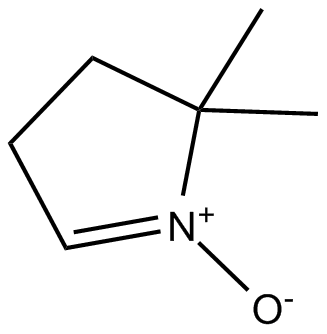
Cas No.: 3317-61-1
Sample solution is provided at 25 µL, 10mM.
DMPO (5,5-dimethyl-1-pyrroline-N-oxide) es una trampa de espín de óxido nítrico soluble en agua que se puede utilizar para medir radicales libres centrados en el óxigeno en sistemas biológicos a temperatura ambiente utilizando resonancia de espín electrónico (ESR) [1]. La trampa de espín reaaciona con radicales libres para formar aductos estables que se pueden estudiar más a fondo [2]. DMPO es soluble en agua, impregna rápidamente las bicapas de lípidos, tiene baja toxicidad y se puede utilizar in vitro e in vivo [3, 4].
In vitro, el tratamiento DMPO (50 mM) de macrófagos RAW 264.7 durante 24 h mostró actividad antiinflamatoria, redujo la expresión de oxidado nítrico inducible sintasa (iNOS), inhibió la fosforilación de MAPK, Akt e IκBα, y redujo la translocación NF-κB p65[5].
In vivo, DMPO (10-100 mg/kg, inyección intraperitoeal) tuvo un efecto analgésico sobre la hiperalgesia inducida por la formalina en ratas[6].
References:
[1] Wang P, Zweier J L. Measurement of nitric oxide and peroxynitrite generation in the postischemic heart: evidence for peroxynitrite-mediated reperfusion injury[J]. Journal of Biological Chemistry, 1996, 271(46): 29223-29230.
[2] Bačić G, Spasojević I, Šećerov B, et al. Spin-trapping of oxygen free radicals in chemical and biological systems: new traps, radicals and possibilities[J]. Spectrochimica Acta Part A: Molecular and Biomolecular Spectroscopy, 2008, 69(5): 1354-1366.
[3]West M B, Rokosh G, Obal D, et al. Cardiac myocyte–specific expression of inducible nitric oxide synthase protects against ischemia/reperfusion injury by preventing mitochondrial permeability transition[J]. Circulation, 2008, 118(19): 1970-1978.
[4]Qin X, Wu C, Niu D, et al. Peroxisome inspired hybrid enzyme nanogels for chemodynamic and photodynamic therapy[J]. Nature Communications, 2021, 12(1): 5243.
[5]Zhai Z, Gomez-Mejiba S E, Zhu H, et al. The spin trap 5, 5-dimethyl-1-pyrroline N-oxide inhibits lipopolysaccharide-induced inflammatory response in RAW 264.7 cells[J]. Life sciences, 2012, 90(11-12): 432-439.
[6]Chung W S, Go Y G, Lee W H. Antinociceptive effect of intraperitoneally administered 5, 5-dimethyl-1-pyrroline N-oxide on formalin induced nociception in rats[J]. Korean J Anesthesiol, 2008, 54(3).
Este plan solo proporciona una guía, modifíquela para satisfacer sus necesidades específicas.
1. Preparación de la solución
(1)Solución de trabajo: Disuelva DMPO en un tampón experimental hasta una cocnetración final de 1 M. Utilice un filtro de película de 0.22μm.
Nota: Por favor, ajuste la concentración de trabajo óptima de acuerdo con la situación real o consulte la literatura para establecer la concentración de gradiente usted mismo. La solución de trabajo debe prepararse y usarse de inmediato.
2. Detección in vivo de radicales libres de óxigeno usando DMPO [1, 2] (de la literatura, solo para referencia)
(1)Inducir la anestesia intraperitoneal con pentobarbital sódico (5 mg). Retire el corazón, conecte la cánula a´´ortica ascendente y perfuse con el tampón Krebs-Henseleit a un caudal constante (2 mL/min).
(2)Desoués de la isquemia, disuelva el DMPO en un tampón que contenga 100μM de ácido dietilentriaminapentaacético (DTPA) a una concentración final de 1 M. Immediatamente durante la reperfusión, inyecte la trampa a una velocidad de 100μL/min a través del brazo lateral cerca del corazón.
(3)Durante la reperfusión, recoja el efluente regularmente hasta la reperfusión durante 5 minutos en el intervalo de tiempo especificado. Después de recoger las muestras, congele cada tubo en nitrógeno líquido inmediatamente.
(4)Utilice un espectrómetro para detectar y registrar la señal de los radicales libres deoxígeno capturados por DMPO.
3. Detección in vitro de radicales libres de hidroxilo usando DMPO [3] (de la literatura, solo para referencia)
(1) Añadir diferentes concentraciones de solución de Fe3O4 a 1 mL de muestra. Agregue 10 μL de solución de trabajo DMPO a cada muestra como un eliminador de radicales libres. Incubar la muestra a 37°C durante 6 horas para asegurarse de que la reacción se lleva a cabo completamente. Agregue 10 μL de DMPO a 1 mL PBS como grupo de control de la solución de reacción.
(2) La mezcla de reacción se filtró utilizando un filtro de 0.22 µm para eliminar residuos sólidos y partículas grandes.
(3) Utilice un espectrómetro para detectar y registrar la señal de los radicales libres de hidroxilo capturados por DMPO.
Nota: Este protocolo proporciona orientación para la detección de radicales libres centrados en el oxígeno utilizando DMPO in vivo ae in vitro. Se puede ajustar de acuerdo con otra literatura y requisitos experimentales específicos.
References:
[1]West M B, Rokosh G, Obal D, et al. Cardiac myocyte–specific expression of inducible nitric oxide synthase protects against ischemia/reperfusion injury by preventing mitochondrial permeability transition[J]. Circulation, 2008, 118(19): 1970-1978.
[2]Wang P, Chen H, Qin H, et al. Overexpression of human copper, zinc-superoxide dismutase (SOD1) prevents postischemic injury[J]. Proceedings of the National Academy of Sciences, 1998, 95(8): 4556-4560.
[3]Qin X, Wu C, Niu D, et al. Peroxisome inspired hybrid enzyme nanogels for chemodynamic and photodynamic therapy[J]. Nature Communications, 2021, 12(1): 5243.
| Cas No. | 3317-61-1 | SDF | |
| Sinónimos | 5,5Dimethyl1PyrrolineNOxide | ||
| Chemical Name | 2,2-dimethyl-3,4-dihydro-2H-pyrrole 1-oxide | ||
| Canonical SMILES | [O-][N+]1=CCCC1(C)C | ||
| Formula | C6H11NO | M.Wt | 113.16 |
| Solubility | H2O : ≥ 100 mg/mL (883.70 mM) DMSO : 100 mg/mL (883.70 mM; Need ultrasonic) | Storage | Store at -20°C |
| General tips | Please select the appropriate solvent to prepare the stock solution according to the
solubility of the product in different solvents; once the solution is prepared, please store it in
separate packages to avoid product failure caused by repeated freezing and thawing.Storage method
and period of the stock solution: When stored at -80°C, please use it within 6 months; when stored
at -20°C, please use it within 1 month. To increase solubility, heat the tube to 37°C and then oscillate in an ultrasonic bath for some time. |
||
| Shipping Condition | Evaluation sample solution: shipped with blue ice. All other sizes available: with RT, or with Blue Ice upon request. | ||
| Prepare stock solution | |||

|
1 mg | 5 mg | 10 mg |
| 1 mM | 8.837 mL | 44.1852 mL | 88.3704 mL |
| 5 mM | 1.7674 mL | 8.837 mL | 17.6741 mL |
| 10 mM | 883.7 μL | 4.4185 mL | 8.837 mL |
Step 1: Enter information below (Recommended: An additional animal making an allowance for loss during the experiment)
 g
μL
g
μL
Step 2: Enter the in vivo formulation (This is only the calculator, not formulation. Please contact us first if there is no in vivo formulation at the solubility Section.)
Calculation results:
Working concentration: mg/ml;
Method for preparing DMSO master liquid: mg drug pre-dissolved in μL DMSO ( Master liquid concentration mg/mL, Please contact us first if the concentration exceeds the DMSO solubility of the batch of drug. )
Method for preparing in vivo formulation: Take μL DMSO master liquid, next addμL PEG300, mix and clarify, next addμL Tween 80, mix and clarify, next add μL saline, mix and clarify.
Method for preparing in vivo formulation: Take μL DMSO master liquid, next add μL Corn oil, mix and clarify.
Note: 1. Please make sure the liquid is clear before adding the next solvent.
2. Be sure to add the solvent(s) in order. You must ensure that the solution obtained, in the previous addition, is a clear solution before proceeding to add the next solvent. Physical methods such as vortex, ultrasound or hot water bath can be used to aid dissolving.
3. All of the above co-solvents are available for purchase on the GlpBio website.
Quality Control & SDS
- View current batch:
- Purity: >97.00% Appearance: Solid-liquid mixture
- COA (Certificate of Analysis)
- SDS (Safety Data Sheet)
- Datasheet
Average Rating: 5 (Based on Reviews and 37 reference(s) in Google Scholar.)