

DMPO (Synonyms: 5,5Dimethyl1PyrrolineNOxide) |
カタログ番号GC13957
 One-Click Copy Product Info
|

DMPO (5,5-ジメチル-1-ピロリン-N-オキシド)は、水溶性の一酸化窒素スピントラップであり、生体システム内の酸素中心フリーラジカルを常温で電子スピン共鳴(ESR)を使用して測定するために使用できる。
Products are for research use only. Not for human use. We do not sell to patients.
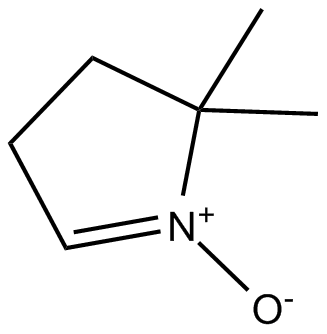
Cas No.: 3317-61-1
Sample solution is provided at 25 µL, 10mM.
DMPO (5,5-ジメチル-1-ピロリン-N-オキシド)は、水溶性の一酸化窒素スピントラップであり、生体システム内の酸素中心フリーラジカルを常温で電子スピン共鳴(ESR)を使用して測定するために使用できる。このスピントラップはフリーラジカルと反応して安定なアダクトを形成し、さらに研究することができる。DMPOは水溶性で、脂質二重層を迅速に通過し、低毒性であり、in vitroおよびin vivoで使用可能である。
In vitroでは、RAW 264.7マクロファージを50mMのDMPOで24時間処理したところ、抗炎症作用が示され、誘導性一酸化窒素合成酵素(iNOS)の発現が減少し、MAPK、AktおよびIκBαのリン酸化が抑制され、NF-κB p65の転位が減少した。
In vivoでは、DMPO(10-100 mg/kg、腹腔内注射)はラットのホルマリン誘発性痛覚過敏に対して鎮痛効果を示した。
References:
[1] Wang P, Zweier J L. Measurement of nitric oxide and peroxynitrite generation in the postischemic heart: evidence for peroxynitrite-mediated reperfusion injury[J]. Journal of Biological Chemistry, 1996, 271(46): 29223-29230.
[2] Bačić G, Spasojević I, Šećerov B, et al. Spin-trapping of oxygen free radicals in chemical and biological systems: new traps, radicals and possibilities[J]. Spectrochimica Acta Part A: Molecular and Biomolecular Spectroscopy, 2008, 69(5): 1354-1366.
[3]West M B, Rokosh G, Obal D, et al. Cardiac myocyte–specific expression of inducible nitric oxide synthase protects against ischemia/reperfusion injury by preventing mitochondrial permeability transition[J]. Circulation, 2008, 118(19): 1970-1978.
[4]Qin X, Wu C, Niu D, et al. Peroxisome inspired hybrid enzyme nanogels for chemodynamic and photodynamic therapy[J]. Nature Communications, 2021, 12(1): 5243.
[5]Zhai Z, Gomez-Mejiba S E, Zhu H, et al. The spin trap 5, 5-dimethyl-1-pyrroline N-oxide inhibits lipopolysaccharide-induced inflammatory response in RAW 264.7 cells[J]. Life sciences, 2012, 90(11-12): 432-439.
[6]Chung W S, Go Y G, Lee W H. Antinociceptive effect of intraperitoneally administered 5, 5-dimethyl-1-pyrroline N-oxide on formalin induced nociception in rats[J]. Korean J Anesthesiol, 2008, 54(3).
このプランはあくまでガイドラインであり、具体的なニーズに合わせて修正してください。
1. 溶液の調製
(1) 作業溶液:実験用バッファーにDMPOを溶解し、最終濃度1Mとする。0.22μmのフィルターフィルムで濾過する。
注意:最適な作業濃度は実際の状況に応じて調整するか、文献を参考にして勾配濃度を設定してください。作業溶液は直ちに調製して使用してください。
2. DMPOを使用した酸素フリーラジカルのin vivo検出[1, 2](文献より、参考までに)
(1) ペントバルビタールナトリウム(5mg)で腹腔内麻酔を誘導する。心臓を取り出し、上行大動脈カニューレを接続し、一定の流量(2mL/min)でKrebs-Henseleitバッファーで灌流する。
(2) 虚血後、100μMのジエチレントリアミンペンタ酢酸(DTPA)を含むバッファーにDMPOを溶解し、最終濃度1Mにする。再灌流時に、心臓に近い側枝からトラップを100μL/minの速度で注入する。
(3) 再灌流中、規定の時間間隔で流出液を定期的に収集し、再灌流後5分間収集する。サンプルを収集した後、各チューブを液体窒素で直ちに冷凍する。
(4) スペクトロメーターを使用して、DMPOによって捕捉された酸素フリーラジカルの信号を検出し記録する。
3. DMPOを使用したヒドロキシルフリーラジカルのin vitro検出[3](文献より、参考までに)
(1) 異なる濃度のFe3O4溶液を1mLのサンプルに加える。各サンプルにフリーラジカル捕捉剤として10μLのDMPO作業溶液を加える。37℃で6時間インキュベートして、反応を十分に行う。反応溶液の対照群として1mLのPBSに10μLのDMPO作業溶液を加える。
(2) 反応混合物を0.22µmのフィルターで濾過し、固体残渣や大きな粒子を除去する。
(3) スペクトロメーターを使用して、DMPOによって捕捉されたヒドロキシルフリーラジカルの信号を検出し記録する。
注意:このプロトコルは、in vivoおよびin vitroでDMPOを使用して酸素中心フリーラジカルを検出するためのガイドラインを提供する。他の文献や特定の実験要件に応じて調整することができる。
参考文献:
[1]West M B, Rokosh G, Obal D, et al. Cardiac myocyte–specific expression of inducible nitric oxide synthase protects against ischemia/reperfusion injury by preventing mitochondrial permeability transition[J]. Circulation, 2008, 118(19): 1970-1978.
[2]Wang P, Chen H, Qin H, et al. Overexpression of human copper, zinc-superoxide dismutase (SOD1) prevents postischemic injury[J]. Proceedings of the National Academy of Sciences, 1998, 95(8): 4556-4560.
[3]Qin X, Wu C, Niu D, et al. Peroxisome inspired hybrid enzyme nanogels for chemodynamic and photodynamic therapy[J]. Nature Communications, 2021, 12(1): 5243.
| Cas No. | 3317-61-1 | SDF | |
| 同義語 | 5,5Dimethyl1PyrrolineNOxide | ||
| Chemical Name | 2,2-dimethyl-3,4-dihydro-2H-pyrrole 1-oxide | ||
| Canonical SMILES | [O-][N+]1=CCCC1(C)C | ||
| Formula | C6H11NO | M.Wt | 113.16 |
| 溶解度 | H2O : ≥ 100 mg/mL (883.70 mM) DMSO : 100 mg/mL (883.70 mM; Need ultrasonic) | Storage | Store at -20°C |
| General tips | Please select the appropriate solvent to prepare the stock solution according to the
solubility of the product in different solvents; once the solution is prepared, please store it in
separate packages to avoid product failure caused by repeated freezing and thawing.Storage method
and period of the stock solution: When stored at -80°C, please use it within 6 months; when stored
at -20°C, please use it within 1 month. To increase solubility, heat the tube to 37°C and then oscillate in an ultrasonic bath for some time. |
||
| Shipping Condition | Evaluation sample solution: shipped with blue ice. All other sizes available: with RT, or with Blue Ice upon request. | ||
| Prepare stock solution | |||

|
1 mg | 5 mg | 10 mg |
| 1 mM | 8.837 mL | 44.1852 mL | 88.3704 mL |
| 5 mM | 1.7674 mL | 8.837 mL | 17.6741 mL |
| 10 mM | 883.7 μL | 4.4185 mL | 8.837 mL |
Step 1: Enter information below (Recommended: An additional animal making an allowance for loss during the experiment)
 g
μL
g
μL
Step 2: Enter the in vivo formulation (This is only the calculator, not formulation. Please contact us first if there is no in vivo formulation at the solubility Section.)
Calculation results:
Working concentration: mg/ml;
Method for preparing DMSO master liquid: mg drug pre-dissolved in μL DMSO ( Master liquid concentration mg/mL, Please contact us first if the concentration exceeds the DMSO solubility of the batch of drug. )
Method for preparing in vivo formulation: Take μL DMSO master liquid, next addμL PEG300, mix and clarify, next addμL Tween 80, mix and clarify, next add μL saline, mix and clarify.
Method for preparing in vivo formulation: Take μL DMSO master liquid, next add μL Corn oil, mix and clarify.
Note: 1. Please make sure the liquid is clear before adding the next solvent.
2. Be sure to add the solvent(s) in order. You must ensure that the solution obtained, in the previous addition, is a clear solution before proceeding to add the next solvent. Physical methods such as vortex, ultrasound or hot water bath can be used to aid dissolving.
3. All of the above co-solvents are available for purchase on the GlpBio website.
Quality Control & SDS
- View current batch:
- Purity: >97.00% Appearance: Solid-liquid mixture
- COA (Certificate of Analysis)
- SDS (Safety Data Sheet)
- Datasheet
Average Rating: 5 (Based on Reviews and 37 reference(s) in Google Scholar.)