

E 64d (Synonyms: Aloxistatin, E64c ethyl ester, EP 453, EST, Loxistatin, NSC 694281) |
Catalog No.GC13787
 One-Click Copy Product Info
|

E 64d es un inhibidor de la proteasa de la cisteína permeable a las células, irreversible y de amplio espectro con actividad inhibidora de la agregación plaquetaria.
Products are for research use only. Not for human use. We do not sell to patients.
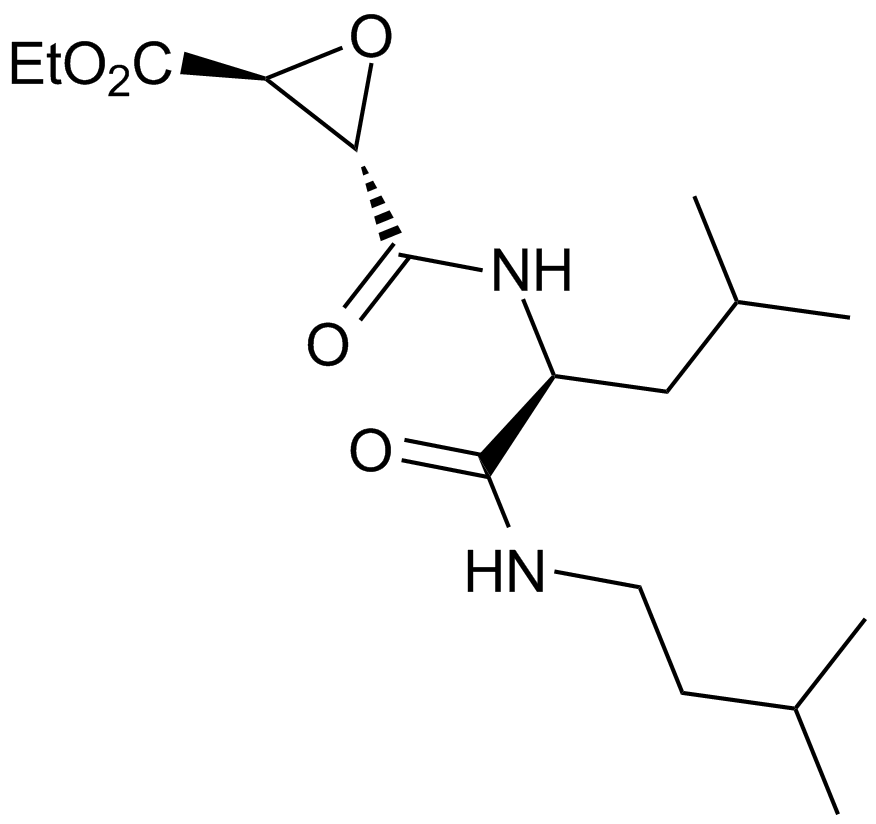
Cas No.: 88321-09-9
Sample solution is provided at 25 µL, 10mM.
E 64d es un inhibidor de la proteasa de la cisteína permeable a las células, irreversible y de amplio espectro con actividad inhibidora de la agregación plaquetaria[1]. E 64d es un inhibidor de la proteasa tisular covalente no selectivo que contiene un anillo de epóxido como una ojiva que puede ser atacada nucleófilamente por Cys-SH y formar un enlace covalente en el sitio catalítico[2]. E 64d inhibe la acumulación de proteína prión resistente a la proteasa (PrP-res) en células ScNB con un IC50 de 0,5 ± 0,11 μM[3].
In vitro, el pretratamiento de las células SH-SY5Y con E 64d (3µM) durante 30 minutos mejoró la disminución inducida por beta amiloide en la secreción de sAPPα y revirtió la regulación a la baja inducida por ceramida de la proteína quinasa C[4]. El tratamiento de células HT22 con E 64d (25μM) durante 24 horas alivió la apoptosis inducida por glutamato, revirtió la disminución en el potencial de membrana mitocondrial y redujo el estrés oxidativo[5].
In vivo, E 64d (9 mg/kg/día) se inyectó intraperitonealmente en ratones artríticos durante 10 días, lo que redujo significativamente la gravedad de la artritis clínica y la histopatología, y disminuyó los niveles de ARNm de las citoquinas IL-6 e IL-1β[6]. E 64d (1 mg/kg) se inyectó por vía intravenosa en ratas con lesión de la médula espinal (SCI) durante 7 días, lo que inhibió la respuesta inflamatoria causada por SCI, redujo la expresión de calretinina 1 en el tejido de la médula espinal, redujo la apoptosis neuronal e inhibió la actividad de la ciclooxigenasa 2[7].
References:
[1] Chen Y, Li Q, Li Q, et al. p62/SQSTM1, a central but unexploited target: advances in its physiological/pathogenic functions and small molecular modulators[J]. Journal of medicinal chemistry, 2020, 63(18): 10135-10157.
[2] Cannalire R, Stefanelli I, Cerchia C, et al. SARS-CoV-2 entry inhibitors: small molecules and peptides targeting virus or host cells[J]. International Journal of Molecular Sciences, 2020, 21(16): 5707.
[3] Doh-Ura K, Iwaki T, Caughey B. Lysosomotropic agents and cysteine protease inhibitors inhibit scrapie-associated prion protein accumulation[J]. Journal of virology, 2000, 74(10): 4894-4897.
[4] Tanabe F, Nakajima T, Ito M. The thiol proteinase inhibitor E-64-d ameliorates amyloid-β-induced reduction of sAPPα secretion by reversing ceramide-induced protein kinase C down-regulation in SH-SY5Y neuroblastoma cells[J]. Biochemical and Biophysical Research Communications, 2013, 441(1): 256-261.
[5] Xie R J, Li T X, Qiao X Y, et al. The Protective Role of E‐64d in Hippocampal Excitotoxic Neuronal Injury Induced by Glutamate in HT22 Hippocampal Neuronal Cells[J]. Neural Plasticity, 2021, 2021(1): 7174287.
[6] Yoshifuji H, Umehara H, Maruyama H, et al. Amelioration of experimental arthritis by a calpain-inhibitory compound: regulation of cytokine production by E-64-d in vivo and in vitro[J]. International immunology, 2005, 17(10): 1327-1336.
[7] Zhang Z, Huang Z, Dai H, et al. Therapeutic Efficacy of E‐64‐d, a Selective Calpain Inhibitor, in Experimental Acute Spinal Cord Injury[J]. BioMed Research International, 2015, 2015(1): 134242.
| Experimentos celulares [1]: | |
Líneas celulares | Células SH-SY5Y |
Método de preparación | Las células SH-SY5Y fueron pretratadas con o sin E 64d (3µM) durante 30 minutos e incubadas con Aβ (0,001 o 0,01 µM) durante 5,5 horas, seguidas de incubación con metacolina (1 mM) durante 2 horas. El sAPPα secretado se analizó mediante Western blotting utilizando el anticuerpo 6E10. |
Condiciones de reacción | 3µM; 30 minutos |
Áreas de aplicación | E 64d restaura la reducción inducida por Aβ de la secreción de sAPPα en células SH-SY5Y. |
| Experimentos con animales [2]: | |
Modelos animales | Ratones BALB/c |
Método de preparación | La artritis se indujo en ratones BALB/c hembras de 7 semanas de edad con una mezcla de mAbs CL anti-tipo II y LPS. Se inyectaron 2 mg por cuerpo de mezcla de mAb i.p. en cada ratón, y 48 horas después, se inyectaron 50 µg por cuerpo de LPS i.p. para mejorar la artritis. Se administró una dosis alta (9 mg/kg/día) o una dosis baja (3 mg/kg/día) de E 64d, pastina cal recombinante (rCS) (9 mg/kg/día) o diluyente de control i.p. a los ratones afectados por la enfermedad durante 10 días a partir del día anterior a la inyección de mAbs. Extira la pata trasera derecha de cada cuerpo y evaluar macroscópicamente la gravedad de la artritis en cada pata. Evaluar la gravedad histopatológica en función de los hallazgos de infiltración celular, formación de pannus y erosión ósea. |
Forma de dosificación | 3,9 mg/kg/día durante 10 días; i.p. |
Áreas de aplicación | La puntuación de artritis clínica del grupo de dosis altas de E 64d fue significativamente más baja que la del grupo no tratado, mientras que no hubo mejoría en el grupo de dosis bajas de E 64d y el grupo tratado con rCS. La puntuación histopatológica de infiltración celular y la puntuación total de artritis histopatológica del grupo de dosis altas de E 64d fueron significativamente más bajas que las del grupo no tratado. |
References: | |
| Cas No. | 88321-09-9 | SDF | |
| Sinónimos | Aloxistatin, E64c ethyl ester, EP 453, EST, Loxistatin, NSC 694281 | ||
| Chemical Name | ethyl (2S,3S)-3-[[(2S)-4-methyl-1-(3-methylbutylamino)-1-oxopentan-2-yl]carbamoyl]oxirane-2-carboxylate | ||
| Canonical SMILES | CCOC(=O)C1C(O1)C(=O)NC(CC(C)C)C(=O)NCCC(C)C | ||
| Formula | C17H30N2O5 | M.Wt | 342.43 |
| Solubility | ≥ 17.1215mg/mL in DMSO | Storage | Store at -20°C |
| General tips | Please select the appropriate solvent to prepare the stock solution according to the
solubility of the product in different solvents; once the solution is prepared, please store it in
separate packages to avoid product failure caused by repeated freezing and thawing.Storage method
and period of the stock solution: When stored at -80°C, please use it within 6 months; when stored
at -20°C, please use it within 1 month. To increase solubility, heat the tube to 37°C and then oscillate in an ultrasonic bath for some time. |
||
| Shipping Condition | Evaluation sample solution: shipped with blue ice. All other sizes available: with RT, or with Blue Ice upon request. | ||
| Prepare stock solution | |||

|
1 mg | 5 mg | 10 mg |
| 1 mM | 2.9203 mL | 14.6015 mL | 29.203 mL |
| 5 mM | 584.1 μL | 2.9203 mL | 5.8406 mL |
| 10 mM | 292 μL | 1.4602 mL | 2.9203 mL |
Step 1: Enter information below (Recommended: An additional animal making an allowance for loss during the experiment)
 g
μL
g
μL
Step 2: Enter the in vivo formulation (This is only the calculator, not formulation. Please contact us first if there is no in vivo formulation at the solubility Section.)
Calculation results:
Working concentration: mg/ml;
Method for preparing DMSO master liquid: mg drug pre-dissolved in μL DMSO ( Master liquid concentration mg/mL, Please contact us first if the concentration exceeds the DMSO solubility of the batch of drug. )
Method for preparing in vivo formulation: Take μL DMSO master liquid, next addμL PEG300, mix and clarify, next addμL Tween 80, mix and clarify, next add μL saline, mix and clarify.
Method for preparing in vivo formulation: Take μL DMSO master liquid, next add μL Corn oil, mix and clarify.
Note: 1. Please make sure the liquid is clear before adding the next solvent.
2. Be sure to add the solvent(s) in order. You must ensure that the solution obtained, in the previous addition, is a clear solution before proceeding to add the next solvent. Physical methods such as vortex, ultrasound or hot water bath can be used to aid dissolving.
3. All of the above co-solvents are available for purchase on the GlpBio website.
Quality Control & SDS
- View current batch:
- Purity: >99.50% Appearance: A solid
- COA (Certificate of Analysis)
- SDS (Safety Data Sheet)
- Datasheet
Average Rating: 5 (Based on Reviews and 30 reference(s) in Google Scholar.)