

E 64d (Synonyms: Aloxistatin, E64c ethyl ester, EP 453, EST, Loxistatin, NSC 694281) |
Catalog No.GC13787
 One-Click Copy Product Info
|

E 64d est un ihnibiteur de protérases cystéines large-spectre irréversible cellules-perméable, avec une activité inhibitrice de l'agrégation plaquettaire.
Products are for research use only. Not for human use. We do not sell to patients.
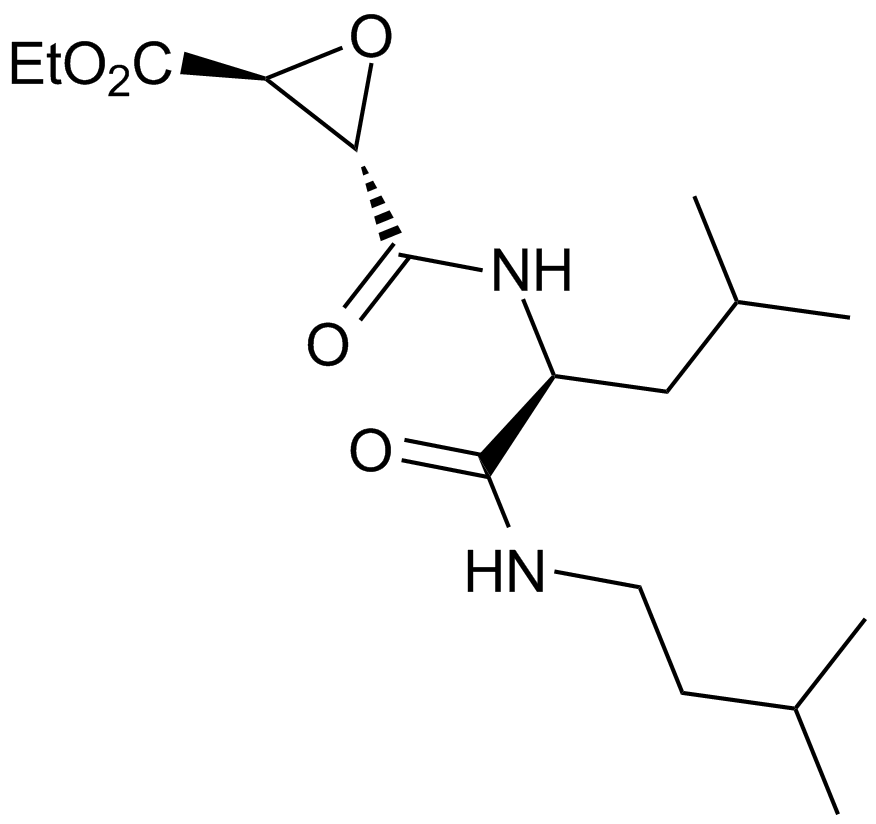
Cas No.: 88321-09-9
Sample solution is provided at 25 µL, 10mM.
E 64d est un ihnibiteur de protérases cystéines large-spectre irréversible cellules-perméable, avec une activité inhibitrice de l'agrégation plaquettaire[1]. E 64d est un inhibiteur non-sélectif de protéases tissulaire covalentes contenant un cycle époxyde en tant qu'un groupe réactif qui peut être attaqué de manière nucléophile par Cys-SH et former une liaison colvante au site catalytique[2]. E 64d inhibe l'accumulation de la protéine de prion protérases-résistante (PrP-res) dans les cellles ScNB, et sa IC50 est 0.5±0.11μM[3].
La pré-traitement in vitro des cellules SH-SY5Y par E 64d (3µM) pendant 30 minutes a amélioré la diminution de la sécrétion de sAPPα amyloïde bêta-induite et a inversé la régulation à la baisse de la protéine kinase C céramide-induite[4]. Le traitement des cellules HT22 par E 64d (25μM) pendant 24 h a atténué l'apoptose glutamate-induite, a inversé la diminution du protentiel de membrane mitochondriale et a réduit le stress oxydatif[5].
E 64d (9mg/kg/jour) a été in vivo injecté par voie intra-péritionéale dans les rats arthritiques pendant 10 jours, ce qui a significativement réduit la sévérité de l'arthrite clinique et de l'histopathologie, et a diminulé le niveau de mRNA des cytokines IL-6 et IL-1β[6]. E 64d (1mg/kg) a été injecté par voie intraveineuse dans les rats lésionnels de la moelle épinière (SCI) pendant 7 jours, ce qui inhibé la réponse inflammatoire caussé par SCI, a réduit l'expression de la calretinine 1 dans le tissu de la moelle épinière, a réduit l'apoptose neuronale et a inhibé l'activité de la cyclooxygénase 2[7].
References:
[1] Chen Y, Li Q, Li Q, et al. p62/SQSTM1, a central but unexploited target: advances in its physiological/pathogenic functions and small molecular modulators[J]. Journal of medicinal chemistry, 2020, 63(18): 10135-10157.
[2] Cannalire R, Stefanelli I, Cerchia C, et al. SARS-CoV-2 entry inhibitors: small molecules and peptides targeting virus or host cells[J]. International Journal of Molecular Sciences, 2020, 21(16): 5707.
[3] Doh-Ura K, Iwaki T, Caughey B. Lysosomotropic agents and cysteine protease inhibitors inhibit scrapie-associated prion protein accumulation[J]. Journal of virology, 2000, 74(10): 4894-4897.
[4] Tanabe F, Nakajima T, Ito M. The thiol proteinase inhibitor E-64-d ameliorates amyloid-β-induced reduction of sAPPα secretion by reversing ceramide-induced protein kinase C down-regulation in SH-SY5Y neuroblastoma cells[J]. Biochemical and Biophysical Research Communications, 2013, 441(1): 256-261.
[5] Xie R J, Li T X, Qiao X Y, et al. The Protective Role of E‐64d in Hippocampal Excitotoxic Neuronal Injury Induced by Glutamate in HT22 Hippocampal Neuronal Cells[J]. Neural Plasticity, 2021, 2021(1): 7174287.
[6] Yoshifuji H, Umehara H, Maruyama H, et al. Amelioration of experimental arthritis by a calpain-inhibitory compound: regulation of cytokine production by E-64-d in vivo and in vitro[J]. International immunology, 2005, 17(10): 1327-1336.
[7] Zhang Z, Huang Z, Dai H, et al. Therapeutic Efficacy of E‐64‐d, a Selective Calpain Inhibitor, in Experimental Acute Spinal Cord Injury[J]. BioMed Research International, 2015, 2015(1): 134242.
| Expériences cellulaires [1]: | |
Lignées cellulaires | Cellules SH-SY5Y |
Méthode de préparation | Les cellules SH-SY5Y ont été pré-traitées par E 64d (3µM) ou rien pendant 30 minutes et ont été incubées par Aβ (0.001 ou 0.01µM) pendant 5,5 heures, suivies d'une incubation par la méthacholine (1mM) pendant 2h. La sAPPα sécrétée a été analysée par Western blotting par l'utilisation de l'anticorps 6E10. |
Conditions de réaction | 3µM; 30minutes |
Domaines d'application | E 64d restaure la réduction de la sécrétion de sAPPα Aβ-induite dans les cellules SH-SY5Y. |
| Expériences animales [2]: | |
Modèles animaux | Rats BALB/c |
Méthode de préparation | L'anthrite a été induite en rats BALB/c femmelles âgées de 7 semaines par le mélange d'anticorps monoclonaux anti-type II CL mAbs et LPS. 2mg par corps de mélange d'anticorps monoclonaux ont été injectés par voie intra-péritionéale à chaque rat, et 48h plus tard, 50µg par corps de LPS ont été injectés par voie intra-péritionéale pour aggraver l'arthrite. Une dose élevée (9mg/kg/jour) ou une dose faible (3mg/kg/jour) d'E 64d, la calpastatine recombinante (rCS) (9mg/kg/semaine) ou le diluant de témoin ont été administrés par voie intra-péritionéale aux rats atteints de la maladie pendant 10 jours à partir du jour avant l'injection des anticorps monoclonaux. Exciver la patte arrière droite de chaque corps et évaluer macroscopiquement la sévérité de l'arthrite dans chaque patte. Evaluer la sévérité histopathologique en fonction des observations d'infiltration cellulaire, de formation de pannus et d'érosion osseuse. |
Forme de dosage | 3、9mg/kg/jour pendant 10 jours; i.p. |
Domaines d'application | Le score d'arthrite clinique du groupe E 64d à dose élevée était significativement inférieur à celui du groupe pas-traité, lorsqu'il n'y avait pas l'amélioration dans le groupe E 64d à dose faible et le groupe traité par rCS. Le score histopathologique d'infiltration cellulaire et le score total d'arthrite histopathologique du groupe E 64d à dose élevée étaient significativement inférieur à ceux du groupe pas-traité. |
References: | |
| Cas No. | 88321-09-9 | SDF | |
| Synonymes | Aloxistatin, E64c ethyl ester, EP 453, EST, Loxistatin, NSC 694281 | ||
| Chemical Name | ethyl (2S,3S)-3-[[(2S)-4-methyl-1-(3-methylbutylamino)-1-oxopentan-2-yl]carbamoyl]oxirane-2-carboxylate | ||
| Canonical SMILES | CCOC(=O)C1C(O1)C(=O)NC(CC(C)C)C(=O)NCCC(C)C | ||
| Formula | C17H30N2O5 | M.Wt | 342.43 |
| Solubility | ≥ 17.1215mg/mL in DMSO | Storage | Store at -20°C |
| General tips | Please select the appropriate solvent to prepare the stock solution according to the
solubility of the product in different solvents; once the solution is prepared, please store it in
separate packages to avoid product failure caused by repeated freezing and thawing.Storage method
and period of the stock solution: When stored at -80°C, please use it within 6 months; when stored
at -20°C, please use it within 1 month. To increase solubility, heat the tube to 37°C and then oscillate in an ultrasonic bath for some time. |
||
| Shipping Condition | Evaluation sample solution: shipped with blue ice. All other sizes available: with RT, or with Blue Ice upon request. | ||
| Prepare stock solution | |||

|
1 mg | 5 mg | 10 mg |
| 1 mM | 2.9203 mL | 14.6015 mL | 29.203 mL |
| 5 mM | 584.1 μL | 2.9203 mL | 5.8406 mL |
| 10 mM | 292 μL | 1.4602 mL | 2.9203 mL |
Step 1: Enter information below (Recommended: An additional animal making an allowance for loss during the experiment)
 g
μL
g
μL
Step 2: Enter the in vivo formulation (This is only the calculator, not formulation. Please contact us first if there is no in vivo formulation at the solubility Section.)
Calculation results:
Working concentration: mg/ml;
Method for preparing DMSO master liquid: mg drug pre-dissolved in μL DMSO ( Master liquid concentration mg/mL, Please contact us first if the concentration exceeds the DMSO solubility of the batch of drug. )
Method for preparing in vivo formulation: Take μL DMSO master liquid, next addμL PEG300, mix and clarify, next addμL Tween 80, mix and clarify, next add μL saline, mix and clarify.
Method for preparing in vivo formulation: Take μL DMSO master liquid, next add μL Corn oil, mix and clarify.
Note: 1. Please make sure the liquid is clear before adding the next solvent.
2. Be sure to add the solvent(s) in order. You must ensure that the solution obtained, in the previous addition, is a clear solution before proceeding to add the next solvent. Physical methods such as vortex, ultrasound or hot water bath can be used to aid dissolving.
3. All of the above co-solvents are available for purchase on the GlpBio website.
Quality Control & SDS
- View current batch:
- Purity: >99.50% Appearance: A solid
- COA (Certificate of Analysis)
- SDS (Safety Data Sheet)
- Datasheet
Average Rating: 5 (Based on Reviews and 30 reference(s) in Google Scholar.)