

FSL-1 |
Catalog No.GC18761
 One-Click Copy Product Info
|

FSL-1 es un agonista de diacil lipopéptido sintético TLR2/6
Products are for research use only. Not for human use. We do not sell to patients.
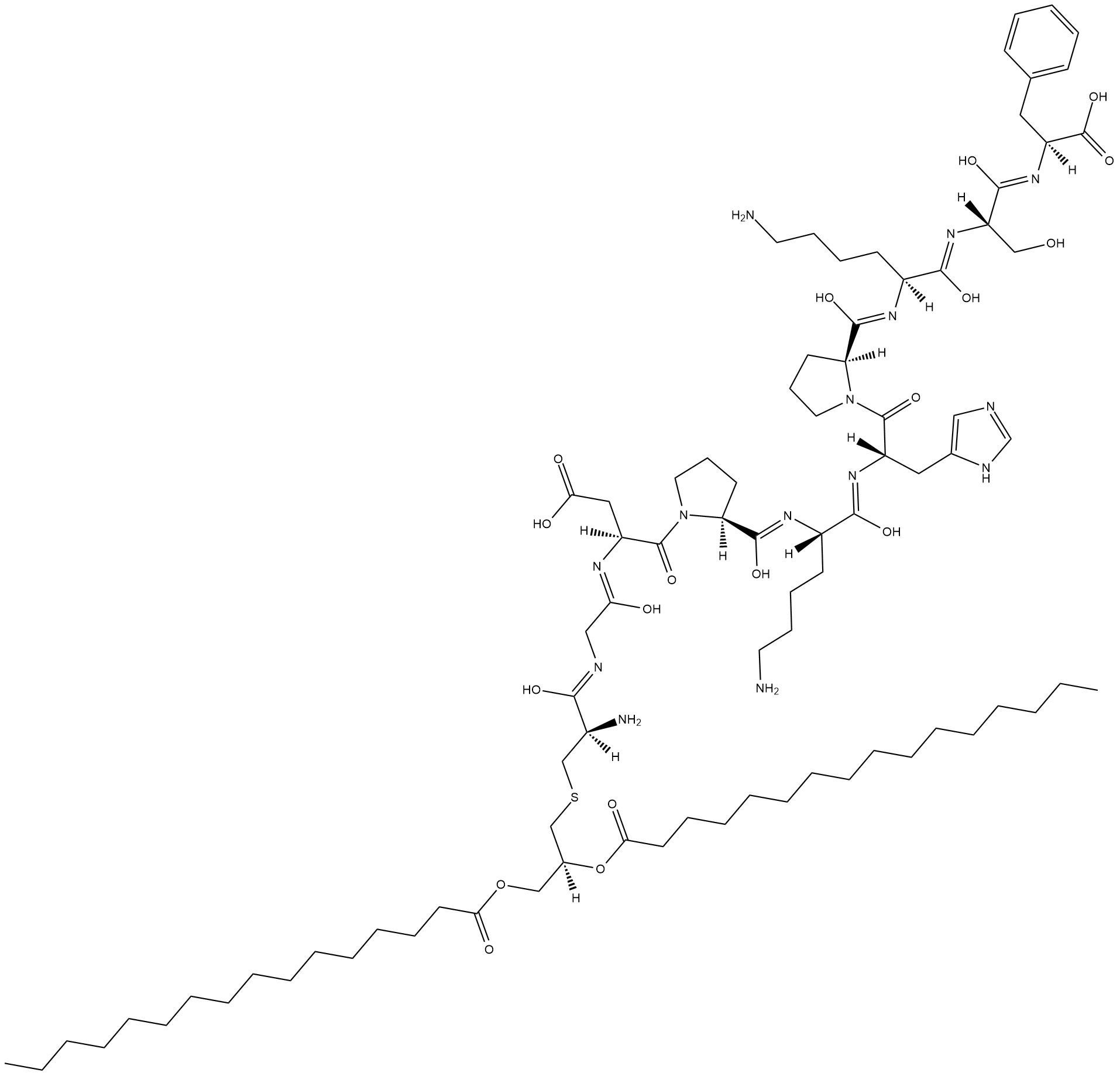
Cas No.: 322455-70-9
Sample solution is provided at 25 µL, 10mM.
FSL-1 es un agonista de diacil lipopéptido sintético TLR2/6 [1]. FSL-1 se une y activa los heterodímeros TLR2/6, activando vías de señalización dependientes de MyD88 aguas abajo, lo que lleva a la activación de NF-κB, MAPK y otras vías, e induciendo la liberación de múltiples factores inflamatorios (TNF-α, IL-1β, IL-6, IL-8) y quimiocinas [2-3]. FSL-1 se utiliza principalmente en inmunología e investigación de la inflamación [4].
En las células THP-1, FSL-1 (50ng/mL; 24h) induce la expresión del gen MMP-9 [5]. En las células HaCaT, la estimulación FSL-1 (100ng/mL; 0.5-2h) regula a la baja la expresión de TGB6 [6].
En el modelo de ratones de radiación, la administración profiláctica de FSL-1 (0.25mg/kg; sc; 40d) mejora significativamente la tasa de supervivencia de ratones C57BL/6 machos y hembras [7]. En el modelo de ratones de radiación, FSL-1 (0.09mg/kg; sc; 8d) estimula el reclutamiento de células progenitoras hematopoyéticas [8].
References:
[1]. Rose W A, McGowin C L, Pyles R B. FSL-1, a bacterial-derived toll-like receptor 2/6 agonist, enhances resistance to experimental HSV-2 infection[J]. Virology journal, 2009, 6(1): 195.
[2]. Kurkjian C J, Guo H, Montgomery N D, et al. The toll–like Receptor 2/6 agonist, FSL–1 lipopeptide, therapeutically mitigates acute radiation syndrome[J]. Scientific Reports, 2017, 7(1): 17355.
[3]. Nakamura J, Shibata K, Hasebe A, et al. Signaling pathways induced by lipoproteins derived from Mycoplasma salivarium and a synthetic lipopeptide (FSL‐1) in normal human gingival fibroblasts[J]. Microbiology and immunology, 2002, 46(3): 151-158.
[4]. Lim R, Barker G, Lappas M. The TLR 2 Ligand FSL‐1 and the TLR 5 Ligand Flagellin Mediate Pro‐Inflammatory and Pro‐Labour Response via MyD88/TRAF 6/NF‐κB‐Dependent Signalling[J]. American Journal of Reproductive Immunology, 2014, 71(5): 401-417.
[5]. Ahmad R, Shihab P K, Jasem S, et al. FSL-1 induces MMP-9 production through TLR-2 and NF-κB/AP-1 signaling pathways in monocytic THP-1 cells[J]. Cellular Physiology and Biochemistry, 2014, 34(3): 929-942.
[6]. Xu M, Huang J, Zhu F, et al. FOXO1 inhibits FSL-1 regulation of integrin β6 by blocking STAT3 binding to the integrin β6 gene promoter[J]. Frontiers in Cellular and Infection Microbiology, 2022, 12: 998693.
[7]. Holmes-Hampton G P, Kumar V P, Valenzia K, et al. FSL-1: A Synthetic Peptide Increases Survival in a Murine Model of Hematopoietic Acute Radiation Syndrome[J]. Radiation Research, 2024, 201(5): 449-459.
[8]. Brickey W J, Caudell D L, Macintyre A N, et al. The TLR2/TLR6 ligand FSL-1 mitigates radiation-induced hematopoietic injury in mice and nonhuman primates[J]. Proceedings of the National Academy of Sciences, 2023, 120(50): e2122178120.
| Experimentos celulares [1]: | |
Líneas celulares | Células THP-1 |
Método de preparación | Las células THP-1 se sembraron en placas de 12 pozos a 1 × 10⁶ celdas por pozo. Las células fueron estimuladas con FSL-1 (50ng/mL) o TNF-α (25ng/mL) a 37℃ durante 24 horas. Las células se recogieron para el aislamiento del ARN, y se recogió el medio acondicionado para la determinación de la secreción de MMP-9 y la actividad de SEAP. El medio acondicionado se recogió y se almacenó a -80℃. |
Condiciones de reacción | 50ng/mL; 24h |
Áreas de aplicación | En las células THP-1, FSL-1 induce la expresión del gen MMP-9. |
| Experimentos con animales [2]: | |
Modelos animales | Modelo de ratones de radiación |
Método de preparación | Para investigar la eficacia radioprotectora de FSL-1, todos los ratones del estudio se pesaron antes del inicio del estudio; se excluyeron los animales que pesaban ± 10% del peso corporal medio. Luego, los ratones se dividieron al azar en dos grupos (control de vehículos y grupos FSL-1), con cinco animales por jaula. Veinticuatro horas antes de la exposición a la radiación, los ratones recibieron una dosis única de 0,25 mg/kg de FSL-1 o vehículo (PBS estéril) inyectado subcutáneamente en la nuca del cuello utilizando una aguja de 23 G. Cada grupo de medicamentos y vehículos tratados (PBS) contenía 25 animales. Los hombres recibieron una dosis de radiación de 8,1 Gy. Debido a que las hembras son más resistentes a la radiación que los hombres, las hembras recibieron una dosis más alta de 8,7Gy. La supervivencia fue monitoreada hasta cuatro veces al día durante 30 días, y los animales supervivientes fueron sacrificados al finalizar el estudio. |
Forma de dosificación | 0,25 mg/kg; sc; 40d |
Áreas de aplicación | La administración profiláctica de FSL-1 mejora significativamente la tasa de supervivencia de ratones C57BL/6 machos y hembras. |
References: | |
| Cas No. | 322455-70-9 | SDF | |
| Chemical Name | S-[2,3-bis[(1-oxohexadecyl)oxy]propyl]-L-cysteinylglycyl-L-α-aspartyl-L-prolyl-L-lysyl-L-histidyl-L-prolyl-L-lysyl-L-seryl-L-phenylalanine | ||
| Canonical SMILES | N/A | ||
| Formula | C84H140N14O18S | M.Wt | 1666.2 |
| Solubility | Soluble in DMSO | Storage | Store at -20°C |
| General tips | Please select the appropriate solvent to prepare the stock solution according to the
solubility of the product in different solvents; once the solution is prepared, please store it in
separate packages to avoid product failure caused by repeated freezing and thawing.Storage method
and period of the stock solution: When stored at -80°C, please use it within 6 months; when stored
at -20°C, please use it within 1 month. To increase solubility, heat the tube to 37°C and then oscillate in an ultrasonic bath for some time. |
||
| Shipping Condition | Evaluation sample solution: shipped with blue ice. All other sizes available: with RT, or with Blue Ice upon request. | ||
| Prepare stock solution | |||

|
1 mg | 5 mg | 10 mg |
| 1 mM | 600.2 μL | 3.0008 mL | 6.0017 mL |
| 5 mM | 120 μL | 600.2 μL | 1.2003 mL |
| 10 mM | 60 μL | 300.1 μL | 600.2 μL |
Step 1: Enter information below (Recommended: An additional animal making an allowance for loss during the experiment)
 g
μL
g
μL
Step 2: Enter the in vivo formulation (This is only the calculator, not formulation. Please contact us first if there is no in vivo formulation at the solubility Section.)
Calculation results:
Working concentration: mg/ml;
Method for preparing DMSO master liquid: mg drug pre-dissolved in μL DMSO ( Master liquid concentration mg/mL, Please contact us first if the concentration exceeds the DMSO solubility of the batch of drug. )
Method for preparing in vivo formulation: Take μL DMSO master liquid, next addμL PEG300, mix and clarify, next addμL Tween 80, mix and clarify, next add μL saline, mix and clarify.
Method for preparing in vivo formulation: Take μL DMSO master liquid, next add μL Corn oil, mix and clarify.
Note: 1. Please make sure the liquid is clear before adding the next solvent.
2. Be sure to add the solvent(s) in order. You must ensure that the solution obtained, in the previous addition, is a clear solution before proceeding to add the next solvent. Physical methods such as vortex, ultrasound or hot water bath can be used to aid dissolving.
3. All of the above co-solvents are available for purchase on the GlpBio website.
Quality Control & SDS
- View current batch:
- Purity: >98.00% Appearance: A solid
- COA (Certificate of Analysis)
- SDS (Safety Data Sheet)
- Datasheet
Average Rating: 5 (Based on Reviews and 32 reference(s) in Google Scholar.)