

FSL-1 |
Catalog No.GC18761
 One-Click Copy Product Info
|

FSL-1 is a synthetic diacyl lipopeptide TLR2/6 agonist.
Products are for research use only. Not for human use. We do not sell to patients.
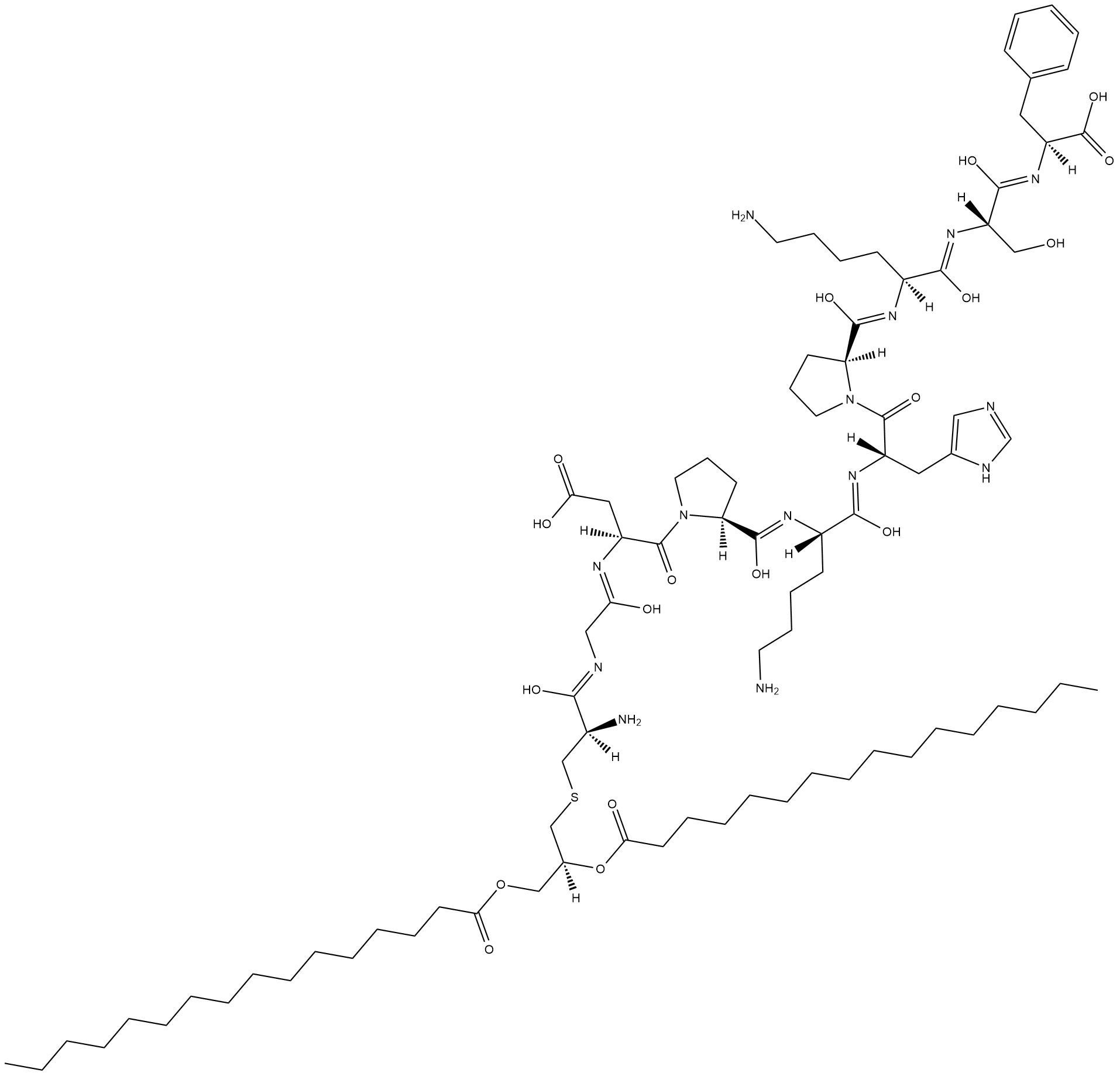
Cas No.: 322455-70-9
Sample solution is provided at 25 µL, 10mM.
FSL-1 is a synthetic diacyl lipopeptide TLR2/6 agonist [1]. FSL-1 binds to and activates TLR2/6 heterodimers, triggering downstream MyD88-dependent signaling pathways, leading to activation of NF-κB, MAPK, and other pathways, and inducing the release of multiple inflammatory factors (TNF-α, IL-1β, IL-6, IL-8) and chemokines [2-3]. FSL-1 is primarily used in immunology and inflammation research [4].
In THP-1 cells, FSL-1 (50ng/mL; 24h) induces MMP-9 gene expression [5]. In HaCaT cells, FSL-1 (100ng/mL; 0.5-2h) stimulation downregulates TGB6 expression [6].
In radiation mice model, prophylactic administration of FSL-1 (0.25mg/kg; sc; 40d) significantly improves the survival rate of male and female C57BL/6 mice [7]. In radiation mice model, FSL-1 (0.09mg/kg; sc; 8d) stimulates the recruitment of hematopoietic progenitor cells [8].
References:
[1]. Rose W A, McGowin C L, Pyles R B. FSL-1, a bacterial-derived toll-like receptor 2/6 agonist, enhances resistance to experimental HSV-2 infection[J]. Virology journal, 2009, 6(1): 195.
[2]. Kurkjian C J, Guo H, Montgomery N D, et al. The toll–like Receptor 2/6 agonist, FSL–1 lipopeptide, therapeutically mitigates acute radiation syndrome[J]. Scientific Reports, 2017, 7(1): 17355.
[3]. Nakamura J, Shibata K, Hasebe A, et al. Signaling pathways induced by lipoproteins derived from Mycoplasma salivarium and a synthetic lipopeptide (FSL‐1) in normal human gingival fibroblasts[J]. Microbiology and immunology, 2002, 46(3): 151-158.
[4]. Lim R, Barker G, Lappas M. The TLR 2 Ligand FSL‐1 and the TLR 5 Ligand Flagellin Mediate Pro‐Inflammatory and Pro‐Labour Response via MyD88/TRAF 6/NF‐κB‐Dependent Signalling[J]. American Journal of Reproductive Immunology, 2014, 71(5): 401-417.
[5]. Ahmad R, Shihab P K, Jasem S, et al. FSL-1 induces MMP-9 production through TLR-2 and NF-κB/AP-1 signaling pathways in monocytic THP-1 cells[J]. Cellular Physiology and Biochemistry, 2014, 34(3): 929-942.
[6]. Xu M, Huang J, Zhu F, et al. FOXO1 inhibits FSL-1 regulation of integrin β6 by blocking STAT3 binding to the integrin β6 gene promoter[J]. Frontiers in Cellular and Infection Microbiology, 2022, 12: 998693.
[7]. Holmes-Hampton G P, Kumar V P, Valenzia K, et al. FSL-1: A Synthetic Peptide Increases Survival in a Murine Model of Hematopoietic Acute Radiation Syndrome[J]. Radiation Research, 2024, 201(5): 449-459.
[8]. Brickey W J, Caudell D L, Macintyre A N, et al. The TLR2/TLR6 ligand FSL-1 mitigates radiation-induced hematopoietic injury in mice and nonhuman primates[J]. Proceedings of the National Academy of Sciences, 2023, 120(50): e2122178120.
| Cell experiment [1]: | |
Cell lines | THP-1 cells |
Preparation Method | THP-1 cells were seeded in 12-well plates at 1 × 10⁶ cells per well. Cells were stimulated with FSL-1 (50ng/mL) or TNF-α (25ng/mL) at 37℃ for 24 hours. Cells were harvested for RNA isolation, and conditioned medium was collected for determination of MMP-9 secretion and SEAP activity. Conditioned medium was collected and stored at −80℃. |
Reaction Conditions | 50ng/mL; 24h |
Applications | In THP-1 cells, FSL-1 induces MMP-9 gene expression. |
| Animal experiment [2]: | |
Animal models | Radiation mice model |
Preparation Method | To investigate the radioprotective efficacy of FSL-1, all mice in the study were weighed before the start of the study; animals weighing ± 10% of the mean body weight were excluded. Mice were then randomly divided into two groups (vehicle control and FSL-1 groups), with five animals per cage. Twenty-four hours before radiation exposure, mice received a single dose of 0.25mg/kg of FSL-1 or vehicle (sterile PBS) subcutaneously injected into the scruff of the neck using a 23-G needle. Each drug- and vehicle-treated (PBS) group contained 25 animals. Males received a radiation dose of 8.1Gy. Because females are more radioresistant than males, females received a higher dose of 8.7Gy. Survival was monitored up to four times daily for 30 days, and surviving animals were euthanized upon completion of the study. |
Dosage form | 0.25mg/kg; sc; 40d |
Applications | Prophylactic administration of FSL-1 significantly improves the survival rate of male and female C57BL/6 mice. |
References: | |
| Cas No. | 322455-70-9 | SDF | |
| Chemical Name | S-[2,3-bis[(1-oxohexadecyl)oxy]propyl]-L-cysteinylglycyl-L-α-aspartyl-L-prolyl-L-lysyl-L-histidyl-L-prolyl-L-lysyl-L-seryl-L-phenylalanine | ||
| Canonical SMILES | N/A | ||
| Formula | C84H140N14O18S | M.Wt | 1666.2 |
| Solubility | Soluble in DMSO | Storage | Store at -20°C |
| General tips | Please select the appropriate solvent to prepare the stock solution according to the
solubility of the product in different solvents; once the solution is prepared, please store it in
separate packages to avoid product failure caused by repeated freezing and thawing.Storage method
and period of the stock solution: When stored at -80°C, please use it within 6 months; when stored
at -20°C, please use it within 1 month. To increase solubility, heat the tube to 37°C and then oscillate in an ultrasonic bath for some time. |
||
| Shipping Condition | Evaluation sample solution: shipped with blue ice. All other sizes available: with RT, or with Blue Ice upon request. | ||
| Prepare stock solution | |||

|
1 mg | 5 mg | 10 mg |
| 1 mM | 600.2 μL | 3.0008 mL | 6.0017 mL |
| 5 mM | 120 μL | 600.2 μL | 1.2003 mL |
| 10 mM | 60 μL | 300.1 μL | 600.2 μL |
Step 1: Enter information below (Recommended: An additional animal making an allowance for loss during the experiment)
 g
μL
g
μL
Step 2: Enter the in vivo formulation (This is only the calculator, not formulation. Please contact us first if there is no in vivo formulation at the solubility Section.)
Calculation results:
Working concentration: mg/ml;
Method for preparing DMSO master liquid: mg drug pre-dissolved in μL DMSO ( Master liquid concentration mg/mL, Please contact us first if the concentration exceeds the DMSO solubility of the batch of drug. )
Method for preparing in vivo formulation: Take μL DMSO master liquid, next addμL PEG300, mix and clarify, next addμL Tween 80, mix and clarify, next add μL saline, mix and clarify.
Method for preparing in vivo formulation: Take μL DMSO master liquid, next add μL Corn oil, mix and clarify.
Note: 1. Please make sure the liquid is clear before adding the next solvent.
2. Be sure to add the solvent(s) in order. You must ensure that the solution obtained, in the previous addition, is a clear solution before proceeding to add the next solvent. Physical methods such as vortex, ultrasound or hot water bath can be used to aid dissolving.
3. All of the above co-solvents are available for purchase on the GlpBio website.
Quality Control & SDS
- View current batch:
- Purity: >98.00% Appearance: A solid
- COA (Certificate of Analysis)
- SDS (Safety Data Sheet)
- Datasheet
Average Rating: 5 (Based on Reviews and 32 reference(s) in Google Scholar.)