

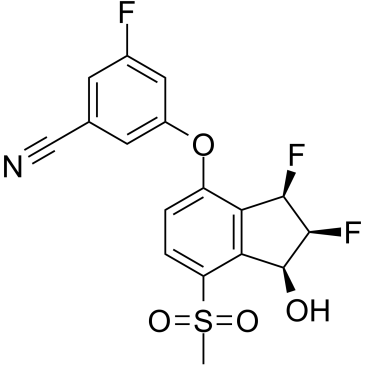
PT2977 (Synonyms: PT2977; MK-6482) |
Catalog No.GC37034
 One-Click Copy Product Info
|

PT2977 es un inhibidor de HIF-2α oralmente activo y selectivo con un IC50 de 9nM
Products are for research use only. Not for human use. We do not sell to patients.
Cas No.: 1672668-24-4
Sample solution is provided at 25 µL, 10mM.
_1-3.$$$39978408@51.jpg');)
_1-9.$$$38538795@65.jpg');)
_1-9.$$$39112701@51.jpg');)
_1-7.$$$37316672@70.jpg');)
_366-372.$$$36198801@70.jpg');)
.$$$38565142@65.jpg');)
_1867-1883.$$$33248023@67.jpg');)
_eads6055.$$$39977546@45.jpg');)
_eadm9805.$$$40080571@45.jpg');)
_eadj3020.$$$39666821@45.jpg');)
_1-20.$$$39757301@28.jpg');)
_1-24.$$$38898113@28.jpg');)
_273-287.$$$36806353@46.jpg');)
_1-16.$$$37156877@44.jpg');)
_1-19.$$$37460805@44.jpg');)
_1291-1307.$$$34518654@46.jpg');)
PT2977 es un inhibidor de HIF-2α oralmente activo y selectivo con un IC50 de 9nM[1]. HIF-2α es un factor de transcripción clave que regula la expresión de los genes de respuesta a la hipoxia y juega un papel fundamental en la angiogénesis tumoral, el mantenimiento de las células madre y la reprogramación metabólica [2]. PT2977 bloquea la transcripción de los genes diana aguas abajo inhibiendo el HIF-2α, y se utiliza principalmente en la investigación para el tratamiento del carcinoma de células renales de células claras (ccRCC)[3].
In vitro, PT2977 (2μM; 48h) inhibió la dimerización de HIF-2α con HIF-1β en líneas celulares de cáncer renal 786-O y A498 , redujo los niveles de mRNA de VEGFA, GLUT1 y Cyclin D1 y bloqueó la formación clonogénica en agar blando[4]. PT2977 (0-2μM; 24h) redujo los niveles de mRNA de los genes diana de HIF sin un efecto significativo en la proliferación celular [5].
In vivo, PT2977 (100mg/kg; p.o.; dos veces al día; 28 días) disminuyó el volumen tumoral, redujo los niveles de VEGF humano circulante (derivado del injerto) y redujo los niveles de mRNA de los genes diana HIF-2α (como VEGFA, CCND1, GLUT1, PAI1 y CXCR4) en un medolo de ratón de xenoinjerto derivado de la línea celular 786-O [6]. PT2977 (30mg/kg o 100mg/kg; p.o.; dos veces al día; 5 días) disminuyó los niveles de proteína HIF-2α y Cyclin D1, aumentó el número de células activas positivas de Caspase-3 y promovió la apoptosis de células tumorales en tejidos tumorales de xenoinjertos ccRCC[7].
References:
[1] Xu R, Wang K, Rizzi JP, et al. 3-[(1S,2S,3R)-2,3-Difluoro-1-hydroxy-7-methylsulfonylindan-4-yl]oxy-5-fluorobenzonitrile (PT2977), a Hypoxia-Inducible Factor 2α (HIF-2α) Inhibitor for the Treatment of Clear Cell Renal Cell Carcinoma. J Med Chem. 2019;62(15):6876-6893.
[2] Murugesan T, Rajajeyabalachandran G, Kumar S, Nagaraju S, Jegatheesan SK. Targeting HIF-2α as therapy for advanced cancers. Drug Discov Today. 2018;23(7):1444-1451.
[3] Wu X, Lazris D, Wong R, Tykodi SS. Belzutifan for the treatment of renal cell carcinoma. Ther Adv Med Oncol. 2025;17:17588359251317846.
[4] Hamal KB, Pavlich CI, Carlson GJ, et al. Synthesis of the Hypoxia-Inducible Factor-2α (HIF-2α) Inhibitor, 3-[(1S,2S,3R)-2,3-Difluoro-1-hydroxy-7-methylsulfonylindan-4-yl]oxy-5-fluorobenzonitrile (PT2977, Belzutifan); Efficient Replication of Established Approaches. Tetrahedron Lett. 2023;128:154691.
[5] Cho H, Du X, Rizzi JP, et al. On-target efficacy of a HIF-2α antagonist in preclinical kidney cancer models. Nature. 2016;539(7627):107-111.
[6] Chen W, Hill H, Christie A, et al. Targeting renal cell carcinoma with a HIF-2 antagonist. Nature. 2016;539(7627):112-117.
[7] Wallace, E. M., Rizzi, J. P., Hanrahan, C. F., et al. A small-molecule antagonist of HIF-2α is efficacious in preclinical models of renal cell carcinoma.
| Experimentos celulares [1]: | |
Líneas celulares | Células de cáncer renal 786-O |
Método de preparación | Las células de cáncer renal 2×10⁵ 786-O se inocularon por pozo en placas de 6 pocillos con 3 réplicas para cada grupo. Las células fueron tratadas con 2μM PT2977 durante 48 horas. El grupo de control negativo no fue tratado con nada. Después de 48 horas, se cosecharon las células y se extrajo ARN usando el reactivo TRIzol siguiendo las instrucciones del fabricante. Luego se realizó RT-PCR. |
Condiciones de reacción | 2μM; 48h |
Áreas de aplicación | PT2977 (2μM; 48h) redujo los niveles de ARNm de VEGFA, GLUT1 y Ciclina D1 en líneas celulares de cáncer renal 786-O. |
| Experimentos con animales [2]: | |
Modelos animales | Ratones NOD/SCID |
Método de preparación | Se implantaron fragmentos de tejido de 64 mm3 de injertos tumorales ortotópicos de crecimiento estable en ratones NOD/SCID hembras y machos de 4 a 6 semanas. El vehículo (10% EtOH, 30% PEG400, 60% MCT [0,5% metilcelulosa, 0,5% Tween 80 (aq)]) se administró por gavage cada 12h. PT2977 se administró a 100 mg/kg por gasado oral cada 12h en 10% EtOH, 30% PEG400, 60% MCT durante 28 días consecutivos. Los pesos de los ratones se tomaron semanalmente. Los tumores generalmente se midieron dos veces por semana usando un calibrador digital. |
Forma de dosificación | 100 mg/kg; p.o.; dos veces al día; 28 días |
Áreas de aplicación | PT2977 (100 mg/kg; p.o.; dos veces al día; 28 días) disminuyó el volumen tumoral en un modelo de ratón de xenoinjerto derivado de la línea celular 786-O. |
References: | |
| Cas No. | 1672668-24-4 | SDF | |
| Sinónimos | PT2977; MK-6482 | ||
| Canonical SMILES | N#CC1=CC(F)=CC(OC2=CC=C(S(=O)(C)=O)C3=C2[C@@H](F)[C@@H](F)[C@H]3O)=C1 | ||
| Formula | C17H12F3NO4S | M.Wt | 383.34 |
| Solubility | DMSO: 50 mg/mL (130.43 mM) | Storage | Store at -20°C, stored under nitrogen |
| General tips | Please select the appropriate solvent to prepare the stock solution according to the
solubility of the product in different solvents; once the solution is prepared, please store it in
separate packages to avoid product failure caused by repeated freezing and thawing.Storage method
and period of the stock solution: When stored at -80°C, please use it within 6 months; when stored
at -20°C, please use it within 1 month. To increase solubility, heat the tube to 37°C and then oscillate in an ultrasonic bath for some time. |
||
| Shipping Condition | Evaluation sample solution: shipped with blue ice. All other sizes available: with RT, or with Blue Ice upon request. | ||
| Prepare stock solution | |||

|
1 mg | 5 mg | 10 mg |
| 1 mM | 2.6087 mL | 13.0433 mL | 26.0865 mL |
| 5 mM | 521.7 μL | 2.6087 mL | 5.2173 mL |
| 10 mM | 260.9 μL | 1.3043 mL | 2.6087 mL |
Step 1: Enter information below (Recommended: An additional animal making an allowance for loss during the experiment)
 g
μL
g
μL
Step 2: Enter the in vivo formulation (This is only the calculator, not formulation. Please contact us first if there is no in vivo formulation at the solubility Section.)
Calculation results:
Working concentration: mg/ml;
Method for preparing DMSO master liquid: mg drug pre-dissolved in μL DMSO ( Master liquid concentration mg/mL, Please contact us first if the concentration exceeds the DMSO solubility of the batch of drug. )
Method for preparing in vivo formulation: Take μL DMSO master liquid, next addμL PEG300, mix and clarify, next addμL Tween 80, mix and clarify, next add μL saline, mix and clarify.
Method for preparing in vivo formulation: Take μL DMSO master liquid, next add μL Corn oil, mix and clarify.
Note: 1. Please make sure the liquid is clear before adding the next solvent.
2. Be sure to add the solvent(s) in order. You must ensure that the solution obtained, in the previous addition, is a clear solution before proceeding to add the next solvent. Physical methods such as vortex, ultrasound or hot water bath can be used to aid dissolving.
3. All of the above co-solvents are available for purchase on the GlpBio website.
Quality Control & SDS
- View current batch:
- Purity: >98.00% Appearance: A solid
- COA (Certificate of Analysis)
- SDS (Safety Data Sheet)
- Datasheet
Average Rating: 5 (Based on Reviews and 17 reference(s) in Google Scholar.)