

Mupirocin (Synonyms: BRL 4910A) |
Catalog No.GC15238
 One-Click Copy Product Info
|

Mupirocin, un metabolito secundario, producido naturalmente por Pseudomonas fluorescens, con una excelente actividad in vitro contra algunos estreptococos
Products are for research use only. Not for human use. We do not sell to patients.
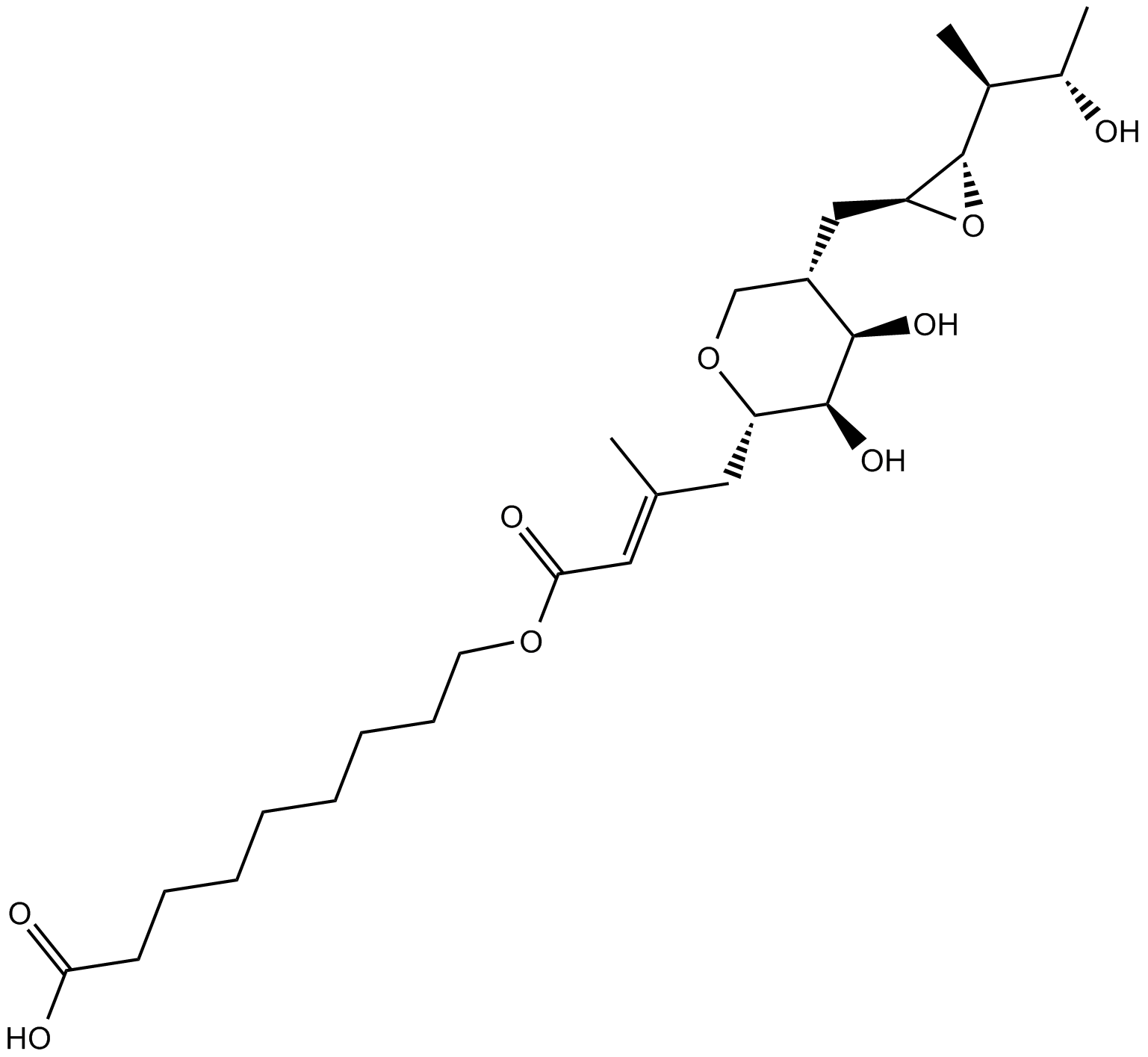
Cas No.: 12650-69-0
Sample solution is provided at 25 µL, 10mM.
Mupirocin, un metabolito secundario, producido naturalmente por Pseudomonas fluorescens, con una excelente actividad in vitro contra algunos estreptococos [1]. Mupirocin actúa sobre la isoleucyl-tRNA synthetase e inhibe la síntesis de proteínas bacterianas[2]. Mupirocin es ampliamente utilizada como agente antibacteriano contra Staphylococcus aureus resistente a la meticilina (MRSA)[3].
In vitro, el tratamiento con Mupirocin durante 72h mostró la potente actividad citotóxica contra la línea celular de melanoma UCT-Mel 1 con un valor de IC50 de 5.4μg/ml[4]. 0.2mM de tratamiento con Mupirocin durante 18 horas mejoró significativamente la viabilidad de las células HaCat y aceleró significativamente la cicatrización de heridas[5]. 0.05mM detratamiento con Mupirocin durante 48 horas inhibió la proliferación de queratinocitos epidérmicos con lesión de psoriasis (PLEKs), promoviendo la apoptosis celular[6].
In vivo, la aplicación de 0.1ml de Mupirocin ointment (20mg/g) a la herida diariamente durante 12 días promovió significativamente la cicatrización de la herida, lo que resultó en un aumento significativo en el grosor epidérmico y una reducción en el crecimiento de Staphylococcus aureus en un modelo de ratón de infección superficial de la piel causada por Staphylococcus aureus [7].
References:
[1] Bencardino D, Amagliani G, Brandi G. Carriage of Staphylococcus aureus among food handlers: An ongoing challenge in public health[J]. Food control, 2021, 130: 108362.
[2] Gisby J, Bryant J. Efficacy of a new cream formulation of mupirocin: comparison with oral and topical agents in experimental skin infections[J]. Antimicrobial agents and chemotherapy, 2000, 44(2): 255-260.
[3] Tucaliuc A, Blaga A C, Galaction A I, et al. Mupirocin: applications and production[J]. Biotechnology letters, 2019, 41(4): 495-502.
[4] Reva O N, Rademan S, Visagie M H, et al. Comparison of structures and cytotoxicity of mupirocin and batumin against melanoma and several other cancer cell lines[J]. Future medicinal chemistry, 2019, 11(7): 677-691.
[5] Twilley D, Reva O, Meyer D, et al. Mupirocin promotes wound healing by stimulating growth factor production and proliferation of human keratinocytes[J]. Frontiers in Pharmacology, 2022, 13: 862112.
[6] Yan B X, Chen X Y, Wang Z Y, et al. Mupirocin blocks imiquimod-induced psoriasis-like skin lesion by inhibiting epidermal isoleucyl-tRNA synthetase[J]. Cell Communication and Signaling, 2022, 20(1): 185.
[7] Pérez M, Robres P, Moreno B, et al. Comparison of antibacterial activity and wound healing in a superficial abrasion mouse model of Staphylococcus aureus skin infection using photodynamic therapy based on methylene blue or mupirocin or both[J]. Frontiers in Medicine, 2021, 8: 673408.
| Experimentos celulares [1]: | |
Líneas celulares | Células HaCat |
Método de preparación | Las células HaCat se sembraron a una concentración de 1,5×10⁵ células/mL en una placa de 24 pozos y se incubaron durante la noche a 37 °C y 5% de CO2 para formar monocapas confluentes. Posteriormente, se dibujó una cruz en el centro de cada pozo para simular una herida usando una punta de pipeta 1000. Los desechos celulares se eliminaron aspirando el medio de cultivo y agregando un medio completo fresco. Luego, las células fueron tratadas con mupirocina a una concentración final de 0,2 mM durante 18 horas. El grupo de control incluía células cultivadas en el medio de cultivo (sin tratar) y células tratadas con DMSO (control del vehículo) al 0,25 %. Las imágenes se capturaron usando un microscopio óptico con un aumento de 4× en el momento del rasguño inicial (0 horas) y 18 horas después del tratamiento. |
Condiciones de reacción | 0,2 mM; 18h |
Áreas de aplicación | El tratamiento con Mupirocin aumentó significativamente la cicatrización de heridas en las células HaCat. |
| Experimentos con animales [2]: | |
Modelos animales | Ratones sin pelo SKH-1 |
Método de preparación | Los ratones sin pelo SKH-1 (6-8 semanas de edad) fueron alojados individualmente en jaulas durante unos días antes del experimento para adaptarse al entorno. Las jaulas se colocaron cerca del suelo para permitir que los ratones se adaptaran a los bajos niveles de luz, y se proporcionaron alimentos y agua comerciales de forma gratuita. Bajo anestesia general, 20 ratones fueron desinfectados con 70% de alcohol en su piel, y las abrasiones se hicieron con un cuchillo quirúrgico hasta que apareció enrojecimiento y la epidermis se perdió significativamente. El diámetro de la herida era de aproximadamente 0,6 cm, ubicado en el área posterior, a 1 cm de distancia. Se aplicó aproximadamente 0,1 ml de ungüento de mupirocina (20 mg/g) a la herida diariamente (usando una pomada separada cada vez), y se realizó un suave masaje hasta que la pomada se absorbió por completo. Todo el proceso duró 12 días, y las características patológicas de las heridas se evaluaron diariamente. |
Forma de dosificación | 20 mg/g/día durante 12 días; aplicar en la herida |
Áreas de aplicación | El tratamiento con Mupirocin promovió significativamente la cicatrización de heridas y condujo al engrosamiento de la epidermis en ratones. |
References: | |
| Cas No. | 12650-69-0 | SDF | |
| Sinónimos | BRL 4910A | ||
| Chemical Name | 9-[(E)-4-[(2S,3R,4R,5S)-3,4-dihydroxy-5-[[(2S,3S)-3-[(2S,3S)-3-hydroxybutan-2-yl]oxiran-2-yl]methyl]oxan-2-yl]-3-methylbut-2-enoyl]oxynonanoic acid | ||
| Canonical SMILES | CC(C1C(O1)CC2COC(C(C2O)O)CC(=CC(=O)OCCCCCCCCC(=O)O)C)C(C)O | ||
| Formula | C26H44O9 | M.Wt | 500.62 |
| Solubility | ≥ 100mg/mL in DMSO | Storage | Store at -20°C |
| General tips | Please select the appropriate solvent to prepare the stock solution according to the
solubility of the product in different solvents; once the solution is prepared, please store it in
separate packages to avoid product failure caused by repeated freezing and thawing.Storage method
and period of the stock solution: When stored at -80°C, please use it within 6 months; when stored
at -20°C, please use it within 1 month. To increase solubility, heat the tube to 37°C and then oscillate in an ultrasonic bath for some time. |
||
| Shipping Condition | Evaluation sample solution: shipped with blue ice. All other sizes available: with RT, or with Blue Ice upon request. | ||
| Prepare stock solution | |||

|
1 mg | 5 mg | 10 mg |
| 1 mM | 1.9975 mL | 9.9876 mL | 19.9752 mL |
| 5 mM | 399.5 μL | 1.9975 mL | 3.995 mL |
| 10 mM | 199.8 μL | 998.8 μL | 1.9975 mL |
Step 1: Enter information below (Recommended: An additional animal making an allowance for loss during the experiment)
 g
μL
g
μL
Step 2: Enter the in vivo formulation (This is only the calculator, not formulation. Please contact us first if there is no in vivo formulation at the solubility Section.)
Calculation results:
Working concentration: mg/ml;
Method for preparing DMSO master liquid: mg drug pre-dissolved in μL DMSO ( Master liquid concentration mg/mL, Please contact us first if the concentration exceeds the DMSO solubility of the batch of drug. )
Method for preparing in vivo formulation: Take μL DMSO master liquid, next addμL PEG300, mix and clarify, next addμL Tween 80, mix and clarify, next add μL saline, mix and clarify.
Method for preparing in vivo formulation: Take μL DMSO master liquid, next add μL Corn oil, mix and clarify.
Note: 1. Please make sure the liquid is clear before adding the next solvent.
2. Be sure to add the solvent(s) in order. You must ensure that the solution obtained, in the previous addition, is a clear solution before proceeding to add the next solvent. Physical methods such as vortex, ultrasound or hot water bath can be used to aid dissolving.
3. All of the above co-solvents are available for purchase on the GlpBio website.
Quality Control & SDS
- View current batch:
- Purity: >98.00% Appearance: A solid
- COA (Certificate of Analysis)
- SDS (Safety Data Sheet)
- Datasheet
Average Rating: 5 (Based on Reviews and 24 reference(s) in Google Scholar.)