

Mupirocin (Synonyms: BRL 4910A) |
Katalog-Nr.GC15238
 One-Click Copy Product Info
|

Mupirocin (BRL-4910A, PseudomoninsÄure) ist ein oral wirksames Antibiotikum, das aus Pseudomonas fluorescens isoliert wurde.
Products are for research use only. Not for human use. We do not sell to patients.
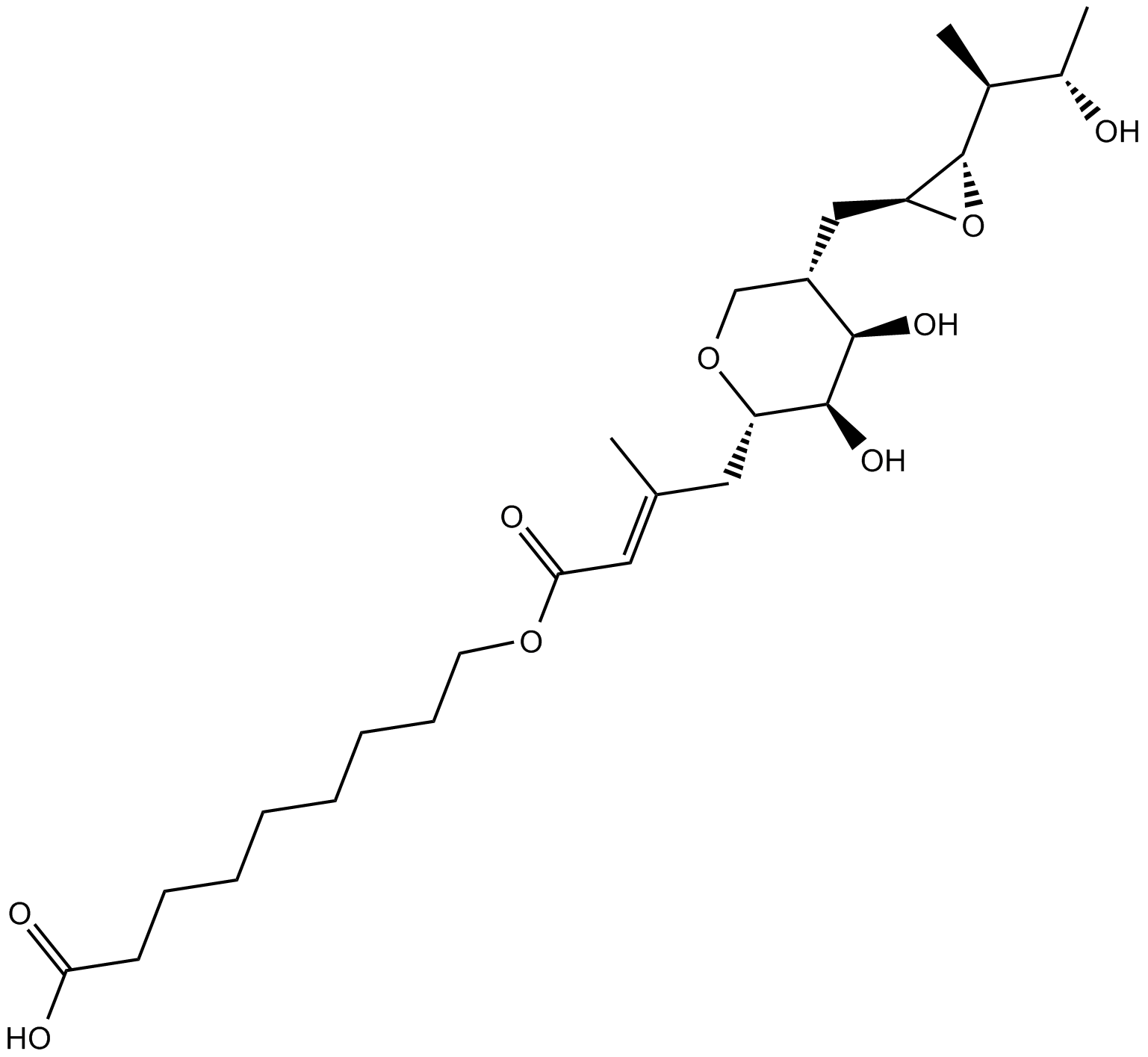
Cas No.: 12650-69-0
Sample solution is provided at 25 µL, 10mM.
Mupirocin, a secondary metabolite, naturally produced by Pseudomonas fluorescens, with an excellent in vitro activity against some streptococci[1]. Mupirocin acts on isoleucyl-tRNA synthetase and inhibits bacterial protein synthesis[2]. Mupirocin is widely used as antibacterial agent against methicillin-resistant Staphylococcus aureus (MRSA)[3].
In vitro, Mupirocin treatment for 72h showed the potent cytotoxic activity against the UCT-Mel 1 melanoma cell line with an IC50 value of 5.4μg/ml[4]. 0.2mM of Mupirocin treatment for 18 hours significantly enhanced the viability of HaCat cells and significantly accelerated wound healing[5]. 0.05mM of Mupirocin treatment for 48 hours inhibited the proliferation of psoriasis lesion epidermal keratinocytes (PLEKs), promoting cell apoptosis[6].
In vivo, applying 0.1ml of Mupirocin ointment (20mg/g) to the wound daily for 12 days significantly promoted wound healing, resulting in a significant increase in epidermal thickness and a reduction in the growth of Staphylococcus aureus in a mouse model of superficial skin infection caused by Staphylococcus aureus [7].
References:
[1] Bencardino D, Amagliani G, Brandi G. Carriage of Staphylococcus aureus among food handlers: An ongoing challenge in public health[J]. Food control, 2021, 130: 108362.
[2] Gisby J, Bryant J. Efficacy of a new cream formulation of mupirocin: comparison with oral and topical agents in experimental skin infections[J]. Antimicrobial agents and chemotherapy, 2000, 44(2): 255-260.
[3] Tucaliuc A, Blaga A C, Galaction A I, et al. Mupirocin: applications and production[J]. Biotechnology letters, 2019, 41(4): 495-502.
[4] Reva O N, Rademan S, Visagie M H, et al. Comparison of structures and cytotoxicity of mupirocin and batumin against melanoma and several other cancer cell lines[J]. Future medicinal chemistry, 2019, 11(7): 677-691.
[5] Twilley D, Reva O, Meyer D, et al. Mupirocin promotes wound healing by stimulating growth factor production and proliferation of human keratinocytes[J]. Frontiers in Pharmacology, 2022, 13: 862112.
[6] Yan B X, Chen X Y, Wang Z Y, et al. Mupirocin blocks imiquimod-induced psoriasis-like skin lesion by inhibiting epidermal isoleucyl-tRNA synthetase[J]. Cell Communication and Signaling, 2022, 20(1): 185.
[7] Pérez M, Robres P, Moreno B, et al. Comparison of antibacterial activity and wound healing in a superficial abrasion mouse model of Staphylococcus aureus skin infection using photodynamic therapy based on methylene blue or mupirocin or both[J]. Frontiers in Medicine, 2021, 8: 673408.
| Cell experiment [1]: | |
Cell lines | HaCat cells |
Preparation Method | HaCat cells were seeded at a concentration of 1.5×10⁵ cells/mL in a 24-well plate and incubated overnight at 37°C and 5% CO2 to form confluent monolayers. Subsequently, a cross was drawn in the center of each well to simulate a wound using a 1000-pipette tip. Cell debris was removed by aspirating the culture medium and adding fresh complete medium. Then, the cells were treated with Mupirocin at a final concentration of 0.2mM for 18 hours. The control group included cells grown in the culture medium (untreated) and cells treated with 0.25% DMSO (vehicle control). Images were captured using an optical microscope with a 4× magnification at the time of the initial scratch (0 hours) and 18 hours after treatment. |
Reaction Conditions | 0.2mM; 18h |
Applications | Mupirocin treatment significantly increased wound healing in HaCat cells. |
| Animal experiment [2]: | |
Animal models | SKH-1 hairless mice |
Preparation Method | Female SKH-1 hairless mice (6-8 weeks old) were individually housed in cages for a few days before the experiment to adapt to the environment. The cages were placed close to the ground to allow the mice to adapt to low light levels, and commercial feed and water were freely provided. Under general anesthesia, 20 mice were disinfected with 70% alcohol on their skin, and abrasions were made with a surgical knife until redness appeared and the epidermis was significantly lost. The wound diameter was approximately 0.6cm, located in the back area, 1cm away. Approximately 0.1ml of Mupirocin ointment (20mg/g) was applied to the wound daily (using a separate ointment each time), and gentle massage was performed until the ointment was fully absorbed. The entire process lasted for 12 days, and the pathological characteristics of the wounds were evaluated daily. |
Dosage form | 20mg/g/day for 12 days; apply to the wound |
Applications | Mupirocin treatment significantly promoted wound healing and led to thickening of the epidermis in mice. |
References: | |
| Cas No. | 12650-69-0 | SDF | |
| Überlieferungen | BRL 4910A | ||
| Chemical Name | 9-[(E)-4-[(2S,3R,4R,5S)-3,4-dihydroxy-5-[[(2S,3S)-3-[(2S,3S)-3-hydroxybutan-2-yl]oxiran-2-yl]methyl]oxan-2-yl]-3-methylbut-2-enoyl]oxynonanoic acid | ||
| Canonical SMILES | CC(C1C(O1)CC2COC(C(C2O)O)CC(=CC(=O)OCCCCCCCCC(=O)O)C)C(C)O | ||
| Formula | C26H44O9 | M.Wt | 500.62 |
| Löslichkeit | ≥ 100mg/mL in DMSO | Storage | Store at -20°C |
| General tips | Please select the appropriate solvent to prepare the stock solution according to the
solubility of the product in different solvents; once the solution is prepared, please store it in
separate packages to avoid product failure caused by repeated freezing and thawing.Storage method
and period of the stock solution: When stored at -80°C, please use it within 6 months; when stored
at -20°C, please use it within 1 month. To increase solubility, heat the tube to 37°C and then oscillate in an ultrasonic bath for some time. |
||
| Shipping Condition | Evaluation sample solution: shipped with blue ice. All other sizes available: with RT, or with Blue Ice upon request. | ||
| Prepare stock solution | |||

|
1 mg | 5 mg | 10 mg |
| 1 mM | 1.9975 mL | 9.9876 mL | 19.9752 mL |
| 5 mM | 399.5 μL | 1.9975 mL | 3.995 mL |
| 10 mM | 199.8 μL | 998.8 μL | 1.9975 mL |
Step 1: Enter information below (Recommended: An additional animal making an allowance for loss during the experiment)
 g
μL
g
μL
Step 2: Enter the in vivo formulation (This is only the calculator, not formulation. Please contact us first if there is no in vivo formulation at the solubility Section.)
Calculation results:
Working concentration: mg/ml;
Method for preparing DMSO master liquid: mg drug pre-dissolved in μL DMSO ( Master liquid concentration mg/mL, Please contact us first if the concentration exceeds the DMSO solubility of the batch of drug. )
Method for preparing in vivo formulation: Take μL DMSO master liquid, next addμL PEG300, mix and clarify, next addμL Tween 80, mix and clarify, next add μL saline, mix and clarify.
Method for preparing in vivo formulation: Take μL DMSO master liquid, next add μL Corn oil, mix and clarify.
Note: 1. Please make sure the liquid is clear before adding the next solvent.
2. Be sure to add the solvent(s) in order. You must ensure that the solution obtained, in the previous addition, is a clear solution before proceeding to add the next solvent. Physical methods such as vortex, ultrasound or hot water bath can be used to aid dissolving.
3. All of the above co-solvents are available for purchase on the GlpBio website.
Quality Control & SDS
- View current batch:
- Purity: >98.00% Appearance: A solid
- COA (Certificate of Analysis)
- SDS (Safety Data Sheet)
- Datasheet
Average Rating: 5 (Based on Reviews and 24 reference(s) in Google Scholar.)