

NECA |
Catalog No.GC15304
 One-Click Copy Product Info
|

NECA es un agonista no selectivo de los receptores de adenosina
Products are for research use only. Not for human use. We do not sell to patients.
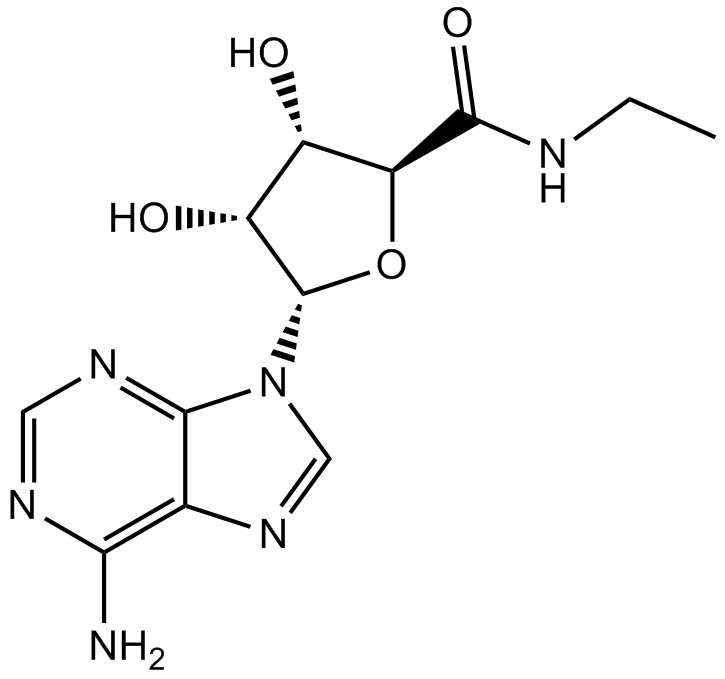
Cas No.: 35920-39-9
Sample solution is provided at 25 µL, 10mM.
NECA es un agonista no selectivo de los receptores de adenosina [1]. NECA regula los niveles intracelulares de cAMP activando los receptores de adenosina, afectando así a muchos procesos fisiológicos celulares, como la antiinflamación, la vasodilatación, la inhibición de la actividad neuronal, la cardioprotección y la regulación inmunológica [2-3].
En las células H9c2, NECA (0.1–10μM; 20min) bloqueó la fosforilación de GSK-3β inducida por H2O2 y la expresión de GRP94 [4]. En las células del músculo esquelético, NECA (100nM, 10μM; 19h) modula CPT1B, estimula LCAD, inhibe la expresión del gen del mRNA ACCβ [5]. En las células HREC, NECA (10μM; 24-72h) indujo un aumento dependiente del tiempo en la proliferación celular [6].
En el modelo de ratones policitémicos ex-hypoxic, NECA (0.05, 0.1µmol/kg; iv; inyección única) aumentó significativamente los niveles de eritropoyetina sérica en ratones con eritrocitosis hipóxica [7]. En ratones que solo estaban inmunizados, la administración intranasal de NECA (50μL; 1mM; administración intranasal; administración única) causó un aumento significativo en el recuento total de células de lavado broncoalveolar (TCC), neutrófilos y eosinófilos[8].
References:
[1]. Knapp C M, Foye M M, Cottam N, et al. Adenosine agonists CGS 21680 and NECA inhibit the initiation of cocaine self-administration[J]. Pharmacology Biochemistry and Behavior, 2001, 68(4): 797-803.
[2]. Elsherbiny N M, Abd El Galil K H, Gabr M M, et al. Reno-protective effect of NECA in diabetic nephropathy: implication of IL-18 and ICAM-1[J]. European Cytokine Network, 2012, 23(3): 78-86.
[3]. Li L, Chen J, Wang Z, et al. NECA alleviates inflammatory responses in diabetic retinopathy through dendritic cell toll-like receptor signaling pathway[J]. Frontiers in Immunology, 2024, 15: 1415004.
[4]. Xing F, Han H, He Y, et al. Roles of endoplasmic reticulum stress in NECA‐induced cardioprotection against ischemia/reperfusion injury[J]. Oxidative Medicine and Cellular Longevity, 2017, 2017(1): 2490501.
[5]. Haddad M. The effect of NECA, CGS 21680, PSB 603 on fatty acid transport and oxidation in skeletal muscle cells[J]. International Journal of Pharmaceutical Sciences and Research, 2016, 7(12): 4827.
[6]. Grant M B, Davis M I, Caballero S, et al. Proliferation, migration, and ERK activation in human retinal endothelial cells through A2B adenosine receptor stimulation[J]. Investigative ophthalmology & visual science, 2001, 42(9): 2068-2073.
[7]. Nakashima J, Ohigashi T, Brookins J W, et al. Effects of 5′-N-ethylcarboxamideadenosine (NECA) on erythropoietin production[J]. Kidney international, 1993, 44(4): 734-740.
[8]. El-Hashim A Z, Abduo H T, Rachid O M, et al. Intranasal administration of NECA can induce both anti-inflammatory and pro-inflammatory effects in BALB/c mice: Evidence for A2A receptor sub-type mediation of NECA-induced anti-inflammatory effects[J]. Pulmonary Pharmacology & Therapeutics, 2009, 22(3): 243-252.
| Experimentos celulares [1]: | |
Líneas celulares | Células H9c2 |
Método de preparación | Las células se lavaron dos veces con solución salina tamponada con fosfato (PBS) y luego se incubaron en solución de Tyrode durante 2 horas antes de los experimentos. Para examinar el efecto de la NECA en el potencial de membrana mitocondrial, la fosforilación de GSK-3β y GRP94, las células se expusieron a 800 μM de H2O2 durante 20 minutos para causar daño oxidante. Se administró un rango de concentraciones de NECA (0,1-10 μM) 10 minutos antes de la exposición a H2O2. En el estudio que explora las funciones del ERS y la vía de señalización cGMP/PKG en la cardioprotección inducida por NECA contra el daño oxidativo, las células se expusieron a 0,1 μM NECA/20mM 2-DG/0,1 μM KT5823 durante 20 minutos. El 2-DG y el KT5823 se aplicaron durante 10 minutos antes de que las células se expusieran a NECA. |
Condiciones de reacción | 0,1-10 μM; 20 minutos |
Áreas de aplicación | NECA bloqueó la fosforilación GSK-3β inducida por H2O2 y la expresión de GRP94. |
| Experimentos con animales [2]: | |
Modelos animales | Modelo de ratones policitémicos exhipóxicos (EHPCM) |
Método de preparación | Este experimento in vivo utilizó el modelo de ratones policitémicos ex-hipóxicos (EHPCM), que indujo la eritrocitosis al exponer a los ratones a un entorno hipóxico de baja presión durante mucho tiempo. Del tercer al sexto día después del final del tratamiento hipóxico, se administró NECA por vía intravenosa o intraperitoneal, y finalmente se administró de nuevo una estimulación de hipoxia a corto plazo. Luego se recogieron la sangre, los riñones y los hígados de los ratones, y se detectó el contenido de Epo (eritropoyetina) en el suero y los tejidos para evaluar el efecto regulador in vivo de la NECA en la producción de Epo. |
Forma de dosificación | 0,05, 0,1 µmol/kg; iv; inyección única |
Áreas de aplicación | NECA aumentó significativamente los niveles séricos de Epo en ratones con eritrocitosis hipóxica. |
References: | |
| Cas No. | 35920-39-9 | SDF | |
| Chemical Name | (2S,3S,4R,5S)-5-(6-amino-9H-purin-9-yl)-N-ethyl-3,4-dihydroxytetrahydrofuran-2-carboxamide | ||
| Canonical SMILES | O[C@H]1[C@@H](N2C3=NC=NC(N)=C3N=C2)O[C@H](C(NCC)=O)[C@H]1O | ||
| Formula | C12H16N6O4 | M.Wt | 308.3 |
| Solubility | ≥ 15.35mg/mL in DMSO | Storage | Store at -20°C |
| General tips | Please select the appropriate solvent to prepare the stock solution according to the
solubility of the product in different solvents; once the solution is prepared, please store it in
separate packages to avoid product failure caused by repeated freezing and thawing.Storage method
and period of the stock solution: When stored at -80°C, please use it within 6 months; when stored
at -20°C, please use it within 1 month. To increase solubility, heat the tube to 37°C and then oscillate in an ultrasonic bath for some time. |
||
| Shipping Condition | Evaluation sample solution: shipped with blue ice. All other sizes available: with RT, or with Blue Ice upon request. | ||
| Prepare stock solution | |||

|
1 mg | 5 mg | 10 mg |
| 1 mM | 3.2436 mL | 16.218 mL | 32.4359 mL |
| 5 mM | 648.7 μL | 3.2436 mL | 6.4872 mL |
| 10 mM | 324.4 μL | 1.6218 mL | 3.2436 mL |
Step 1: Enter information below (Recommended: An additional animal making an allowance for loss during the experiment)
 g
μL
g
μL
Step 2: Enter the in vivo formulation (This is only the calculator, not formulation. Please contact us first if there is no in vivo formulation at the solubility Section.)
Calculation results:
Working concentration: mg/ml;
Method for preparing DMSO master liquid: mg drug pre-dissolved in μL DMSO ( Master liquid concentration mg/mL, Please contact us first if the concentration exceeds the DMSO solubility of the batch of drug. )
Method for preparing in vivo formulation: Take μL DMSO master liquid, next addμL PEG300, mix and clarify, next addμL Tween 80, mix and clarify, next add μL saline, mix and clarify.
Method for preparing in vivo formulation: Take μL DMSO master liquid, next add μL Corn oil, mix and clarify.
Note: 1. Please make sure the liquid is clear before adding the next solvent.
2. Be sure to add the solvent(s) in order. You must ensure that the solution obtained, in the previous addition, is a clear solution before proceeding to add the next solvent. Physical methods such as vortex, ultrasound or hot water bath can be used to aid dissolving.
3. All of the above co-solvents are available for purchase on the GlpBio website.
Quality Control & SDS
- View current batch:
- Purity: >99.50% Appearance: A solid
- COA (Certificate of Analysis)
- SDS (Safety Data Sheet)
- Datasheet
Average Rating: 5 (Based on Reviews and 30 reference(s) in Google Scholar.)