

Ponatinib (AP24534) (Synonyms: AP 24534) |
Catalog No.GC14396
 One-Click Copy Product Info
|

Ponatinib (AP24534) (AP24534) es un inhibidor de cinasa multidiana activo por vÍa oral con IC50 de 0,37 nM, 1,1 nM, 1,5 nM, 2,2 nM y 5,4 nM para Abl, PDGFRα, VEGFR2, FGFR1 y Src, respectivamente.
Products are for research use only. Not for human use. We do not sell to patients.
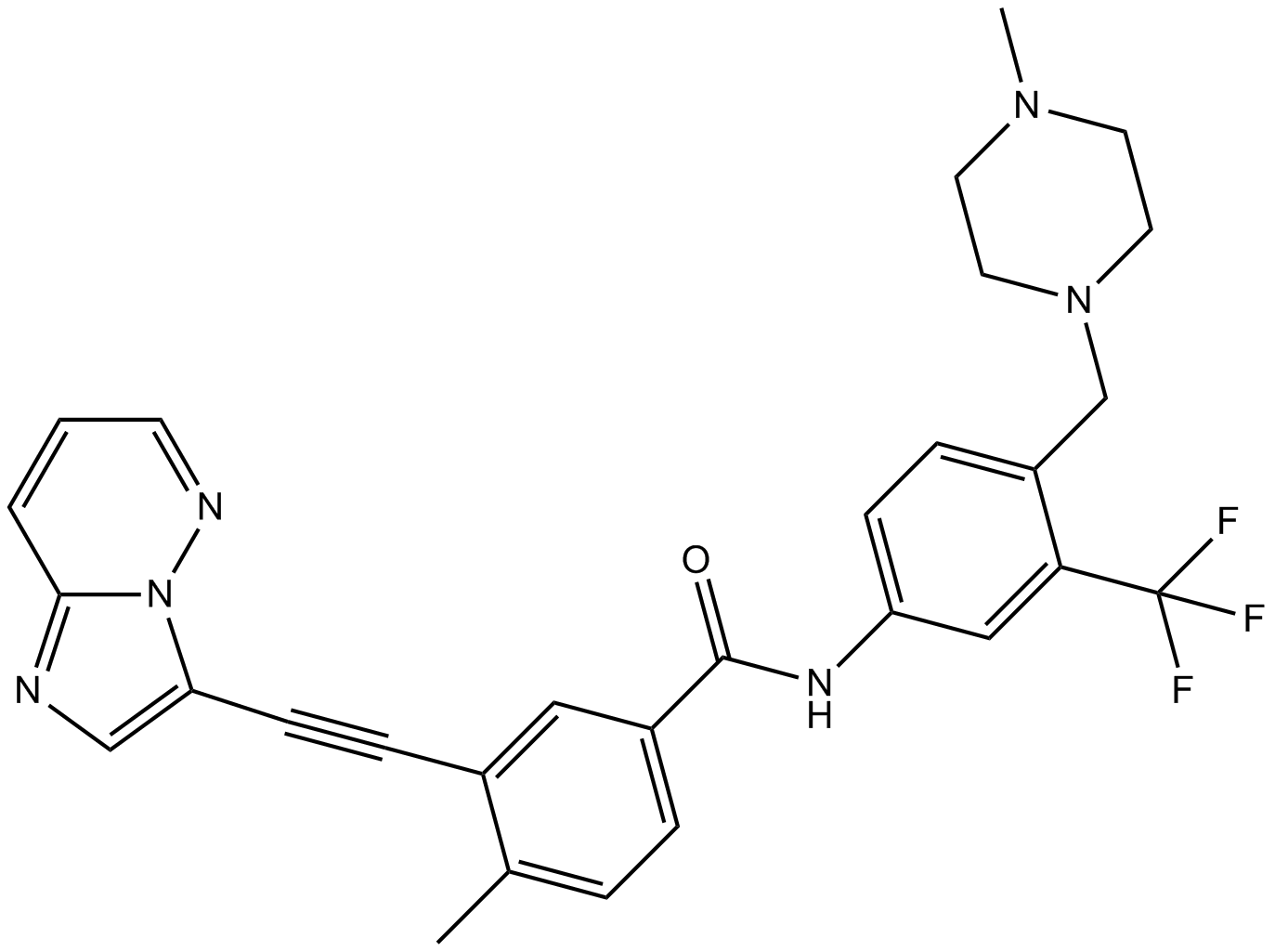
Cas No.: 943319-70-8
Sample solution is provided at 25 µL, 10mM.
Ponatinib (AP24534) is a multi-target tyrosine kinase inhibitor that inhibits the activity of Abl (IC₅₀=0.37nM), PDGFRα (IC₅₀=1.1nM), VEGFR2 (IC₅₀=1.5nM), FGFR1 (IC₅₀=2.2nM), and Src (IC₅₀=5.4nM). Ponatinib can be used in research related to chronic myeloid leukemia and Philadelphia chromosome-positive acute lymphoblastic leukemia[1-4].
In vitro, treatment of BIN67 and SCCOHT-1 cells with Ponatinib (1μM) for 1 hour significantly inhibited the phosphorylation of p38 and Akt[5]. Ponatinib (125-250nM) was used to treat SAOS-2, CAL72, U2OS, and T1000 cells for 24-72 hours. Ponatinib significantly increased telomeric C-circle levels in cells and induced DNA damage and telomere dysfunction[6].
In vivo, Ponatinib (5mg/kg) was administered to ob/ob mice via oral gavage for 8 weeks. Ponatinib significantly improved insulin sensitivity in obese mice[7]. Ponatinib (15mg/kg) was administered intraperitoneally once daily to C57BL/6J or BALB/c mice for 10 days. Ponatinib significantly delayed the growth of B16-F10 melanoma and 4T1 breast cancer and reduced tumor weight[8].
References:
[1] O'Hare T, Shakespeare WC, Zhu X, et al. AP24534, a pan-BCR-ABL inhibitor for chronic myeloid leukemia, potently inhibits the T315I mutant and overcomes mutation-based resistance. Cancer Cell. 2009 Nov 6;16(5):401-12.
[2] Gozgit JM, Wong MJ, Wardwell S, et al. Potent activity of ponatinib (AP24534) in models of FLT3-driven acute myeloid leukemia and other hematologic malignancies. Mol Cancer Ther. 2011 Jun;10(6):1028-35.
[3] Uchida T, Kitaura J, Nakahara F, et al. Hes1 upregulation contributes to the development of FIP1L1-PDGRA-positive leukemia in blast crisis. Exp Hematol. 2014 May;42(5):369-379.e3.
[4] Dufies M, Cassuto O, Jacquel A, et al. Ponatinib circumvents all types of imatinib resistance in chronic myelogenous leukemia cell lines. Cell Cycle. 2013 Jun 1;12(11):1645-6.
[5] Lang JD, Hendricks WPD, Orlando KA, et al. Ponatinib Shows Potent Antitumor Activity in Small Cell Carcinoma of the Ovary Hypercalcemic Type (SCCOHT) through Multikinase Inhibition. Clin Cancer Res. 2018 Apr 15;24(8):1932-1943.
[6] Kusuma FK, Prabhu A, Tieo G, et al. Signalling inhibition by ponatinib disrupts productive alternative lengthening of telomeres (ALT). Nat Commun. 2023 Apr 6;14(1):1919.
[7] Lin Z, Lin X, Lai Y, et al. Ponatinib modulates the metabolic profile of obese mice by inhibiting adipose tissue macrophage inflammation. Front Pharmacol. 2022 Nov 15;13:1040999.
[8] Barnwal A, Tamang R, Sanjeev Das, et al. Ponatinib delays the growth of solid tumours by remodelling immunosuppressive tumour microenvironment through the inhibition of induced PD-L1 expression. Br J Cancer. 2023 Oct;129(6):1007-1021.
| Cell experiment [1]: | |
Cell lines | SW26 (ALT-positive) and SW39 (telomerase-positive) isogenic cell lines derived from IMR90; osteosarcoma (OS) cell lines (SAOS-2, U2OS, T1000, CAL72); well-differentiated liposarcoma (LPS) cell lines; telomerase-positive cell lines (HT161, HOS); normal lung-derived IMR90 fibroblasts |
Preparation Method | The cells were used in a comparative anti-cancer compound library screen and subsequent validation assays. ALT cell lines used in these experiments were ATRX-deficient. ALT cell lines were treated with Ponatinib at 125-250nM. |
Reaction Conditions | 125-250nM; 24-72h |
Applications | Ponatinib exhibited enhanced killing of ALT-positive cells compared to telomerase-positive cells. Ponatinib induced an increase in extrachromosomal telomeric C-circles (a marker of ALT activity) in all tested ALT cell lines after 72 hours. Ponatinib provoked telomeric dysfunction, increased levels of telomere dysfunction-induced foci (TIFs), and caused specific telomere damage and replicative stress (evidenced by colocalization of pS33 RPA and telomeric DNA). Ponatinib interfered with telomeric replication and synthesis, decreasing newly BrdU-labelled telomeres and reducing ALT telomere DNA synthesis in APBs (ATSA assay). Ponatinib treatment also induced DNA damage (increased γH2AX), promoted the formation of large telomere foci, and triggered senescence in ALT cell lines. Ponatinib inhibited an ABL1-JNK-JUN signaling circuit, reducing phosphorylation of JUN at Serine 63 and Threonine 91/93 and decreasing total JUN protein levels. |
| Animal experiment [2]: | |
Animal models | Female C57BL/6J mice (for B16-F10 melanoma and GL261 glioblastoma models) and BALB/c mice (for 4T1 breast carcinoma model), 6-8 weeks old |
Preparation Method | B16-F10 melanoma tumour model was established by injecting 2×10⁵ cells with matrigel subcutaneously into the right flank of C57BL/6J mice. 4T1 breast carcinoma model was established by injecting 8×10⁵ cells in the mammary pad of BALB/c female mice. GL261 glioblastoma model was established by implanting 1×10⁶ cells in the right flank of C57BL/6 mice. Once the tumour volume reached 50–100mm³, mice were randomly divided into groups and the Ponatinib (15mg/kg) was administered daily for 10 days. |
Dosage form | 15mg/kg; i.p.; daily for 10day |
Applications | Ponatinib treatment significantly delayed the growth of B16-F10 melanoma and 4T1 breast tumours and reduced tumour weights. Ponatinib enhanced CD8⁺ T cell infiltration in the tumour microenvironment (TME), downregulated PD-L1 expression and downstream signalling molecules (p-P38, p-Erk, p-JNK), increased cleaved caspase-3 expression, regulated the Th1/Th2 balance (increased IFN-γ, decreased IL-4, increased Th1/Th2 ratio), increased IL-2 levels, lowered FoxP3 expression, and depleted tumour-associated macrophages (TAMs). Ponatinib also induced a favourable systemic antitumour immunity by enhancing CD8⁺ T cell population, tumour-specific CTL activity, balancing the Th1/Th2 ratio, and lowering PD-L1 expression. |
References: | |
| Cas No. | 943319-70-8 | SDF | |
| Sinónimos | AP 24534 | ||
| Chemical Name | 3-(2-imidazo[1,2-b]pyridazin-3-ylethynyl)-4-methyl-N-[4-[(4-methylpiperazin-1-yl)methyl]-3-(trifluoromethyl)phenyl]benzamide | ||
| Canonical SMILES | CC1=C(C=C(C=C1)C(=O)NC2=CC(=C(C=C2)CN3CCN(CC3)C)C(F)(F)F)C#CC4=CN=C5N4N=CC=C5 | ||
| Formula | C29H27F3N6O | M.Wt | 532.56 |
| Solubility | ≥ 53.3mg/mL in DMSO | Storage | Store at -20°C |
| General tips | Please select the appropriate solvent to prepare the stock solution according to the
solubility of the product in different solvents; once the solution is prepared, please store it in
separate packages to avoid product failure caused by repeated freezing and thawing.Storage method
and period of the stock solution: When stored at -80°C, please use it within 6 months; when stored
at -20°C, please use it within 1 month. To increase solubility, heat the tube to 37°C and then oscillate in an ultrasonic bath for some time. |
||
| Shipping Condition | Evaluation sample solution: shipped with blue ice. All other sizes available: with RT, or with Blue Ice upon request. | ||
| Prepare stock solution | |||

|
1 mg | 5 mg | 10 mg |
| 1 mM | 1.8777 mL | 9.3886 mL | 18.7772 mL |
| 5 mM | 375.5 μL | 1.8777 mL | 3.7554 mL |
| 10 mM | 187.8 μL | 938.9 μL | 1.8777 mL |
Step 1: Enter information below (Recommended: An additional animal making an allowance for loss during the experiment)
 g
μL
g
μL
Step 2: Enter the in vivo formulation (This is only the calculator, not formulation. Please contact us first if there is no in vivo formulation at the solubility Section.)
Calculation results:
Working concentration: mg/ml;
Method for preparing DMSO master liquid: mg drug pre-dissolved in μL DMSO ( Master liquid concentration mg/mL, Please contact us first if the concentration exceeds the DMSO solubility of the batch of drug. )
Method for preparing in vivo formulation: Take μL DMSO master liquid, next addμL PEG300, mix and clarify, next addμL Tween 80, mix and clarify, next add μL saline, mix and clarify.
Method for preparing in vivo formulation: Take μL DMSO master liquid, next add μL Corn oil, mix and clarify.
Note: 1. Please make sure the liquid is clear before adding the next solvent.
2. Be sure to add the solvent(s) in order. You must ensure that the solution obtained, in the previous addition, is a clear solution before proceeding to add the next solvent. Physical methods such as vortex, ultrasound or hot water bath can be used to aid dissolving.
3. All of the above co-solvents are available for purchase on the GlpBio website.
Quality Control & SDS
- View current batch:
- Purity: >99.00% Appearance: A solid
- COA (Certificate of Analysis)
- SDS (Safety Data Sheet)
- Datasheet
Average Rating: 5 (Based on Reviews and 2 reference(s) in Google Scholar.)