

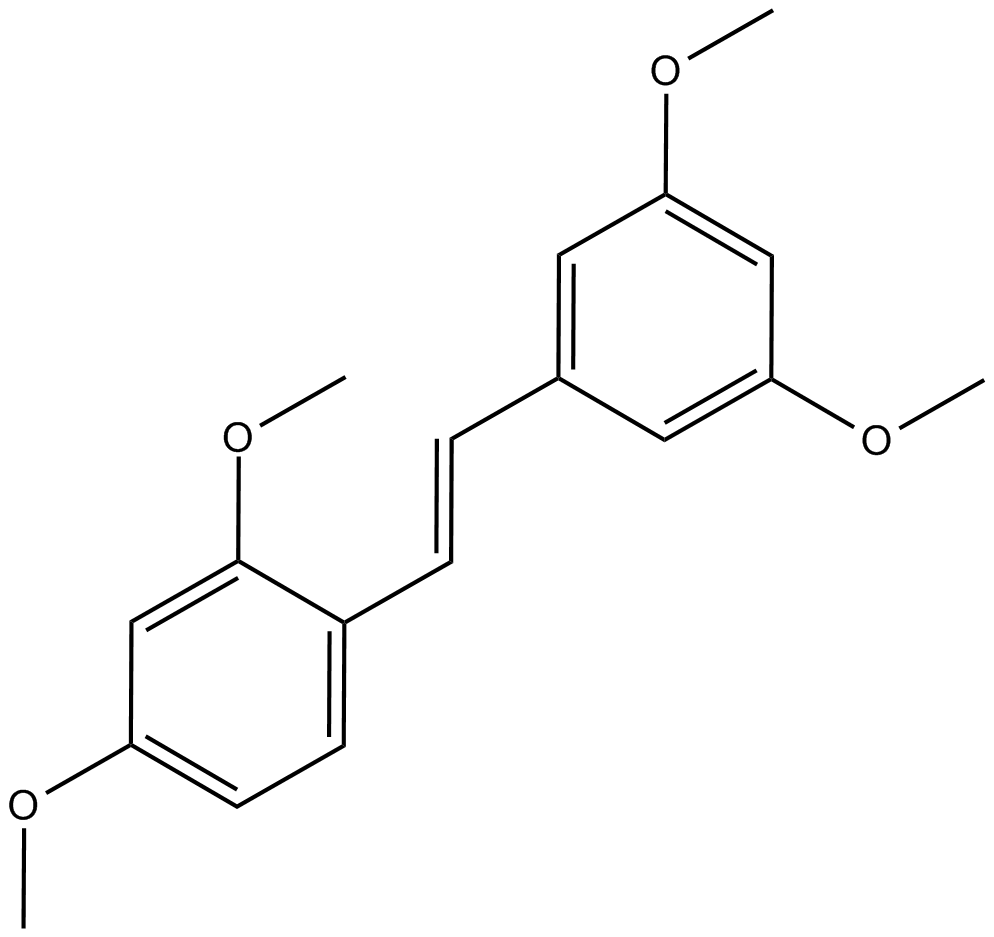
TMS (Synonyms: 2,3',4,5'Tetramethoxystilbene) |
Catalog No.GC15445
 One-Click Copy Product Info
|

TMS (2,3′,4,5′-tetramethoxystilbene) es un inhibidor específico y potente del CYP1B1, con un valor de IC50 de 6±2nmol/L
Products are for research use only. Not for human use. We do not sell to patients.
Cas No.: 24144-92-1
Sample solution is provided at 25 µL, 10mM.
_1-3.$$$39978408@51.jpg');)
_1-9.$$$38538795@65.jpg');)
_1-9.$$$39112701@51.jpg');)
_1-7.$$$37316672@70.jpg');)
_366-372.$$$36198801@70.jpg');)
.$$$38565142@65.jpg');)
_1867-1883.$$$33248023@67.jpg');)
_eads6055.$$$39977546@45.jpg');)
_eadm9805.$$$40080571@45.jpg');)
_eadj3020.$$$39666821@45.jpg');)
_1-20.$$$39757301@28.jpg');)
_1-24.$$$38898113@28.jpg');)
_273-287.$$$36806353@46.jpg');)
_1-16.$$$37156877@44.jpg');)
_1-19.$$$37460805@44.jpg');)
_1291-1307.$$$34518654@46.jpg');)
TMS (2,3′,4,5′-tetramethoxystilbene) es un inhibidor específico y potente del CYP1B1, con un valor de IC50 de 6±2nmol/L[1]. TMS se ha utilizado en estudios de actividad enzimática CYP1B1 y en estudios de detección y comparativos de análogos de TMS [2].
In vitro, TMS(0-20μmol/L) inhibió significativamente la proteína CYP1B1 estimulada por 2,3,7,8-tetrachlorodibenzo-p-dioxin (TCDD) y la expresión de mRNA de una manera dependiente de la concentración en células MCF-7, MCF-10A y HL-60 después de 24 horas de incubación[3]. El tratamiento con TMS (10μmol/L) durante 72 horas inhibió significativamente la viabilidad de las células MDA-MB-231 e indujo la apoptosis celular[4]. El tratamiento con TMS (20μmol/L) durante 48 horas causó un aumento en el nivel de inhibidor del ciclo celular p27kip1 y promovió la apoptosis de células de cáncer de próstata PC-3 [5].
In vivo, TMS, inyección intraperitoneal de 300μg/kg cada 3 días, normalizó la presión arterial en un modelo de rata de hipertensión, redujo la actividad de CYP1B1, inhibió la hipertrofia cardiovascular y renal, y previno el aumento de la reactividad vascular y la disfunción endotelial [6]. El tratamiento diario con TMS (600μg/kg; i.p.) durante 6 semanas redujo la producción de especies reactivas de oxígeno (ROS) y el aumento de la actividad de la oxidasa NADPH, e inhibió el aumento de citoquinas y catecolaminas proinflamatorias en ratas espontáneamente hipertensas (SHR), acompañado de la disminución de los niveles plasmáticos de citoqinas inflamatorias [7].
References:
[1]Kim S, Ko H, Park J E, et al. Design, synthesis, and discovery of novel trans-stilbene analogues as potent and selective human cytochrome P450 1B1 inhibitors[J]. Journal of medicinal chemistry, 2002, 45(1): 160-164.
[2]Chun Y J, Oh Y K, Kim B J, et al. Potent inhibition of human cytochrome P450 1B1 by tetramethoxystilbene[J]. Toxicology letters, 2009, 189(1): 84-89.
[3]Chun Y J, Lee S K, Kim M Y. Modulation of human cytochrome P450 1B1 expression by 2, 4, 3′, 5′-tetramethoxystilbene[J]. Drug metabolism and disposition, 2005, 33(12): 1771-1776.
[4]Chae Y S, Kim J G, Jung H J, et al. Anticancer effect of (E)-2-hydroxy-3′, 4, 5′-trimethoxystilbene on breast cancer cells by mitochondrial depolarization[J]. Cancer chemotherapy and pharmacology, 2011, 68: 349-358.
[5]Kim S W, Jung H K, Kim M Y. Induction of p27 kip1 by 2, 4, 3′, 5′-tetramethoxystilbene is regulated by protein phosphatase 2A-dependent Akt dephosphorylation in PC-3 prostate cancer cells[J]. Archives of pharmacal research, 2008, 31: 1187-1194.
[6]Sahan-Firat S, Jennings B L, Yaghini F A, et al. 2, 3′, 4, 5′-Tetramethoxystilbene prevents deoxycorticosterone-salt-induced hypertension: contribution of cytochrome P-450 1B1[J]. American Journal of Physiology-Heart and Circulatory Physiology, 2010, 299(6): H1891-H1901.
[7]Jennings B L, Montanez D E, May M E, et al. Cytochrome P450 1B1 contributes to increased blood pressure and cardiovascular and renal dysfunction in spontaneously hypertensive rats[J]. Cardiovascular drugs and therapy, 2014, 28: 145-161.
| Experimentos celulares [1]: | |
Líneas celulares | Células MCF-7 |
Método de preparación | Sembrar células MCF-7 en placas de 12 pozos a una densidad de 7.5×10⁴ células por pozo y realizar este procedimiento por triplicado. Las células unidas se sometieron a tratamiento con 1μmol/L benzo[a]pyrene(BP) y recibieron 0, 1 o 4μmol/L TMS. Las células se sometieron a lisis mediante la adición de RIPA Lysis Buffer en puntos de tiempo de 4 horas, 12 horas, 24 horas o 72 horas. Se colocaron dos muestras idénticas de lisado celular homogéneo en una placa de 96 pozos y se mezclaron con el mismo volumen de solución de luminiscencia. La luminiscencia se midió utilizando el luminómetro de microplaca. La evaluación de la viabilidad de las células expuestas solo a la BP implicó realizar el tratamiento de 72 horas dos veces con ensayos triplicados para cada experimento. Los resultados se presentan como porcentajes relativos al control con solo disolvente DMSO. |
Condiciones de reacción | 0, 1 y 4μmol/L; 4, 12, 24 o 72h |
Áreas de aplicación | La exposición al TMS combinada con la BP aumentó la expresión genral de CYP1A1 y CYP1B1 de manera dependiente de la dosis sin influir en la actividad celular. |
| Experimentos con animales [2]: | |
Modelos animales | Rstas Spontaneously hypertensive (SHR) y ratas Wistar-Kyoto |
Método de preparación | El estudio utilizó 36 ratas SHR macho de tres semanas de edad y 36 ratas Wistar-Kyoto de la misma edad. A partir de las 8 semanas de edad, cada cepa de ratas se dividió en dos gruppos, donde uno recibió inyecciones intraperitoneal diarias de TMS a 600μg/kg y el otro grupo recibió solución de vehículo DMSO (100μl). Se recogieron muestras para su análisis cuando las ratas alcanzaron las 14 semanas de edad. Mida tanto la presión arterial sistólica como la presión arterial media (MAP) dos veces por semana a partir de las 4 semanas de edad utilizando un método no invasivo que involucra un manguito de la cola. Las ratas se sometieron a una semana de aclimatación al dispositivo de medición de la presión arterial antes de comenzar cada experimento. |
Forma de dosificación | 600μg/kg/día durante 6 semanas; i.p. |
Áreas de aplicación | TMS revirtió el aumento de la presión arterial e inhibió el aumento en la actividad de CYP1B1 de SHR. TMS atenuó al máximo la reactividad vascular mejorada, la hipertrofia cardiovascular, la disfunción endotelial y renal y la fibrosis cardíaca y renal en SHR. |
References: | |
| Cas No. | 24144-92-1 | SDF | |
| Sinónimos | 2,3',4,5'Tetramethoxystilbene | ||
| Chemical Name | (E)-1-(3,5-dimethoxystyryl)-2,4-dimethoxybenzene | ||
| Canonical SMILES | COC1=CC(OC)=CC=C1/C=C/C2=CC(OC)=CC(OC)=C2 | ||
| Formula | C18H20O4 | M.Wt | 300.35 |
| Solubility | DMF: 30 mg/ml,DMF:PBS (pH 7.2)(1:1): 500 µ g/ml,DMSO: 20 mg/ml,Ethanol: 400 µ g/ml | Storage | Store at -20°C |
| General tips | Please select the appropriate solvent to prepare the stock solution according to the
solubility of the product in different solvents; once the solution is prepared, please store it in
separate packages to avoid product failure caused by repeated freezing and thawing.Storage method
and period of the stock solution: When stored at -80°C, please use it within 6 months; when stored
at -20°C, please use it within 1 month. To increase solubility, heat the tube to 37°C and then oscillate in an ultrasonic bath for some time. |
||
| Shipping Condition | Evaluation sample solution: shipped with blue ice. All other sizes available: with RT, or with Blue Ice upon request. | ||
| Prepare stock solution | |||

|
1 mg | 5 mg | 10 mg |
| 1 mM | 3.3294 mL | 16.6472 mL | 33.2945 mL |
| 5 mM | 665.9 μL | 3.3294 mL | 6.6589 mL |
| 10 mM | 332.9 μL | 1.6647 mL | 3.3294 mL |
Step 1: Enter information below (Recommended: An additional animal making an allowance for loss during the experiment)
 g
μL
g
μL
Step 2: Enter the in vivo formulation (This is only the calculator, not formulation. Please contact us first if there is no in vivo formulation at the solubility Section.)
Calculation results:
Working concentration: mg/ml;
Method for preparing DMSO master liquid: mg drug pre-dissolved in μL DMSO ( Master liquid concentration mg/mL, Please contact us first if the concentration exceeds the DMSO solubility of the batch of drug. )
Method for preparing in vivo formulation: Take μL DMSO master liquid, next addμL PEG300, mix and clarify, next addμL Tween 80, mix and clarify, next add μL saline, mix and clarify.
Method for preparing in vivo formulation: Take μL DMSO master liquid, next add μL Corn oil, mix and clarify.
Note: 1. Please make sure the liquid is clear before adding the next solvent.
2. Be sure to add the solvent(s) in order. You must ensure that the solution obtained, in the previous addition, is a clear solution before proceeding to add the next solvent. Physical methods such as vortex, ultrasound or hot water bath can be used to aid dissolving.
3. All of the above co-solvents are available for purchase on the GlpBio website.
Quality Control & SDS
- View current batch:
- Purity: >98.00% Appearance: A solid
- COA (Certificate of Analysis)
- SDS (Safety Data Sheet)
- Datasheet
Average Rating: 5 (Based on Reviews and 15 reference(s) in Google Scholar.)