

Alda 1 |
Catalog No.GC16597
 One-Click Copy Product Info
|

Alda 1 est un activateur de l'aldéhyde déshydrogénase 2 (ALDH2).
Products are for research use only. Not for human use. We do not sell to patients.
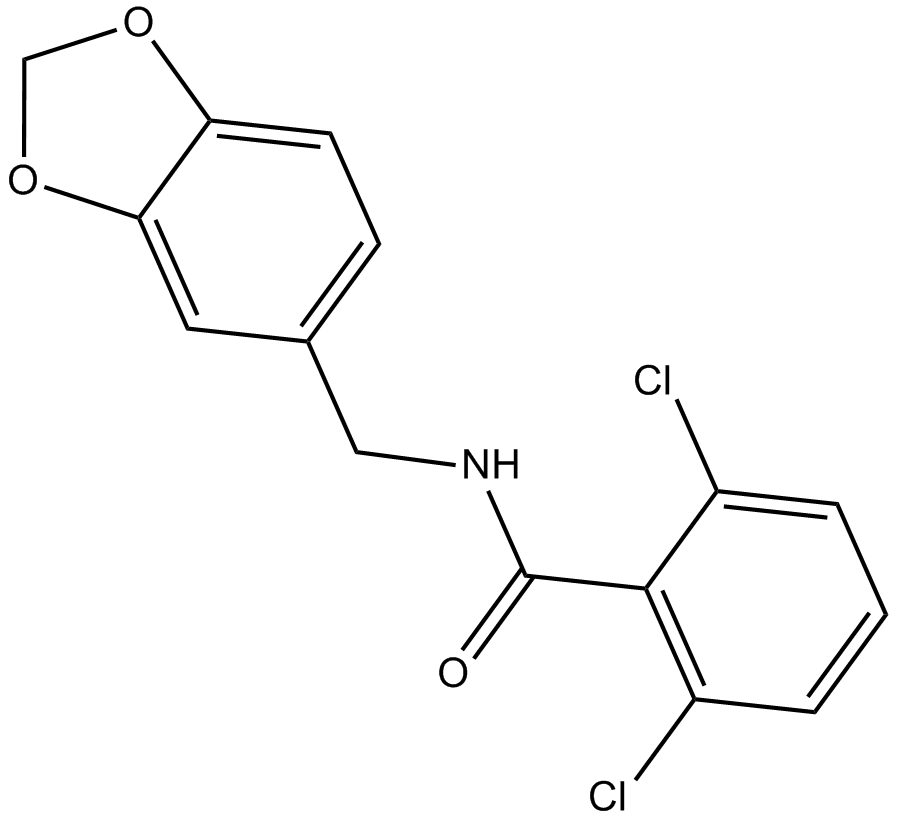
Cas No.: 349438-38-6
Sample solution is provided at 25 µL, 10mM.
Alda 1 est un activateur de l'aldéhyde déshydrogénase 2 (ALDH2)[1]. Alda 1 active spécifiquement l'enzyme ALDH2 dans les mitochondries, améliore la capacité de l'enzyme à métaboliser des aldéhydes toxiques comme l'acétaldéhyde, réduisant ainsi les lésions cellulaires causées par ces substances [2-3]. Alda 1 est principalement utilisé pour étudier les maladies associées à un métabolisme anormal de l'acétaldéhyde[4].
Dans les cellules épithéliales alvéolaires pulmonaires humaines, un pré-traitement avec Alda 1 (20μM; 1h) peut atténuer les lésions d'ischémie - reperfusion pulmonaire[5]. Dans les cellules SH-SY5Y, un pré-traitement avec Alda 1 (20 μM; 24 h) restaure l'activité et la teneur en ALDH2, augmente le potentiel de membrane mitochondriale et réduit les espèces réactives d'oxygène dans les cellules [6].
Dans les rats C57BL/6J, après Alda 1 (5mg/kg; ip; injection unique) augmente l'activité hépatique de ALDH, un effet bloqué par l'inhibiteur spécifique de ALDH2, la diadzine [7]. Dans le modèle murin de lésions d'ischémie-reperfusion (IRI) hépatique, Alda 1 (30mg/kg; ip; injection unique) peut améliorer IRI hépatique en éliminant les aldéhydes réactifs et en améliorant l'autophagie[8]. Dans le modèle murin d'hyperoxie, un pré-traitement avec Alda 1 (8mg/kg; sc; 48h) atténue l'infiltration des cellules immunitaires induite par l'hyperoxie [9].
References:
[1]. Stachowicz A, Olszanecki R, Suski M, et al. Proteomic analysis of mitochondria-enriched fraction isolated from the frontal cortex and hippocampus of apolipoprotein E knockout mice treated with Alda-1, an activator of mitochondrial aldehyde dehydrogenase (ALDH2)[J]. International Journal of Molecular Sciences, 2017, 18(2): 435.
[2]. Stachowicz A, Głombik K, Olszanecki R, et al. The impact of mitochondrial aldehyde dehydrogenase (ALDH2) activation by Alda-1 on the behavioral and biochemical disturbances in animal model of depression[J]. Brain, Behavior, and Immunity, 2016, 51: 144-153.
[3]. Ikeda T, Takahashi T, Tsujita M, et al. Effects of Alda-1, an aldehyde dehydrogenase-2 agonist, on hypoglycemic neuronal death[J]. PLoS One, 2015, 10(6): e0128844.
[4]. Stachowicz A, Olszanecki R, Suski M, et al. Mitochondrial aldehyde dehydrogenase activation by Alda‐1 inhibits atherosclerosis and attenuates hepatic steatosis in apolipoprotein E‐knockout mice[J]. Journal of the American Heart Association, 2014, 3(6): e001329.
[5]. Ding J, Zhang Q, Luo Q, et al. Alda-1 attenuates lung ischemia-reperfusion injury by reducing 4-hydroxy-2-nonenal in alveolar epithelial cells[J]. Critical care medicine, 2016, 44(7): e544-e552.
[6]. Deza-Ponzio R, Albrecht P A, Fernandez-Hubeid L E, et al. ALDH2 inhibition by lead and ethanol elicits redox imbalance and mitochondrial dysfunction in SH-SY5Y human neuroblastoma cell line: Reversion by Alda-1[J]. Neurotoxicology, 2023, 97: 12-24.
[7]. Zhong W, Zhang W, Li Q, et al. Pharmacological activation of aldehyde dehydrogenase 2 by Alda-1 reverses alcohol-induced hepatic steatosis and cell death in mice[J]. Journal of hepatology, 2015, 62(6): 1375-1381.
[8]. Li M, Xu M, Li J, et al. Alda‐1 Ameliorates Liver Ischemia‐Reperfusion Injury by Activating Aldehyde Dehydrogenase 2 and Enhancing Autophagy in Mice[J]. Journal of Immunology Research, 2018, 2018(1): 9807139.
[9]. Sidramagowda Patil S, Hernández-Cuervo H, Fukumoto J, et al. Alda-1 attenuates hyperoxia-induced acute lung injury in mice[J]. Frontiers in pharmacology, 2021, 11: 597942.
| Expériences cellulaires [1]: | |
Lignées cellulaires | Cellules épithéliales alvéolaires pulmonaires humaines |
Méthode de préparation | Les cellules épithéliales alvéolaires pulmonaires humaines primaires humaines ont été cultivées à 37°C et 5% de CO2, dans un milieu de cellules épithéliales alvéolaires et un milieu de croissance de cellules endothéliales MV2. L'hypoxie a été induite en exposant les cellules pendant 24 heures à un milieu dépourvu de sérum dans un bocal anaérobie scellé équipé de AnaeroPack pour éliminer tout oxygène libre. Les cellules ont été ensuite lavées avec PBS et réoxygénées pendant 2 heures dans les conditions normales en milieu complet. Alda 1, 20μM, a été ajouté au milieu pendant 1 heure avant l'exposition hypoxique du groupe hypoxie/réoxygénation (H/R) + Alda 1. |
Conditions de réaction | 20μM; 1h |
Domaines d'application | Le pré-traitement avec Alda 1 peut atténuer les lésions d'ischémie-reperfusion pulmonaire. |
| Expériences animales [2]: | |
Modèles animaux | Rats C57BL/6J |
Méthode de préparation | Les rats ont reçu 5mg/kg de poids corporel (BW) de Alda 1 (dissous dans du diméthylsulfoxyde, DMSO) à 9:00 am via trois voies, par injection intra-péritonéale (i.p.). Les foies ont été collectés 3 heures après les traitements, et l'activité hépatique de ALDH a été mesurée immédiatement. Pour évaluer la spécificité d' Alda 1 dans l'activation d' ALDH2, les rats ont reçu un inhibiteur spécifique de ALDH2, la daidzine, à 50mg/kg BW (dissous dans DMSO) via i.p. simultanément à l'administration d' Alda 1 à 5mg/kg de BW à 9:00 am (n = 4). Trois heures plus tard, le foie et l'iléon ont été collectés, les fractions mitochondriales et cytosoliques du foie ont été isolées, et l'activité de ALDH a été mesurée immédiatement. |
Forme de dosage | 5mg/kg; ip; injection unique |
Domaines d'application | Une dose unique de Alda 1 a augmenté l'activité hépatique de ALDH, un effet bloqué par l'inhibiteur spécifique de ALDH2, la daidzine. |
References: | |
| Cas No. | 349438-38-6 | SDF | |
| Chemical Name | N-(benzo[d][1,3]dioxol-5-ylmethyl)-2,6-dichlorobenzamide | ||
| Canonical SMILES | ClC1=CC=CC(Cl)=C1C(NCC2=CC=C3OCOC3=C2)=O | ||
| Formula | C15H11Cl2NO3 | M.Wt | 324.16 |
| Solubility | ≥ 15.15mg/mL in DMSO | Storage | Store at -20°C |
| General tips | Please select the appropriate solvent to prepare the stock solution according to the
solubility of the product in different solvents; once the solution is prepared, please store it in
separate packages to avoid product failure caused by repeated freezing and thawing.Storage method
and period of the stock solution: When stored at -80°C, please use it within 6 months; when stored
at -20°C, please use it within 1 month. To increase solubility, heat the tube to 37°C and then oscillate in an ultrasonic bath for some time. |
||
| Shipping Condition | Evaluation sample solution: shipped with blue ice. All other sizes available: with RT, or with Blue Ice upon request. | ||
| Prepare stock solution | |||

|
1 mg | 5 mg | 10 mg |
| 1 mM | 3.0849 mL | 15.4245 mL | 30.849 mL |
| 5 mM | 617 μL | 3.0849 mL | 6.1698 mL |
| 10 mM | 308.5 μL | 1.5424 mL | 3.0849 mL |
Step 1: Enter information below (Recommended: An additional animal making an allowance for loss during the experiment)
 g
μL
g
μL
Step 2: Enter the in vivo formulation (This is only the calculator, not formulation. Please contact us first if there is no in vivo formulation at the solubility Section.)
Calculation results:
Working concentration: mg/ml;
Method for preparing DMSO master liquid: mg drug pre-dissolved in μL DMSO ( Master liquid concentration mg/mL, Please contact us first if the concentration exceeds the DMSO solubility of the batch of drug. )
Method for preparing in vivo formulation: Take μL DMSO master liquid, next addμL PEG300, mix and clarify, next addμL Tween 80, mix and clarify, next add μL saline, mix and clarify.
Method for preparing in vivo formulation: Take μL DMSO master liquid, next add μL Corn oil, mix and clarify.
Note: 1. Please make sure the liquid is clear before adding the next solvent.
2. Be sure to add the solvent(s) in order. You must ensure that the solution obtained, in the previous addition, is a clear solution before proceeding to add the next solvent. Physical methods such as vortex, ultrasound or hot water bath can be used to aid dissolving.
3. All of the above co-solvents are available for purchase on the GlpBio website.
Quality Control & SDS
- View current batch:
- Purity: >99.50% Appearance: A solid
- COA (Certificate of Analysis)
- SDS (Safety Data Sheet)
- Datasheet

Average Rating: 5 (Based on Reviews and 20 reference(s) in Google Scholar.)