
Accueil>>Signaling Pathways>> Others>> Estrogen Receptor/ERR>>G-15

G-15

Catalog No.GC16618

G-15 est un antagoniste sélectif à haute affinité du récepteur d'estrogène couplé aux protéines G (GPER/ GPR30) (Ki = 20nM).

Products are for research use only. Not for human use. We do not sell to patients.
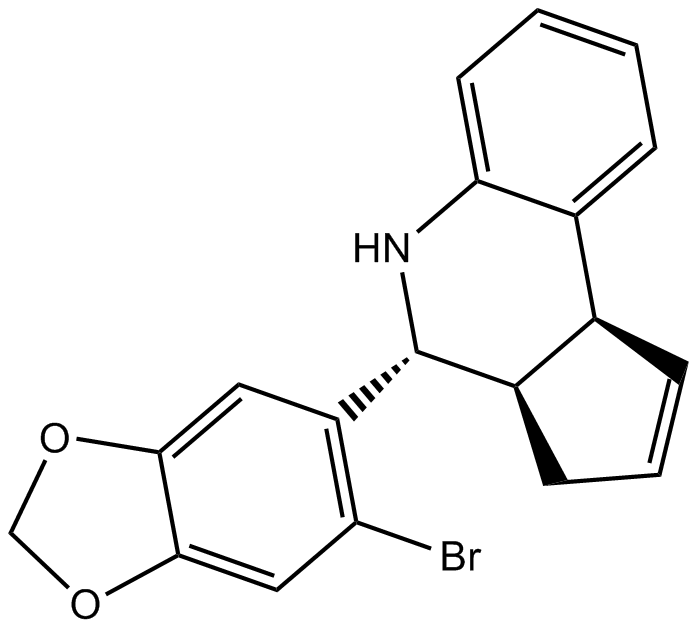
G-15 Chemical Structure

Cas No.: 1161002-05-6

Taille Prix Stock Qté
10mM (in 1mL DMSO)
55,00 $US
En stock
1mg
23,00 $US
En stock
5mg
50,00 $US
En stock
10mg
87,00 $US
En stock
25mg
166,00 $US
En stock
50mg
266,00 $US
En stock

Tel:(909) 407-4943 Email: sales@glpbio.com


Avis des clients

Based on customer reviews.

Sample solution is provided at 25 µL, 10mM.

Product has been cited by 2 publications

Description of G-15

G-15 est un antagoniste sélectif à haute affinité du récepteur d'estrogène couplé aux protéines G (GPER/ GPR30) (Ki = 20nM)[1]. G‑15 complète avec GPER pour les sites de liaison des ligands, bloquant ainsi l'action des hormones sur le récepteur et inhibant par conséquent la croissance, la prolifération ou la migration cellulaire[2]. G‑15 est communément utilisé dans la recherche du traitement du cancer [3-4].

Dans les cellules SCC4, SCC9, et HSC-3, après un traitement par G-15 (5-20μM; 24h. 48h), les trois lignées cellulaires ont montré une inhibition dose-dépendante de la prolifération cellulaire[5]. Dans les cellules MCF-7, MDA-MB-231, Bcap-37, des concentrations plus élevées de G15 (1.25µM, 2.5µM, 5.0µM; 48h) ont significaitvement inhibé la viabilité de ces trois lignées cellulaires[6]. Dans les cellules A549, le traitement avec G-15 (1μM; 24h) a inhibé la croissance cellulaire[7].

Chez les rats C57BL/6, le traitement avec G-15 (50μg/kg; sc; 6j) a diminué l'expression de GPER dans tous les groupes d'âge traités, avec une diminution significative chez les animaux matures [8]. Dans les rats C57BL/6, le traitement avec G-15 (10μg/kg, 50μg/kg; sc; 10j) antagonise l'augmentation du ratio HVA/DA striatal induite par G1 [9].

References:
[1]. Kang W B, Cong Y, Ru J Y, et al. Osteoprotective effect of combination therapy of low-dose oestradiol with G15, a specific antagonist of GPR30/GPER in ovariectomy-induced osteoporotic rats[J]. Bioscience reports, 2015, 35(4): e00239.
[2]. Xu F, Ma J, Wang X, et al. The role of G protein-coupled estrogen receptor (GPER) in vascular pathology and physiology[J]. Biomolecules, 2023, 13(9): 1410.
[3]. Zhu Z, Nie X, Deng L, et al. Regulation of cervical cancer via G15-mediated inhibition of G protein-coupled estrogen receptor[J]. Anti-Cancer Drugs, 2024, 35(9): 817-829.
[4]. Liu C, Liao Y, Fan S, et al. G-protein-coupled estrogen receptor antagonist G15 decreases estrogen-induced development of non-small cell lung cancer[J]. Oncology Research, 2019, 27(3): 283.
[5]. Bai L Y, Weng J R, Hu J L, et al. G15, a GPR30 antagonist, induces apoptosis and autophagy in human oral squamous carcinoma cells[J]. Chemico-biological interactions, 2013, 206(2): 375-384.
[6]. Liu Y, Du F Y, Chen W, et al. G15 sensitizes epithelial breast cancer cells to doxorubicin by preventing epithelial-mesenchymal transition through inhibition of GPR30[J]. American Journal of Translational Research, 2015, 7(5): 967.
[7]. Shen Y, Li C, Zhou L, et al. G protein‐coupled oestrogen receptor promotes cell growth of non‐small cell lung cancer cells via YAP1/QKI/circNOTCH1/m6A methylated NOTCH1 signalling[J]. Journal of cellular and molecular medicine, 2021, 25(1): 284-296.
[8]. Kotula-Balak M, Pawlicki P, Milon A, et al. The role of G-protein-coupled membrane estrogen receptor in mouse Leydig cell function—in vivo and in vitro evaluation[J]. Cell and Tissue Research, 2018, 374(2): 389-412.
[9]. Bourque M, Morissette M, Côté M, et al. Implication of GPER1 in neuroprotection in a mouse model of Parkinson's disease[J]. Neurobiology of aging, 2013, 34(3): 887-901.

Protocol of G-15

Expériences cellulaires [1]:

Lignées cellulaires

Cellules SCC4, SCC9, et HSC-3

Méthode de préparation

Les cellules SCC4, SCC9, et HSC-3 ont été ensemencées à raison de 5 × 10³ cellules par puits dans les plaques à 96 puits à fond plat; ensuite, 24 heures plus tard, les cellules ont été traitées avec G15 ou DMSO aux concentrations indiquées dans les figures individuelles. A la fin du traitement, le milieu a été retiré, remplacé par 200µL de DMEM/F12 contenant 0,5mg/mL de MTT et les cellules ont été incubées dans l'incubateur à CO2 à 37°C pendant 2 heures. Les surnageants ont été aspirés des puits, et le colorant MTT réduit a été solubilisé dans 200µL/puit de DMSO.

Conditions de réaction

5-20μM; 24h, 48h

Domaines d'application

Après le traitement avec G-15, les trois lignées cellulaires ont montré une inhibition dose-dépendante de la prolifération cellulaire.
Expériences animales [2]:

Modèles animaux

Rats C57BL/6

Méthode de préparation

Les rats C57BL/6 de différents groupes d'âge ont été divisés en groupes expérimentaux (chaque groupe comprenant 5 animaux); et un groupe témoin (Cont). et un groupe traité recevant l'antagoniste sélectif du récepteur GPER (G-15). G-15 a été dissous dans DMSO et les solution de stock ont été conservées à -20°C. Les animaux des groupes expérimentaux ont été injectés par voie sous-cutanée avec des solutions fraîchement préparées de G-15 (50μg/kg) dans une saline tamponnée au phosphate. Les rats des groupes témoins ont reçu seulement le véhicule.

Forme de dosage

50μg/kg; sc; 6j

Domaines d'application

Le traitement avec G-15 a diminué l'expression de GPER dans tous les groupes d'âge traités, avec une diminution significative chez les animaux matures.

[1]. Bai L Y, Weng J R, Hu J L, et al. G15, a GPR30 antagonist, induces apoptosis and autophagy in human oral squamous carcinoma cells[J]. Chemico-biological interactions, 2013, 206(2): 375-384.
[2]. Kotula-Balak M, Pawlicki P, Milon A, et al. The role of G-protein-coupled membrane estrogen receptor in mouse Leydig cell function—in vivo and in vitro evaluation[J]. Cell and Tissue Research, 2018, 374(2): 389-412.

Chemical Properties of G-15

Cas No. 1161002-05-6 SDF
Chemical Name (3aR,4R,9bS)-4-(6-bromobenzo[d][1,3]dioxol-5-yl)-3a,4,5,9b-tetrahydro-3H-cyclopenta[c]quinoline
Canonical SMILES BrC1=C(C=C2OCOC2=C1)[C@@H]3NC4=CC=CC=C4[C@@H]5[C@H]3CC=C5
Formula C19H16BrNO2 M.Wt 370.24
Solubility ≥ 37mg/mL in DMSO Storage -20°C, protect from light
General tips Please select the appropriate solvent to prepare the stock solution according to the solubility of the product in different solvents; once the solution is prepared, please store it in separate packages to avoid product failure caused by repeated freezing and thawing.Storage method and period of the stock solution: When stored at -80°C, please use it within 6 months; when stored at -20°C, please use it within 1 month.
To increase solubility, heat the tube to 37°C and then oscillate in an ultrasonic bath for some time.
Shipping Condition Evaluation sample solution: shipped with blue ice. All other sizes available: with RT, or with Blue Ice upon request.

Complete Stock Solution Preparation Table of G-15

Prepare stock solution
1 mg 5 mg 10 mg
1 mM 2.701 mL 13.5048 mL 27.0095 mL
5 mM 540.2 μL 2.701 mL 5.4019 mL
10 mM 270.1 μL 1.3505 mL 2.701 mL
  • Molarity Calculator

  • Dilution Calculator

  • Molecular Weight Calculator

Mass
=
Concentration
x
Volume
x
MW*


**When preparing stock solutions always use the batch-specific molecular weight of the product found on the vial label and MSDS / CoA (available online).

Calculate

In vivo Formulation Calculator (Clear solution) of G-15

Step 1: Enter information below (Recommended: An additional animal making an allowance for loss during the experiment)

mg/kg g μL

Step 2: Enter the in vivo formulation (This is only the calculator, not formulation. Please contact us first if there is no in vivo formulation at the solubility Section.)

% DMSO % % Tween 80 % ddH2O
%DMSO %

Calculation results:

Working concentration: mg/ml;

Method for preparing DMSO master liquid: mg drug pre-dissolved in μL DMSO ( Master liquid concentration mg/mL, Please contact us first if the concentration exceeds the DMSO solubility of the batch of drug. )

Method for preparing in vivo formulation: Take μL DMSO master liquid, next addμL PEG300, mix and clarify, next addμL Tween 80, mix and clarify, next add μL ddH2O, mix and clarify.

Method for preparing in vivo formulation: Take μL DMSO master liquid, next add μL Corn oil, mix and clarify.

Note: 1. Please make sure the liquid is clear before adding the next solvent.
2. Be sure to add the solvent(s) in order. You must ensure that the solution obtained, in the previous addition, is a clear solution before proceeding to add the next solvent. Physical methods such as vortex, ultrasound or hot water bath can be used to aid dissolving.
3. All of the above co-solvents are available for purchase on the GlpBio website.

Product Documents

Quality Control & SDS

View current batch:

Quality Control

Avis

Review for G-15

Average Rating: 5 ★★★★★ (Based on Reviews and 31 reference(s) in Google Scholar.)

5 Star
100%
4 Star
0%
3 Star
0%
2 Star
0%
1 Star
0%
Review for G-15

GLPBIO products are for RESEARCH USE ONLY. Please make sure your review or question is research based.

Required fields are marked with *

You may receive emails regarding this submission. Any emails will include the ability to opt-out of future communications.
