

BQ-788 |
Catalog No.GC35546
 One-Click Copy Product Info
|

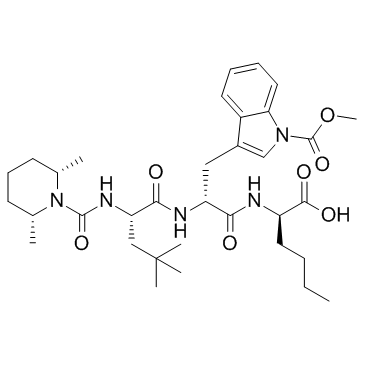
BQ-788 est un agoniste sélectif du récepteur de l'endothéline de type B (ETB) non-peptidique, avec une valeur d'IC50 de 1,2nM. BQ-788 peut se lier spécifiquement aux récepteurs ETB, bloquant l'interaction entre l'endothéline et ses récpeteurs, et inhibant ainsi les effets médiés par l'endothéline tels que la vasoconstriction et la prolifération cellulaire.
Products are for research use only. Not for human use. We do not sell to patients.
Cas No.: 173326-37-9
Sample solution is provided at 25 µL, 10mM.
_1-3.$$$39978408@51.jpg');)
_1-9.$$$38538795@65.jpg');)
_1-9.$$$39112701@51.jpg');)
_1-7.$$$37316672@70.jpg');)
_366-372.$$$36198801@70.jpg');)
.$$$38565142@65.jpg');)
_1867-1883.$$$33248023@67.jpg');)
_eads6055.$$$39977546@45.jpg');)
_eadm9805.$$$40080571@45.jpg');)
_eadj3020.$$$39666821@45.jpg');)
_1-20.$$$39757301@28.jpg');)
_1-24.$$$38898113@28.jpg');)
_273-287.$$$36806353@46.jpg');)
_1-16.$$$37156877@44.jpg');)
_1-19.$$$37460805@44.jpg');)
_1291-1307.$$$34518654@46.jpg');)
BQ-788 est un agoniste sélectif du récepteur de l'endothéline de type B (ETB) non-peptidique, avec une valeur d'IC50 de 1,2nM[1]. BQ-788 peut se lier spécifiquement aux récepteurs ETB, bloquant l'interaction entre l'endothéline et ses récpeteurs, et inhibant ainsi les effets médiés par l'endothéline tels que la vasoconstriction et la prolifération cellulaire[2]. BQ-788 est utilisé pour étudier les mécanismes de ETB dans le système cardiovasculaire (comprendre des maladies comme l'hypertension et l'insuffisance cardiaque)[3]. BQ-788 peut également être utilisé pour étudier le rôle d' ETB dans le système nerveux, comme la neuroprotection et la neuro-inflammation[4].
In vitro, BQ-788 (1μM) co-traité avec du fibrinogène (Fg; 4mg/mL) dans les cellules endothéliales microvasculaires cardiaques de rat (RHMECs) pendant 45 minutes a significativement atténué la phosphorylation de la kinase régulée par le signal extracellulaire 1/2 (ERK-1/2) induite par Fg[5]. BQ-788 (10μM) ayant pré-traité les cellules de la muqueuse olfative de rat pendant une semaine n'a eu aucun effet significatif sur la prolifération cellulaire, mais a significativement augmenté le niveau d'expression de l'endothéline-1 endogène (ET-1)[6].
In vivo, BQ-788 (0.2, 1, et 5mg/kg) a été injecté par voie intraveineuse chez les rats ICR, suivie d'une stimulation avec ET-1 (0.1μmol/kg), et BQ-788 a significativement inhibé la bronchoconstriction induite par ET-1 chez les rats[7]. BQ-788 (30nmol) injecté par voie sous-cutanée conjointement avec ET-1 (100pmol) chez les rats C57BL/6J a considérablement amélioré le comportement de grattage induit par ET-1[8].
References:
[1] Okada M, Nishikibe M. BQ-788, a selective endothelin ET(B) receptor antagonist. Cardiovasc Drug Rev. 2002 Winter;20(1):53-66.
[2] O'Donnell SR, Kay CS. Effects of endothelin receptor selective antagonists, BQ-123 and BQ-788, on IRL 1620 and endothelin-1 responses of airway and vascular preparations from rats. Pulm Pharmacol. 1995 Feb;8(1):11-9.
[3] Schroeder RL, Keiser JA, Cheng XM, et al. PD 142893, SB 209670, and BQ 788 selectively antagonize vascular endothelial versus vascular smooth muscle ET(B)-receptor activity in the rat. J Cardiovasc Pharmacol. 1998 Dec;32(6):935-43.
[4] Costa RA, Amatnecks JA, de Oliveira Guaita G, et al. Sexual dimorphism of hypothalamic serotonin release during systemic inflammation: Role of endothelin-1. J Neuroimmunol. 2024 Sep 15;394:578427.
[5] Sen U, Tyagi N, Patibandla PK, et al. Fibrinogen-induced endothelin-1 production from endothelial cells. Am J Physiol Cell Physiol. 2009 Apr;296(4):C840-7.
[6] Bryche B, Saint-Albin A, Le Poupon Schlegel C, et al. Endothelin increases the proliferation of rat olfactory mucosa cells. Neural Regen Res. 2020 Feb;15(2):352-360.
[7] Nagase T, Aoki T, Oka T, et al. ET-1-induced bronchoconstriction is mediated via ETB receptor in mice. J Appl Physiol (1985). 1997 Jul;83(1):46-51.
[8] Liang J, Kawamata T, Ji W. Molecular signaling of pruritus induced by endothelin-1 in mice. Exp Biol Med (Maywood). 2010 Nov;235(11):1300-5.
| Expériences cellulaires [1]: | |
Lignées cellulaires | Cellules endothéliales microvasculaires cardiaques de rat (RHMECs) |
Méthode de préparation | RHMECs ont été cultivées dans un milieu complet MCDB-131 à 37°C et 5% CO₂. Les cellules ont été privées de sérum pendant une heure à l'aide d'un milieu MCDB-131C sans sérum avant l'expérimentation. Les cellules ont été traitées avec 4mg/ml de fibrinogène (Fg) avec ou sans 1µM de BQ-788 pendant 45 minutes. |
Conditions de réaction | 1μM; 45min |
Domaines d'application | BQ-788 a significativement atténué la phosphorylation de la kinase régulée par le signal extracellulaire 1/2 (ERK-1/2) induite par Fg chez RHMECs. |
| Expériences animales [2]: | |
Modèles animaux | Rats ICR |
Méthode de préparation | Les rats ont été anesthésiés et ventilés par voie mécanique. Ils ont été pré-traités avec BQ-788 (0.2, 1, or 5mg/kg) via injection intraveineuse avant l'administration de ET-1 (0.1μmol/kg). |
Forme de dosage | 0.2, 1, ou 5mg/kg; i.v. |
Domaines d'application | BQ-788 a significativement inhibé la bronchoconstriction induite par ET-1, suggérant que les récepteurs ETB médient le rétrécisssement des voies aériennes induit par ET-1 en affectant la contraction du muscle lisse des voies aériennes. |
References: | |
| Cas No. | 173326-37-9 | SDF | |
| Canonical SMILES | CCCC[C@H](C(O)=O)NC([C@@H](CC1=CN(C(OC)=O)C2=CC=CC=C12)NC([C@H](CC(C)(C)C)NC(N3[C@H](C)CCC[C@@H]3C)=O)=O)=O | ||
| Formula | C34H51N5O7 | M.Wt | 641.8 |
| Solubility | DMSO : 100 mg/mL (155.81 mM; Need ultrasonic) | Storage | Store at -20°C,protect from light |
| General tips | Please select the appropriate solvent to prepare the stock solution according to the
solubility of the product in different solvents; once the solution is prepared, please store it in
separate packages to avoid product failure caused by repeated freezing and thawing.Storage method
and period of the stock solution: When stored at -80°C, please use it within 6 months; when stored
at -20°C, please use it within 1 month. To increase solubility, heat the tube to 37°C and then oscillate in an ultrasonic bath for some time. |
||
| Shipping Condition | Evaluation sample solution: shipped with blue ice. All other sizes available: with RT, or with Blue Ice upon request. | ||
| Prepare stock solution | |||

|
1 mg | 5 mg | 10 mg |
| 1 mM | 1.5581 mL | 7.7906 mL | 15.5812 mL |
| 5 mM | 311.6 μL | 1.5581 mL | 3.1162 mL |
| 10 mM | 155.8 μL | 779.1 μL | 1.5581 mL |
Step 1: Enter information below (Recommended: An additional animal making an allowance for loss during the experiment)
 g
μL
g
μL
Step 2: Enter the in vivo formulation (This is only the calculator, not formulation. Please contact us first if there is no in vivo formulation at the solubility Section.)
Calculation results:
Working concentration: mg/ml;
Method for preparing DMSO master liquid: mg drug pre-dissolved in μL DMSO ( Master liquid concentration mg/mL, Please contact us first if the concentration exceeds the DMSO solubility of the batch of drug. )
Method for preparing in vivo formulation: Take μL DMSO master liquid, next addμL PEG300, mix and clarify, next addμL Tween 80, mix and clarify, next add μL saline, mix and clarify.
Method for preparing in vivo formulation: Take μL DMSO master liquid, next add μL Corn oil, mix and clarify.
Note: 1. Please make sure the liquid is clear before adding the next solvent.
2. Be sure to add the solvent(s) in order. You must ensure that the solution obtained, in the previous addition, is a clear solution before proceeding to add the next solvent. Physical methods such as vortex, ultrasound or hot water bath can be used to aid dissolving.
3. All of the above co-solvents are available for purchase on the GlpBio website.
Quality Control & SDS
- View current batch:
- Purity: >98.00% Appearance: A solid
- COA (Certificate of Analysis)
- SDS (Safety Data Sheet)
- Datasheet
Average Rating: 5 (Based on Reviews and 19 reference(s) in Google Scholar.)